
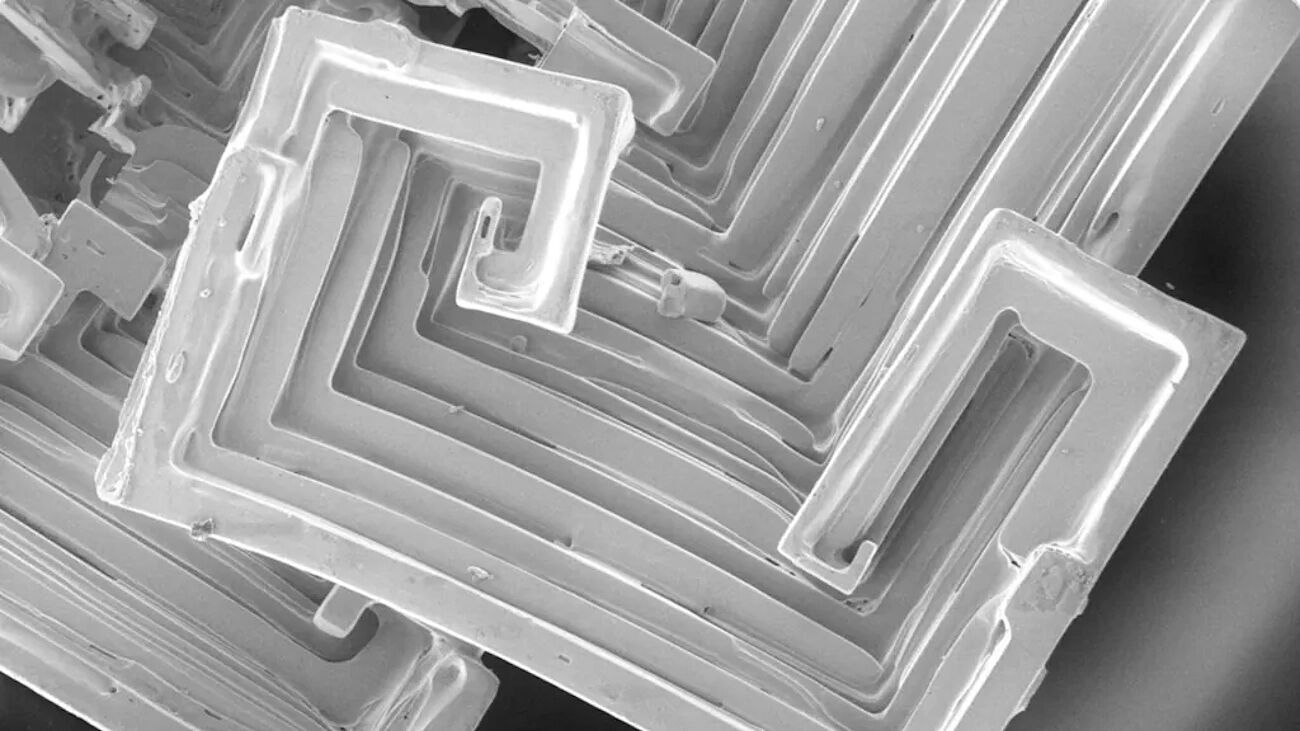
© Don Pettit via XA potassium chloride crystal was grown aboard the International Space Station, where microgravity enables it to form in stepped, hollow layers instead of the solid shapes seen on Earth.
Astronauts have grown a common crystal in space — but this extraterrestrial version is exhibiting a very uncommon behavior. Under a microscope, the crystal looks more like a tiny futuristic sculpture than something that formed naturally. The pyramid-like assembly curls in on itself in stair-stepped layers, seeming almost too orderly to be real. But according to scientists, the striking shape is what happens when gravity stops calling the shots.
The image, shared on July 18 by NASA astronaut Don Pettit, and accompanying video were captured aboard the International Space Station (ISS) and show potassium chloride crystals growing in microgravity — the near-weightless environment experienced in orbit.
Microgravity isn't quite zero gravity; astronauts experience a gravitational pull roughly a million times weaker than on Earth's surface, Anne Wilson, a professor of chemistry and biochemistry at Butler University, told Live Science. That reduction in gravity's tug has profound impacts on the human body, and, as the new image shows, completely changes how liquids and crystals behave as well.
"[Other] forces start to become far more pronounced than gravity forces," Wilson said, pointing to molecular attraction and polarity as two influences that suddenly take over once gravity fades into the background.
Those conditions enable potassium chloride — a common salt used as a sodium substitute in foods and sports drinks — to crystallize in ways that are nearly impossible to reproduce in a terrestrial lab.
On Earth, growing crystals eventually get heavy enough to sag, break or settle at the bottom of their container. But in microgravity, they keep growing outward from wherever they started.
Potassium chloride naturally forms cube-shaped crystals, Wilson said. In microgravity, those crystals grow mainly from their edges and corners instead of across their faces, leaving the center hollow and creating the striking pyramid-like structures seen in the image.



Reader Comments