
I live in Montana but I am from Pennsylvania so I follow a Facebook page called I live In Pa. I kept seeing AI data centers on this channel split-screened against the farmland and covered bridges they're replacing. Larry Fink's picture and shareholder letter, where he said the quiet part out loud about how they get paid for. So I sat down and pulled the threads.
This is what came out of it. It's longer than I usually publish. Every cut lost something the rest needed, so here it is at full length. By the time everyone agrees on what this buildout is for, the concrete will already be poured. Right now is the window — the language is still being decided, the legal challenges are still possible, and the public memory of similar buildouts is still warm.
What an AI Data Center Actually Is
"AI data center" sounds like a server room — abstract, technical, somebody else's business. The vagueness is doing work. You can't organize against something you can't picture.
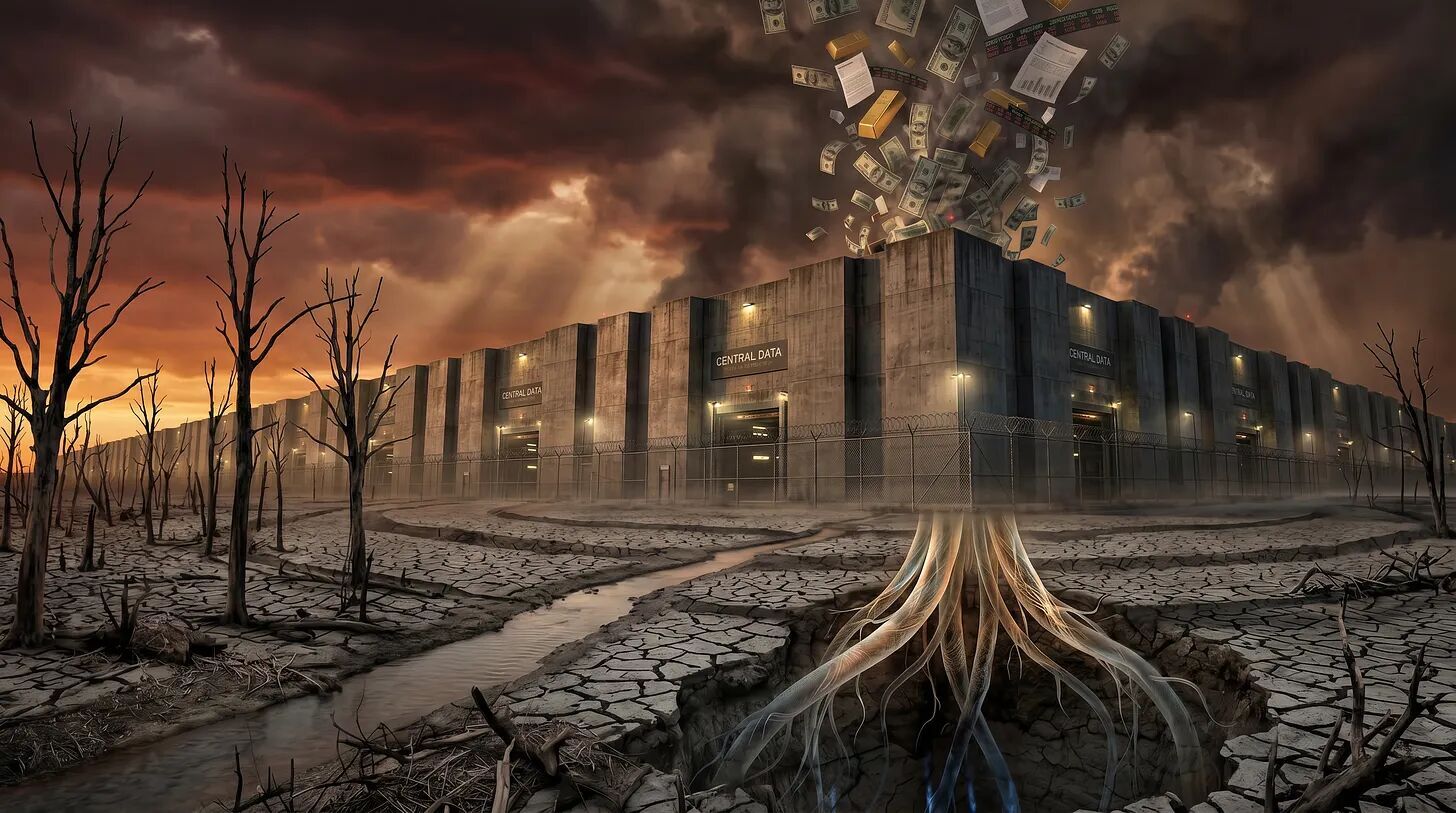
So here's what one is. A massive industrial facility, typically half a million to several million square feet. Tens of thousands of specialized processors in dense racks, each rack drawing more power than an average home. A full center can draw 100 to over 1,000 megawatts — the largest rival the power use of a mid-sized city. Cooling the heat takes water, sometimes millions of gallons a day, pulled from local aquifers, rivers, or municipal supply. Featureless buildings. No windows. Razor wire. A facility that uses a city's worth of electricity might employ thirty to a hundred people. It exists to host computation, not workers.
What that computation is for is the question.
The Argument This Piece Makes
Let me be straight about what's documented and what's my read.
The documented, boring use of these buildings is commercial: training and running AI models, cloud services. That's real. But I'm going to make the case that the strategic reason for a buildout this fast, this coordinated, and this heavily financed is bigger than chatbots — that these facilities are becoming the physical substrate for surveillance, digital identity, and behavioral data systems, and that the people funding them have said as much in public. Where I'm citing a fact, I'll source it. Where I'm drawing a conclusion, I'll say so. You can take the facts and disagree with my conclusion. That's fair. But the facts are the facts.
Start with one thread you can verify yourself.
The UN's 2030 Agenda does not say "digital ID." Target 16.9 says "provide legal identity for all, including birth registration" by 2030 — clean, humanitarian, nothing to object to.¹ The word "digital" lives one layer down. The World Bank's ID4D program — the body operationalizing 16.9 — states in its own materials that it's delivering that legal identity as digital identification systems.² That's the pattern worth understanding: the mandate is written in language no one can attack, and the machinery is built somewhere you have to go looking. You need both documents to see the whole picture. That's not me connecting dots that aren't there — that's how the structure is built.
I want to be careful here, because this is where these arguments usually overreach. The 2030 Agenda is mostly seventeen goals about poverty, water, health, education, and labor — and most of it is exactly what it says. I'm not claiming the whole framework is a surveillance plot. My claim is narrower: one target inside it is the on-ramp for population-scale digital ID, and that earns scrutiny even if the other sixteen goals are benign.
Comment: Though they are quite probably not benign.
The broader thing to watch isn't a single master document. It's convergence. Digital identity (UN/World Bank), central bank digital currencies (central banks and the BIS), behavioral data systems (the ad-tech and surveillance industry), smart-city programs — these come from different bodies, not one blueprint. What they share is that every one of them needs enormous compute to run at scale. The data centers are that compute. That's the connection I'm asking you to hold: not one conspiracy, but a set of systems converging on the same physical requirement.
¹ UN, SDG Target 16.9 — https://www.un.org/sustainabledevelopment/peace-justice/
² World Bank ID4D — https://id4d.worldbank.org/guide/good-id-supports-multiple-development-goals
The Pattern You Might Remember
If you lived through the fracking boom of the late 2000s and 2010s, you've seen this script.
Fracking was sold to rural communities in Pennsylvania, Ohio, West Virginia, North Dakota, and Texas as salvation. Jobs. Tax revenue. Energy independence. Outside companies signed leases, fast-tracked permits before community input could complete, drilled, extracted, and left. What stayed was the externalities — contaminated wells, methane migration, earthquakes, road damage on the local tax base, gutted property values. The jobs were mostly temporary. The tax revenue mostly got abated.
The data center buildout is the same playbook, different commodity. Same target communities — rural, semi-rural, eroded tax bases, thin local government. Same fast permits. Same outside money. Same promises. Same externalities about to land on the same people.
The fracking generation remembers. That memory is one of the few advantages this round of resistance has, and it won't last forever.
Who's Actually Paying
Larry Fink runs BlackRock, the world's largest asset manager — $13.9 trillion under management as of its Q1 2026 filing. A significant portion is American retirement money: pensions, 401(k) allocations, target-date funds that auto-allocate to whatever the managers point them at.
In his April 2026 letter to investors, Fink argued AI leadership would require sustained, large-scale investment. At a BlackRock event in Waco, Texas — Texas State Technical College, alongside Governor Greg Abbott, part of BlackRock's "Future Builders" initiative — he predicted where the money comes from: trillions, from "savings accounts and pension accounts." (BlackRock later clarified he meant long-term retirement-type investment accounts, not bank savings.) He estimated the buildout could total around $10 trillion over ten years. A fact-check confirmed the quote; it was a prediction of the plan, not a slip — which is exactly why it matters. He's telling you how it gets paid for.
BlackRock founded the AI Infrastructure Partnership (AIP) in September 2024 with Global Infrastructure Partners, MGX (an Abu Dhabi sovereign-wealth vehicle), Microsoft, and NVIDIA. In October 2025, AIP's first deal was the roughly $40 billion acquisition of Aligned Data Centers — the largest data-center transaction on record, with a target of $30 billion in equity and up to $100 billion including debt. American retirement capital, pooled with Gulf sovereign wealth, building the AI backbone.
If you hold a 401(k), an IRA, a pension, or any retirement vehicle run by a major asset manager, some portion of your money is likely funding this right now. You didn't consent to this specifically. You consented to "diversified investment." The managers decide what that means. You can opt out only by accepting financial damage most working people can't absorb. That's not force in the obvious sense. It's force in the structural sense.
That's who's paying. You are — through retirement vehicles, tax dollars, utility bills as the grid is upgraded for data center demand, and water bills as the aquifers draw down.
Newspeak
Before going further, look at the language. It's not a detour — the language is the architecture.
Watch the inversions running in everyday coverage. Surveillance becomes data collection. Censorship becomes content moderation. Coercion becomes nudging. Dissent becomes misinformation. Forced reallocation becomes investment. Land grabs become development. Aquifer depletion becomes resource utilization. Each one collapses the space where the accurate word used to live. By the time you reach for the word you need, the preferred one is the only one left.
Watch the law titles too. The Patriot Act expanded domestic surveillance. The pattern of naming a bill for the thing it erodes is old, and once a law like the Patriot Act exists, it rarely gets repealed — it gets renewed, quietly, repeatedly. We're still living under emergency powers from September 2001.
This isn't new. In nearly every modern authoritarian turn, the same move shows up first: reclassify dissent into a category that strips it of protection, then deploy force against the category instead of against speech. Weimar Germany used Reichsfeinde — enemies of the Reich; the 1933 Reichstag Fire Decree suspended civil liberties on the threat of terrorism. Stalin's USSR ran on "enemies of the people." Apartheid South Africa's Terrorism Act of 1967 defined terrorism broadly enough that organizing qualified — Nelson Mandela was officially designated a terrorist, and the U.S. kept him on a terrorism watch list until 2008. Post-9/11 America widened the domestic-terrorism framework under the Patriot Act, and the category has crept outward ever since.
The reframe is the prerequisite. When a system starts reclassifying citizens into the language of terrorism, the clampdown isn't theoretical — it's the next phase. A document called Silent Weapons for Quiet Wars described economic and informational pressure as a substitute for open warfare on a domestic population. Its origin is disputed — possibly authentic, possibly satire — but the playbook it describes is recognizable.
Why It's Happening This Fast
My read: the speed isn't organic market demand. AI consumer demand barely existed five years ago. The buildout is racing a timeline.
The financing and the framing both point to a deadline. The 2030 Agenda set targets for 2030. The systems that depend on compute — digital ID first among them — matured faster than the physical infrastructure to carry them. Fink saying the U.S. is "not moving fast enough" reads less like a market comment and more like a project status update. They're behind on a schedule they set, and the window for installing the infrastructure without resistance is closing.
That's interpretation, not proven fact — but it fits the financing, the public statements, and the documented deadlines better than "everyone suddenly wanted chatbots."
The Historical Lock
IG Farben was the German chemical and pharmaceutical conglomerate that backed the Third Reich — synthetic fuel, synthetic rubber, the Zyklon B used in the camps, and its own slave-labor facility at Auschwitz-Monowitz. After the war the Allies broke it into Bayer, BASF, Hoechst, and Agfa. The names changed; the personnel, patents, and relationships largely survived. The cartel reconstituted within years of Nuremberg.
That's the pattern: the financial and industrial scaffolding behind authoritarian projects rarely gets dismantled when the regime fails. It gets renamed, restructured, and reattached to whatever comes next. Hold that lens.
The Apparatus
In mid-May 2026, Fink publicly raised the prospect of civilians using inexpensive drones to attack AI data centers, framing it as a security risk his firm is planning around.
Read the framing, not just the worry. The most powerful asset manager in the world doesn't float hardware-store drones in public unless his security team has already war-gamed civilian resistance. He's not a tactical operator — what he said in public is what advisors briefed him to say, which means the internal assessment reached the level of a public statement. And notice how short the distance is between "civilian security threat to critical infrastructure" and "domestic terrorism" in the policy language. Once that reclassification happens, force doesn't need to be threatened. It becomes automatic.
Set this beside the buildout of detention capacity. The One Big Beautiful Bill Act (H.R. 1), signed July 4, 2025, directed more than $75 billion to ICE over four years — including roughly $45 billion for new detention centers, family detention included — and funds an expansion of detention capacity from about 56,000 beds toward 100,000 or more. The stated target population is immigration enforcement. But detention infrastructure has no target-population filter built into it. Once it exists, it holds whoever the regime in power decides it holds. The bed doesn't know who's in it.
There's also a quieter move worth naming: the push for "data embassies" — arrangements that would treat data centers as quasi-sovereign territory, partially exempt from local jurisdiction. Saudi Arabia, Estonia, and others have floated versions of it; industry likes it. Industrial sites granted sovereign-style exemption from local law is not a hypothetical — it's an active proposal.
On the First Amendment: speech is still protected by the text. What's been thinned is the procedural protection around speech that touches what the regime defines as security. You can still say what you want. What changes is the category you become when you say it.
The infrastructure doesn't deploy in one dramatic event. The old dissident prediction — one big roundup — never panned out. What comes instead is the metered rollout: slow, episodic, normalized through repetition, each wave widening who qualifies.
What the Buildout Is For
Pulling it together — and this is my thesis, stated as a thesis: the data centers are the physical substrate that surveillance, digital ID, behavioral scoring, and predictive systems all run on. The reclassification of pushback as a security threat is the legal lever. The detention capacity is the physical one. The language operation is the cultural one. All three are being installed at once, and all three depend on the compute the data centers provide.
That's the case. Not chatbots. The backbone of a control architecture that's been planned, in pieces, by different bodies, and is now being installed in the open.
Where the Resistance Is Working
The framework has to land somewhere physical, and physical places have laws — some not yet captured.
Tucson, Arizona rejected Project Blue after sustained organizing. Chesterfield County, Virginia has delayed builds through zoning. Communities in Oregon and Arizona forced water-use disclosure that didn't exist before. Utah passed legislation requiring large data centers to report water usage to the state engineer.
In Montana, where this is written, the legal scaffolding for water-rights fights has been building for over a decade — CSKT compact litigation, Flathead watershed disputes, ranch-versus-development tension. When data centers try to land here, they walk into an environment that already has antibodies.
And every enforcement system depends on the bottom of the pyramid showing up to work. Soldiers, cops, guards, mid-level bureaucrats — also citizens, with rent and family and eyes. When Ceaușescu gave his final speech in Bucharest in December 1989, his own security stopped defending him and the crowd that always applauded started booing. The apparatus collapsed in a week. The pyramid doesn't get pushed over from outside. It collapses from the middle when the people inside stop believing what they're enforcing.
What You Can Actually Do
This doesn't end with "call your senator." That door is mostly closed. The open ones:
Read what your retirement money is actually buying, and pull what you can out of target-date funds that auto-allocate into AI infrastructure indexes.
Show up to zoning meetings before the build is announced, not after. The fight is won or lost at the permit stage.
File public records requests on water-use agreements and tax-abatement deals while they're still being negotiated. Once signed, they're nearly impossible to reverse.
Document everything. The case studies cited five years from now are being built right now by people taking notes.
What won't work: petitions to BlackRock, appeals to the FTC, waiting for an administration to fix it. The mechanism is engineered to be unreachable through those channels. Naming the dead ends saves your energy for where the leverage is.
The Project That Cannot Finish
In nearly every case, authoritarian projects attempt the same impossible thing: freeze a complex society into a fixed configuration. None have managed to hold it. The thousand-year Reich lasted twelve years. The Soviet system, designed as the endpoint of history, lasted seventy. Mao's Cultural Revolution was unwound by his own party within a decade of his death. The British Empire dissolved in two generations. Each looked unstoppable at its peak. Each had apparatus that seemed total. Each came undone faster than its planners or its critics predicted.
That's not coincidence. Total control requires perfect coordination among the people implementing it — and they can't fully trust each other once they understand what total control means. The faction that wins absolute power becomes a threat to every other faction, so no faction can be allowed to win absolutely. The project stays permanently undermined from within. That's the structural ceiling, and the current configuration will hit it too.
The damage between here and there will be real. The transition will be hard. But the totality the planners are aiming at is not reachable, because the coordination it requires doesn't survive contact with the people who'd have to maintain it.
Here's what they haven't absorbed: the cultural permission slip they depend on has already thinned. The audience has stopped pretending. The Berlin Wall fell in 1989 with the Stasi holding files on a third of the East German population — the most comprehensive surveillance of its time. It didn't matter. The system collapsed in weeks once attention rerouted away from compliance. The apparatus was a stage set. When the actors stopped performing, the set came down.
The vault is being built in your county while your retirement pays for it. The fracking generation knew something was wrong but didn't have the framework. You do. The work isn't victory — it's witness, organization, refusal of the language they hand you, and refusal to treat the project as the permanent reality it claims to be.
That's why you should care. Not because the analysis is interesting. Because what's being built is being built with your money, for use against your category of person, on a timeline that closes before the end of this decade.
They don't need camps when they have cloud regions. They also don't get to keep them.
Sources
- UN SDG Target 16.9 — un.org/sustainabledevelopment/peace-justice
- World Bank ID4D — id4d.worldbank.org/guide/good-id-supports-multiple-development-goals
- BlackRock Q1 2026 AUM ($13.9T) — BlackRock Q1 2026 earnings release (SEC 8-K)
- Fink "savings and pension accounts" — Snopes fact-check, May 2026; 25 News KXXV (Waco)
- AI Infrastructure Partnership / Aligned Data Centers $40B — Global Infrastructure Partners press release, Oct 2025
- ICE detention funding — One Big Beautiful Bill Act (H.R. 1, July 2025); American Immigration Council, Brennan Center analyses



Comment: See also: