
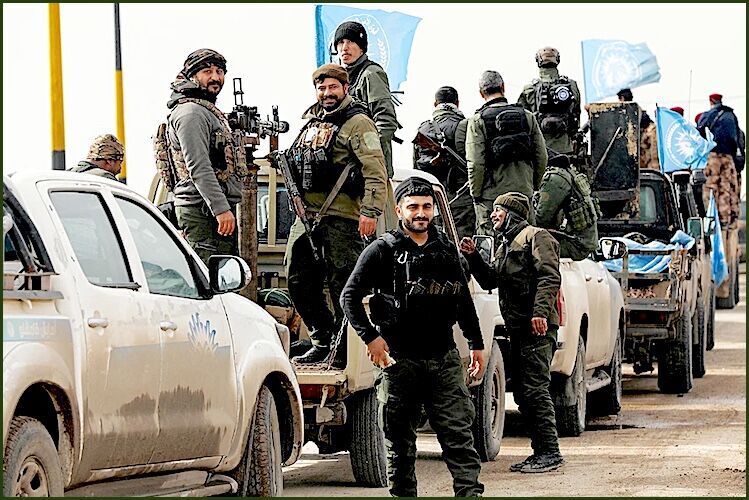
© RostaniKurds ready for action
The Iraqi Kurdistan region, bordering Turkey, Iran, and Syria, with three provinces of Dohuk, Erbil, and Sulaymaniyah, and a population of about 5 million, has been governed autonomously since 1991.
Iranians and Kurds have many common cultural, linguistic, historical, and ethnic similarities. Kurdish leaders have repeatedly said that they will not allow and do not want the Kurdistan Region to be a launching pad for attacking Iran. However, Iraqi Kurdistan could become a major point of tension.
According to the 2024 agreement between Baghdad and the international coalition, some coalition forces will remain in the Kurdistan Region until at least September 2026. Despite the budget cuts, many American officials continue to emphasize the strategic importance of the Kurdistan Region.
On February 22, five Kurdish-Iranian militia factions — the Democratic Party of Kurdistan of Iran (PDKI), the Party of Free Life of Kurdistan (PJAK), the Kurdistan Freedom Party (PAK), the Khabat Organization, and a branch of the Komala Party Kurdistan of Iran — aliased and announced that they would fight against Tehran.
From February 28, 2026, with the start of the attack on Iran, Israel and the United States were considering better use of the Kurdish card.
US President Donald Trump spoke by phone with the Kurdish authorities of the region on March 1. The grounds were prepared for the entry of Kurdish groups from Iraqi Kurdistan into Iran, and Iranian military targets and the entry routes were bombed. But during the war with Iran, Donald Trump repeatedly accused the Kurds of stealing or hiding weapons.
However, extensive obstacles such as the contradiction in the goals of Israel and the United States in the war with Iran, the cautious calculations of the regional authorities, the fear of severe revenge from Tehran, and internal disputes among the Kurds have stopped the ground attack project for the time being.
Although the Kurdistan Region has fulfilled its obligations under its previous security agreement with Iran to some extent, it has not fully implemented it. Therefore, during the 40-day war, there were movements from the borders towards Iran.
Financial and arms aid: controversial issues
With the beginning of Iranian missile and drone attacks on Iraqi Kurdistan, the Kurdish authorities preferred not to deliver a significant part of the weapons to the Iranian Kurdish militias to prevent further conflict. Some Kurdish groups called it a "project with dubious goals" that would turn the Kurds into American and Israeli infantry.
Although some Kurdish groups say that they have not received any weapons and that they have not been included in the American and Israeli security project. However, many also believe that some of the Western financial and weapons aid went to the Kurdish (separatist) parties. But with the accurate intelligence work of Iran and its allies and the targeting of their equipment and forces, a significant part of their operational capacity was destroyed.
Iran's approach to the Kurdish issue and relations with Iraqi Kurdistan
Given the presence of Kurdish ethnicity in Iran, any negative developments in Iraqi Kurdistan, the presence of Iranian Kurdish militias such as PJAK in the Kurdistan Region, and their passage across the border can be dangerous and put pressure on Iran's territorial integrity.
The signing of the agreement by Ali Larijani and Qassem Al-Araji in August 2025 was a step towards greater bilateral cooperation and strengthening security. In September 2025, Iraq and Iran reached an agreement on 13 points, such as strengthening cooperation and coordination between border crossings, increasing security at all border crossings, combating smuggling of goods and drugs, not opening new border crossings, monitoring, tracking, and exchanging intelligence and security information to identify suspicious movements at the border, and mutual recognition and electronic verification of customs documents and information, to improve the performance of border crossings.
Iran's strategic policy in Iraq is to maintain the political independence and territorial integrity of the country, reduce the presence and role of the United States and Israel, and prevent the use of airspace for aggression against Iran.
Threat perception and response
From Tehran's perspective, sensitivities, and factors such as security concerns regarding the actions of America and Israel, the risk of geographical encirclement of Iran, ensuring regional peace and stability, and preventing foreign powers from dominating Iran's approach in the climate of Kurdistan are important. From the perspective of many in Iran, receiving anti-Iranian weapons means a clear violation of Erbil's neutrality. Therefore, according to Article 51 of the United Nations Charter, weapons depots and positions of groups were targeted dozens of times.
In recent months, Iran has warned the Iraqi Kurdistan Region that in the event of any action by "separatist" groups against its borders, it will target all the region's facilities. For example, from February 28 to March 28, the Kurdistan Region was attacked with 460 drones and missiles, with most of the attacks being on Erbil and its suburbs.
However, it appears that a significant part of the Western auxiliary weapons has been deported to the Kurdistan Region. Some have even been sent inside Iran or are kept in secret warehouses to be used in "appropriate situations." Furthermore, Tehran has identified and destroyed several teams affiliated with the Kurdish counter-revolutionary group inside the country.
Some of the Kurdish elites and media support the war against Iran. Iran condemns false statements about the disintegration of Iran and Kurdish media support for internal division and discord in Iran. In fact, an organized network to create an identity gap between Iran and its peripheral civilizational sphere in the Iraqi Kurdistan Region (Barzani) is inciting Kurdish public opinion against Iran.
In the project of arming the Kurds against Tehran, Iraqi Kurdistan continues to threaten Iran. From this perspective, close contacts between some officials of the Iraqi Kurdistan Region and Israel, the logistical bases of the Iranian Kurdish counter-revolutionary movements, and the transfer of major infiltrators from the common border into Iranian territory could turn into a regional crisis.
Therefore, further cooperation with Erbil in accordance with the previous security agreement, prohibiting the activities of smugglers, especially in border areas, preventing the use of Iraqi Kurdistan as a base for anti-Iranian groups, disarmament, and eliminating the threat of separatist groups near the border are what Iran wants.
On May 22, 2026, in a telephone call between the President of the Iraqi Kurdistan Region and Iranian Foreign Minister Abbas Araqchi, discussions were held on ensuring security and stability in the Middle East and improving coordination for border security.
While Iran is fully prepared for any possible war, if the war starts again, its scope will go beyond the borders of the region. Various military bases, as well as numerous intelligence-espionage centers, are legitimate military targets for Iran in times of war.
Comment: Thanks to the USA and 'other' factors, as of June 10, 2026, the war appears to have resumed.
Middle East Security Prospects: The Kurdish Question and Regional Stability
Although a visit by Iraqi officials to Tehran is planned for the near future to fully implement the security memorandum of understanding signed between Iran and Iraq, the question of Iranian Kurdish groups infiltrating Iran from Iraqi Kurdistan or initiating a ground war still depends on the decision of the United States and the future of the war with Iran.
However, military cross-border movement is impossible, and Iranians are highly sensitive to their territorial integrity: external threats often strengthen national solidarity and socio-political cohesion within the country.
In the event of a renewed aggression against Iran, the Kurdish militia could become a military tool, so, "using the Kurds as a tool" to keep Iranian forces engaged will increase the risk of spreading the crisis to a wider regional crisis.
Tehran's firm determination is based on suppressing Kurdish terrorist bases. The position of the Erbil leaders, their alignment with the US, and the presence of illegal parties could impose high costs. Therefore, the main parties in Iraqi Kurdistan, especially in Erbil, must seriously pursue the complete disarmament, handover, and expulsion of militia elements from Iraqi Kurdistan.


Comment: Ending the war is not in Israel's decades-long interest. It was USA's best chance at exit and Trump blew it. The way forward promises no mercy.
See also:
United States launches renewed attacks on Iran