
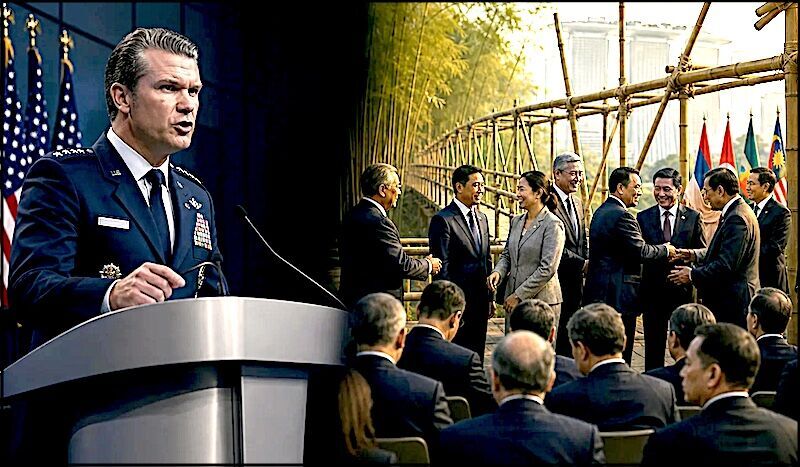
© UnknownUS Secretary of War Pete Hegseth • Shangri-La Dialogue
The Speech That Misread the Room
The opening plenary belongs, by Shangri-La tradition, to Washington. This year, US Secretary of War Pete Hegseth declared:
"The era of the United States subsidizing the defence of wealthy nations is over," demanded that allies spend at least 3.5% of GDP on defence, and denounced the "utopian idealism" of the old multilateral order. He boasted about the extrajudicial capture of Venezuelan President Nicolás Maduro, touted improved US-China relations under President Trump — conspicuously omitting any mention of Taiwan — and closed with the assertion that the region needs "less Shangri-La, more combat power."It was a speech that alienated the very audience it sought to lead. In fact, as events show, the starkest divide at the Dialogue was not between Washington and Beijing; it was between Washington and its own partners. ASEAN, alongside the European Union, remains among the world's most committed advocates of multilateral diplomacy and rules-based order. Telling such an audience, at a conference, that conferences are superfluous was a striking misreading of the room.
The dissonance ran deeper than tone.
Hegseth's capture of Maduro was widely condemned across Southeast Asia as a violation of international law. US strikes on Iran, and their economic reverberations through the Strait of Hormuz, had already disrupted petrochemical supply chains across the region and fuelled public unease. European NATO allies present at the Dialogue were conspicuously equivocal about both episodes. Meanwhile, Hegseth's softer line on China — promoting "constructive strategic stability" following Trump's Beijing summit — sat in uncomfortable tension with his simultaneous demand that regional partners build up military capabilities to counter Chinese power. Washington was, in effect, asking its partners to arm for a threat it was publicly downgrading. The contradiction could not have been more evident and harder to accept for the 'partner' states.
The fundamental problem was not rhetorical but structural: the United States continues to demand alignment while demonstrating, through its conduct in Venezuela and the Middle East, that it applies international legal norms selectively. For the Indo-Pacific's small and medium-sized states — whose security doctrines rest on the equal and consistent application of those norms — this is precisely the posture that makes American security guarantees feel unreliable.
The Counter-Vision From Hanoi
The speech that actually captured the room's instincts came the evening before Hegseth took the podium. Vietnamese Communist Party General Secretary Tô Lâm — the first holder of that office ever to address the Shangri-La Dialogue — warned against "uncontrolled competition" and called for "peace, trust, and development" as the region's organizing principles. He cautioned that the selective interpretation of international law creates a "big fish eat small fish" world that pressures smaller states to choose sides. Ultimately, he cast Vietnam, pointedly, as a defender of the rules-based order rather than a client of any great power.
This was not mere diplomatic courtesy. It was a precisely calibrated ideological counter-offer to the bloc-centred logic that Washington is known for projecting. The region's response was telling: the framing Tô Lâm offered is what the majority of Indo-Pacific states actually want, i.e., a world in which small and medium-sized powers retain genuine agency, where order derives from rules rather than the preferences of the strongest.
Vietnam's keynote role itself carried strategic meaning. Hanoi's so-called "bamboo diplomacy" — maintaining economic depth with China while upgrading security ties with the United States, Japan, India, and the EU — has long been studied as a hedging model. But deploying the party's top leader to articulate it globally was a signal that Vietnam considers this not a temporary improvisation but a durable doctrine. Hours after the speech, Tô Lâm reinforced the point by telling reporters that Vietnam "does not approach its relations with major powers through the prism of security" — a direct rebuke of the security-first framing Hegseth had just delivered.
Vietnam was not alone. Indonesia's delegation, led by its Deputy Defence Minister rather than its minister, conveyed a similar posture of calibrated, non-aligned engagement. Jakarta has signed a defence cooperation agreement with Washington but has been careful to avoid the optics of full alignment. Japan's Defence Minister Shinjiro Koizumi expressed "sadness" at China's second consecutive ministerial-level absence and urged more dialogue with Beijing, thus offering a notably more conciliatory register than Washington's. The Netherlands' Deputy Prime Minister acknowledged the imperative of European strategic self-reliance. Across the forum, the pattern was consistent: states were investing in their own capabilities while deliberately keeping their political options open.
The Architecture Being Built Without Washington's Blueprint
The cumulative picture from Singapore is of a region constructing a new security architecture, one that does not replace the US presence but no longer treats it as the organizing logic. Several developments from the Dialogue's sidelines made this concrete. The GUIDE framework on critical underwater infrastructure — a multilateral initiative among middle powers to protect shared assets — was formalized at the summit, demonstrating that the region's middle powers are increasingly willing to cooperate independently to safeguard shared strategic interests. Countries are diversifying arms procurement beyond American suppliers: Southeast Asian states have accelerated purchases of BrahMos missiles, Korean fighter jets, and European naval platforms, reducing the strategic leverage that exclusive defence dependence once conferred.
China's absence from the ministerial podium matters in this context not because it signals weakness, but because it confirms a feature of this emerging order: it is being built in the space between the two superpowers, not by either of them. What became apparent is that the future of Asian stability will not rest on a single alliance or dominant power but on a dynamic balance maintained by increasingly capable middle powers determined to preserve their autonomy. Their efforts are only complimented by China that does not, unlike the US, have hegemonic ambitions, although it does care a lot about its vital strategic interests.
What comes next is more than multipolarity in the classical sense. Rather, the future appears to be more fluid and arguably more stable: a networked regional order in which countries like Vietnam, Indonesia, Japan, India, and middle-weight European powers maintain overlapping, non-exclusive partnerships calibrated to specific interests rather than comprehensive alignment. This model is more complex to manage and less legible to Washington's alliance logic, but it is already taking shape.
The deeper question the 2026 Shangri-La Dialogue poses is not whether the US-led security order is declining — the evidence for that is now substantial — but whether Washington can adapt its statecraft to remain relevant within a regional architecture it no longer designs. Hegseth's speech suggested it cannot, yet. The states filing out of that Singapore hotel had already moved on.



Reader Comments
to our Newsletter