
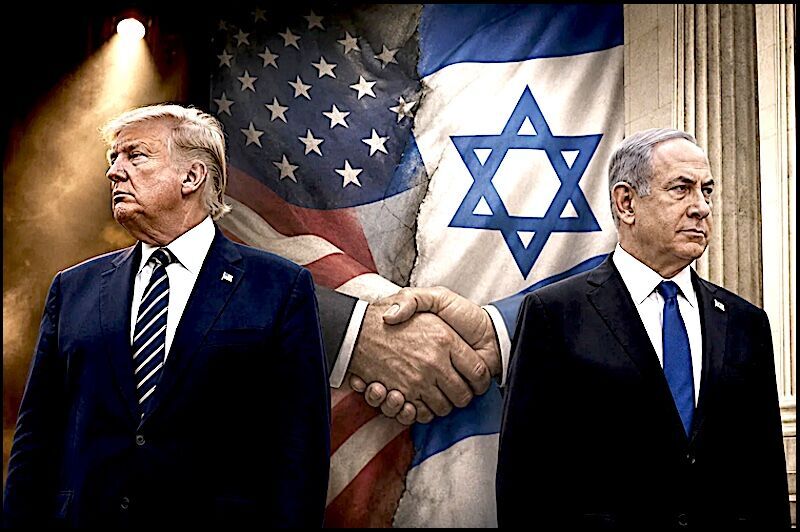
© UnknownUS President Donald Trump • Israeli PM Benjamin Netanyahu
"You are crazy. What the hell are you doing?" This is what Trump told Netanyahu, according to the report, after learning of Israeli military actions in Lebanon. Is this the end of the US-Israel partnership? Well, it's too early to say this. Since the inception of the Trump 2.0 administration, disagreements between the US and Israel have erupted recurringly over Gaza, Iran, or Lebanon. On one occasion, US Vice President JD Vance once commented on Israel's plan to occupy the West Bank as, "What a stupid idea this is!"
The actual question is: whether these disagreements are a genuine rupture of relations or just political theater. President Trump has always been blunt to gain media attention and to maintain his political base.
Remember one thing: any kind of tactical divergences should not be confused with decades-long strategic cooperation between the two counterparts.
Why Does Media See a Rift?
President Donald Trump is trying to appear independent of any foreign influence. But we all know it's Tel Aviv where American foreign policy is being formulated. To disown this claim, the Trump administration has long been trying to portray itself as a senior partner of Israel, not its subordinate. Moreover, it's the American public whose changing narrative is forcing Trump to do so. There has been an increase in the public criticism over the unconditional support for Israel. A simple question they ask is, "To make America great again, if European or other allies are not getting American money, then why is Israel receiving it?" Thus, to preserve his America First image, President Trump often does such conflictual things, and the media portrays it as real.
In addition, Netanyahu is also facing serious domestic constraints, especially from the right-wing opposition. Netanyahu's government has remained in power owing to the backing that he receives from various nationalistic and religious groups that have always been aggressive toward Hamas, Iran, and Hezbollah. This becomes even more pertinent in light of the October 7 attacks, as Netanyahu's credibility hinges on his government's capability against Iran and its allies. Therefore, Netanyahu might sometimes pursue such policies, which would be in complete contradiction with what Washington is pursuing. The ongoing Iran negotiations are its best manifestation, whereby the US is maintaining its stance over a ceasefire with Hezbollah, but Israel is continuously attacking Lebanon. Likewise, for the US, the Gaza and Iran games are now over, but for Israel, both are still lingering over their heads. Neither is Hamas being eliminated completely nor is Iranian nuclear and ballistic missile production being halted.
Strategic Relations Remain Strong
The cooperation between the US and Israel does not rely on personal relations between the leaders of the two nations; rather, it is characterized by a long history of institutional cooperation. The feud between Trump and Netanyahu is not new. It has several historical precedents. Tensions persisted between Obama and Netanyahu over Israeli settlements and the Iran nuclear deal, but neither the support nor the strategic partnership with Israel was affected in any way. As per the National Security Strategy (2025) of the US, Israel has been portrayed as the model ally of the US for all others to follow its trajectory.
Likewise, the bipartisan support for Israel in Congress is still upheld. There is a bill being drafted in Congress, which would integrate the Israeli military into the US military-industrial complex. Furthermore, there has been an addition to the US defense budget — section 224 of the National Defense Authorization Act — which would further entwine the two armies together. All of this merely illustrates the single fact that although personal differences can draw the attention of the media, they cannot change the strategic dynamics between the two nations.
The Midterm Election Factor
One of the major reasons behind Trump's criticism of Netanyahu and accepting it publicly is to secure his seat in the upcoming midterm election in November 2026. Since the abduction of Venezuelan President Maduro and his wife, Trump has been continuously facing domestic political backlash. His domestic popularity has reached nearly 35 percent. His policies against Iran have backfired, and the US is being humiliated in the international arena. Trump tried his best to make his China visit a win-win element, but all in vain. The Chinese dealt with Trump in a clear, strategic way with no mercy. For President Trump, any type of self-orchestrated victory against Iran is of utmost importance for his midterm elections. But Iran is not letting the US go.
Therefore, President Trump is trying different things, and the ongoing tensions between him and Netanyahu are one of them. He is attempting to convey the message that Netanyahu, as well as some unpatriotic Republicans and the Democrats, are posing an obstacle in his path to finding a peaceful solution to the crisis in Iran. According to the US House of Representatives, as of June 2026, there has been legislation passed in order to stop President Donald Trump from engaging in military activities in Iran. The bill was passed through a 215-208 vote, although mainly symbolic, after four Republicans voted alongside the Democrats against the war, which started in February.
Conclusion
"For me to be an artist today, it is political" (Yseult)
It would not be exaggerated to say that President Trump is a political artist who knows what media wants and how to manipulate public opinion. The US-Israel growing institutional integration and resiliency clarify the fact that the presence of disagreements does not mean the absence of partnership. It depends upon political actors to mold those disagreements in their favor. Thus, conflicts between Trump and Netanyahu are temporary and politically oriented. Hence, while people argue that there is a separation between the US and Israel, such an approach should also be analyzed through the aforementioned perspective.





Comment: Rift is merely a raft. Dissolution? Not any time soon.