
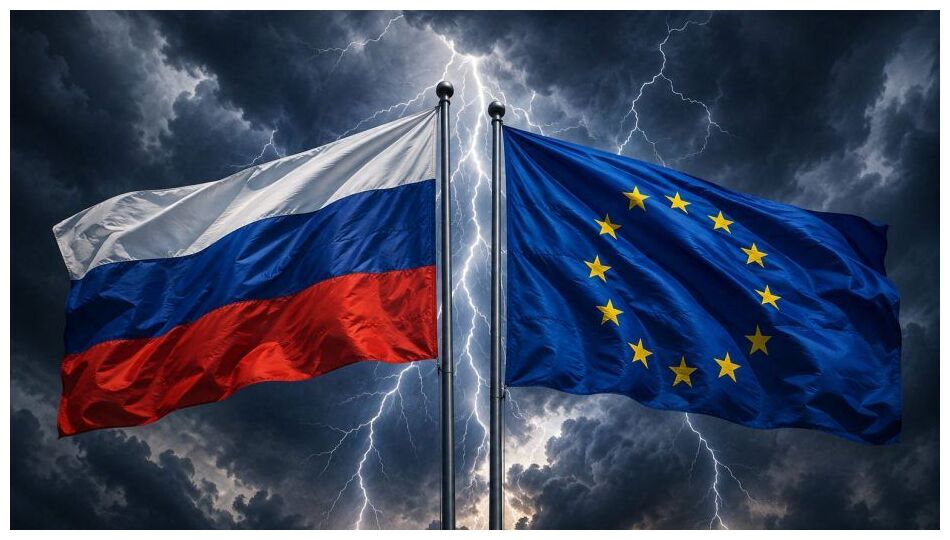
© Public Domain
No doubt part of the shifting policy is due to the economic mess that Europe has created for itself by cutting off energy trade with Russia. Escalating energy costs are destroying European industries and imposing crippling financial hardship on millions of its citizens. Realizing the self-inflicted disaster, European capitals are desperate to appear to be normalizing relations with Russia and resume affordable energy supplies.
France and Italy are advocating the appointment of an envoy to engage with Russia to resolve the conflict and the lifting of anti-Russian sanctions.
Last weekend, the leaders of Britain, France, and Germany - the so-called E3 - stated that they would "help mediate" a peace deal between Ukraine and Russia. The Ukrainian puppet president, Vladimir Zelensky, was feted in Downing Street on June 7 by Britain's Kier Starmer, France's Macron, and Germany's Merz. They proposed taking the lead in negotiations from the United States since President Trump seems more preoccupied with ending the war against Iran.
Various names have been suggested as to who could serve as an interlocutor representing Europe. Angela Merkel, the former German Chancellor, and former Italian Prime Minister Mario Draghi are two names that have been put forward. Finnish President Alexander Stubb has also been suggested. It's unlikely any of them would be acceptable to Moscow, especially Merkel, mainly due to her past role in covertly undermining the 2015 Minsk Accords, thereby sowing the seeds for war that erupted seven years later.
The telling - almost laughable - thing is the paucity of any European figure with credibility as an envoy.
The EU's top diplomat, Kaja Kallas, has become a laughing stock over her rank incompetence. Her Russophobic ranting has rendered her redundant in conducting foreign policy. So much so that there is a revolt among European diplomats against what they declaim as her "dysfunction".
This week, Europe sent three ambassadors to Moscow to renew some form of dialogue. Russia's deputy foreign minister, Mikhail Galuzin, met with representatives from Britain, France, and Germany. The Russian foreign ministry said it was open to hearing what Europe had to say.
However, Galuzin reportedly gave the visitors short shrift, reminding them that Europe cannot pose as mediators when it is a participant in the war against Russia.
Following the meeting on Thursday, Maria Zakharova, the foreign ministry spokeswoman, dismissed the European mission as not serious about addressing the challenge of finding a peace settlement.
Zakharova accused the ambassadors of promoting a "dead-end Zelensky formula."
She said: "The leaders of these countries are pretending, through their statements, to be calling for peace, but in reality they are putting forward unacceptable conditions, increasing the production of long-range weapons for Kiev and generally taking steps towards the militarisation of Ukraine and Europe."
If Europe were serious about peace, it would stop arming the Kiev NeoNazi regime and show some meaningful acknowledgment of Russia's long-held demand to deal with the root causes of the conflict.
Europe's backing of the Kiev regime's call for an immediate ceasefire while expanding Ukraine's ability to carry out deep strikes on Russian territory with European-manufactured drones, killing hundreds of civilians over recent months, is just a cynical ploy to rearm the proxy regime and give it some respite in order to resume the war with more lethal vigour at a later stage.
The duplicity of the European politicians goes back to the treachery of the Minsk Peace Accords in 2015 and the sabotage of the Istanbul peace negotiations in April 2022. That has culminated in the biggest war in Europe since World War Two, with millions of casualties and a real threat of spiralling into open war.
Europe's governments and its EU and NATO bureaucrats are still wedded to the ideology of inflicting a strategic defeat on Russia. So, too, it seems is Washington, despite Trump's talk of wanting peace.
Arming the Nazi regime in Kiev at an increasing pace while calling for a superficial ceasefire is proof that the European leaders are not authentic in their belated espousal of seeking diplomacy with Russia.
Former German foreign minister Sigmar Gabriel (2017-2018) recently pointed out a shameful truth when he said that Europe lost its chance for diplomacy in 2021.
Back then, the EU leadership and the American Biden administration both repudiated Russia's earnest efforts to negotiate a way to avoid war in Ukraine. Moscow had clearly set out its objections to NATO expansion, in particular, the absorption of Ukraine into the military alliance, and it proposed rational solutions for collective security. Russia's diplomacy was rejected out of hand by Washington and Brussels.
The Europeans and the Americans were bent on provoking Russia into an armed confrontation with their proxy Ukrainian regime that they had installed in the 2014 coup and weaponized. Diplomacy was rejected because the NATO axis calculated that it could defeat Russia with war and economic strangulation, or, as some Western politicians admitted, "total war".
The European agenda, as reflected in demands for an immediate ceasefire without any cognizance of Russia's arguments about historic claims and indivisible security, demonstrates that European leaders are not yet ready or willing to engage genuinely and meaningfully.
As 18th-century Prussian strategist Carl von Clausewitz might put it, their recent overtures for political talks are simply war by other means.



Reader Comments