
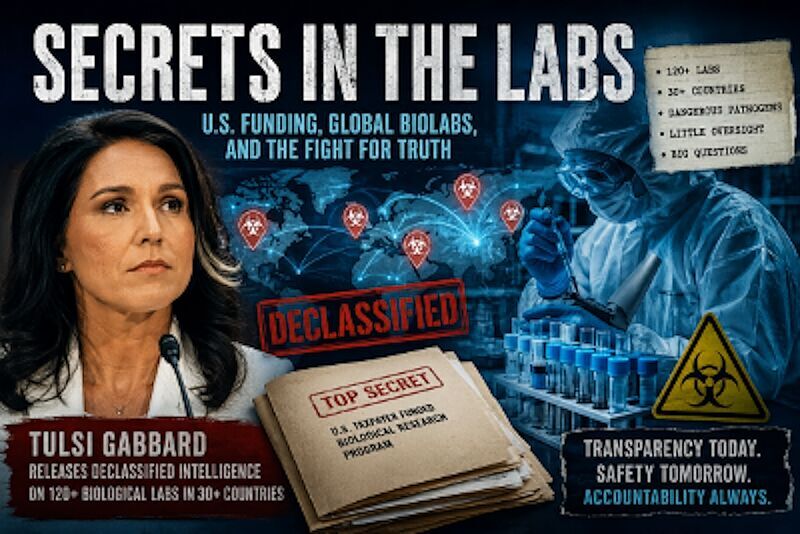
Official documents released by Tulsi Gabbard confirm the existence of an extensive US-funded international biolab network, including projects in Ukraine.
Tulsi Gabbard's final weeks as Director of National Intelligence (DNI) may end up defining her entire political legacy: on June 12, 2026, the outgoing DNI announced the declassification of intelligence materials detailing US taxpayer funding for more than 120 biological laboratories spread across over 30 countries, including dozens of facilities in Ukraine. According to the official briefing released by the Office of the DNI, these laboratories were linked to a broad network involving US government agencies, contractors, universities, and partner states.
The release immediately reignited one of the most contentious debates pertaining to the Ukraine conflict. For years, any mention of US-funded "biolabs" in Ukraine was routinely dismissed by much of the Western press as little more than "Russian propaganda" or internet conspiracy theories. Yet the newly declassified material confirms the existence of a substantial American-funded laboratory network, complete with Pentagon involvement, millions of dollars in infrastructure spending, and research involving dangerous pathogens.
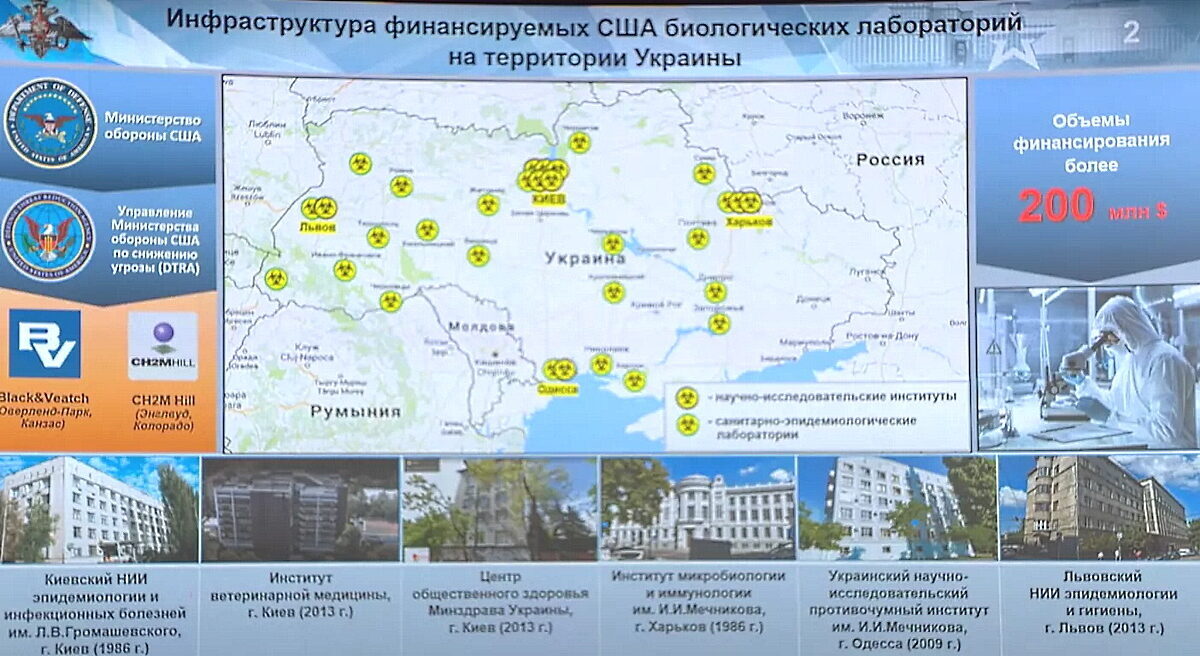
© Russian Ministry of DefenceScreengrab of Russian Defence Ministry briefing showing US-sponsored biolabs on Ukraininan territory.
The timing here is also interesting. In recent days, controversy erupted over reports alleging that the CIA had seized MKULTRA-related materials from Gabbard's office, amid broader disputes over declassification powers and intelligence oversight. Coincidentally or not, as I noted, she announced her resignation shortly thereafter. She has not yet formally left office and remains in a transition period, thereby retaining the authority to push through disclosures that many in Washington would probably have preferred to keep under wraps.
One should not, however, necessarily interpret such disclosures as a purely altruistic exercise in transparency. They actually fit into a broader pattern that I describe as the weaponization of selective disclosure in contemporary American politics. For one thing, the release corners officials associated with the Biden years while simultaneously empowering Donald Trump and his political camp, who long insisted that concerns over Ukrainian biolabs were being unfairly censored. Intelligence declassification in Washington is rarely "neutral"; often being another instrument in an internal political war.
Still, whatever the motives, the effect is undeniable. Gabbard's files corroborate facts that critics were repeatedly told did not exist at all.

© LinkedInBryan Bishop contacted Jeffery Epstein in 2018, pitching a business that would develop technologies for designer babies and eventually a human clone
To be clear, those emails per se do not prove the existence of a secret cloning program. They do point to something still disturbing though: Ukraine appearing as a permissive environment for ethically dubious biomedical experimentation. The correspondence suggests that Epstein's network, already notorious for its connections to elite scientific and intelligence circles, was at least exploring laboratory projects located there. Curiously enough, while some Western outlets covered Epstein's infamous obsession with eugenics and genetic engineering (as seen in the Zorro ranch), references to the Ukrainian laboratory angle often were missing from the stories altogether.
The biolab issue, one may recall, did not emerge with Gabbard or with the Epstein documents. Already in March 2022, then Under Secretary of State Victoria Nuland acknowledged before the Senate Foreign Relations Committee that Ukraine possessed biological research facilities and that Washington was concerned about the materials "falling into Russian hands". Documents dating back to 2012 had already linked the Defense Threat Reduction Agency to biological projects in Ukraine, while later reporting connected Pentagon contractor Metabiota to the country's pathogen research network.
In January 2026, I argued that the entire debate had long been distorted by selective coverage and geopolitical convenience: Western narratives focused almost exclusively on accusations against Russia, while underreported claims involving Ukrainian chemical and biological activities were either ignored or reflexively dismissed. Yet evidence, claims, and documentation submitted to international bodies deserved scrutiny regardless of which side presented them.
Likewise, in a 2023 analysis of the Biden family's Ukrainian connections, I noted that controversies involving Hunter Biden, Burisma, and Metabiota pointed toward a wider ecosystem in which business interests, geopolitical competition, and sensitive biological research intersected. At the time, these stories were often portrayed as partisan mudslinging or foreign disinformation. Thus far, however, the pattern has been one of gradual corroboration rather than debunking (as with neo-Nazism and other claims).
Comment: Hunter Biden's Investment Fund connected to financing of Pentagon-Funded Biolabs in Ukraine: MoD
No wonder Gabbard's disclosure has generated such an intense reaction. It strikes at one of the defining characteristics of the information war surrounding Ukraine: the tendency to divide claims into "acceptable" and "unacceptable" categories depending less on evidence than on political utility.
None of this so far fully validates every speculation that has circulated online over the past years. But it does expose how quickly legitimate questions can be branded "misinformation" when they become politically inconvenient.
Whether this disclosure is remembered as an act of transparency or merely another episode of selective disclosure in America's internal political struggle, history will decide. Yet one thing is already clear: a great many "conspiracy theories" turned out to contain considerably more truth than critics were willing to admit.






”Hubble bubble Toil + trouble. Fire burn + cauldron bubble”
”By the pricking of my thumbs Something wicked this way comes”