Earthquakes
S


Seismograph

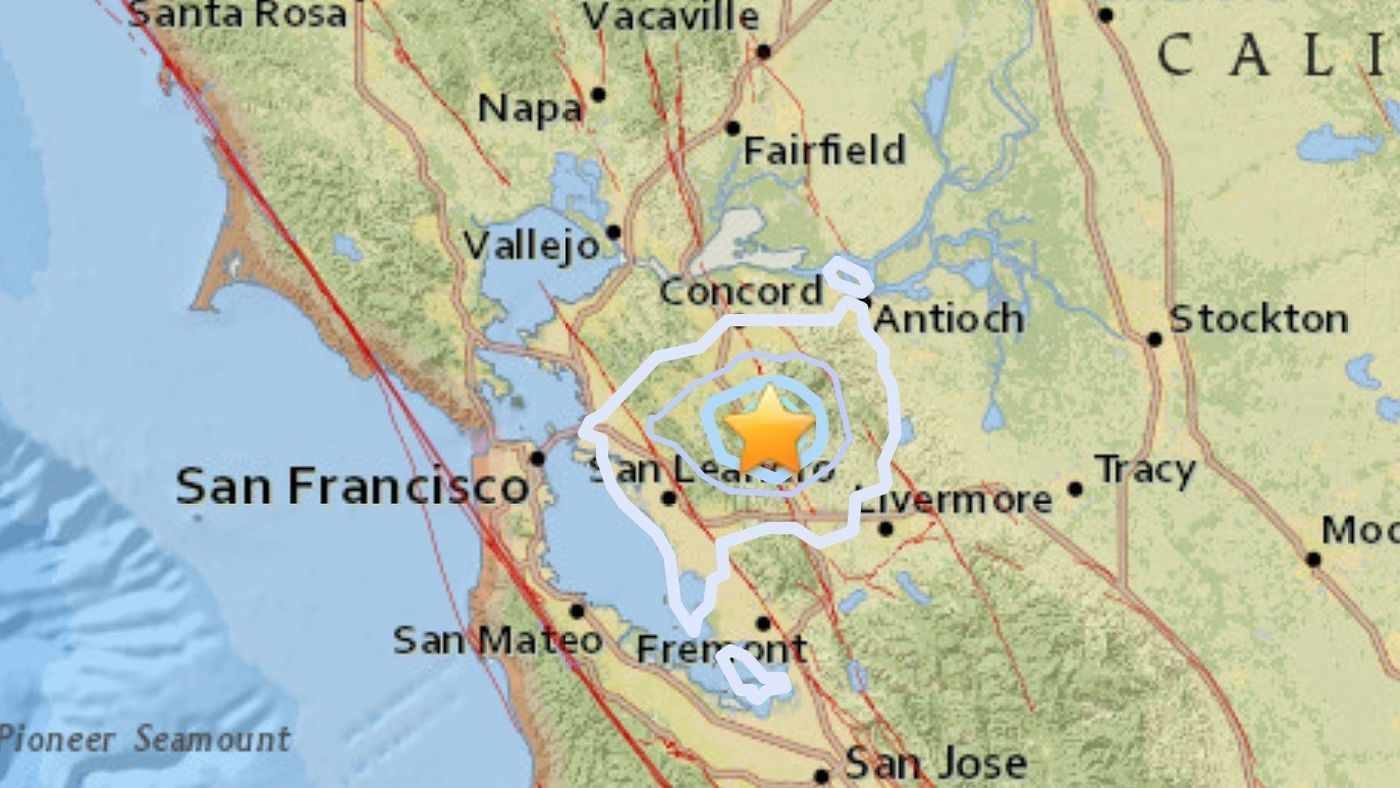
Earthquake swarm rattles San Francisco Bay Area

San Francisco earthquake swarm
© USGSEpicenter of a magnitude 3.6 earthquake Friday in the East Bay area.
Several magnitude 2 and 3 earthquakes rumbled through the San Francisco Bay Area on Friday. It's the latest seismic activity to add to a swarm of 60 earthquakes greater than magnitude 1 to hit the Danville area in the past week.

The largest in the sequence, a magnitude 3.6 earthquake, came at 12:19 p.m. Friday. The U.S. Geological Survey received reports from more than 1,000 people who said they felt the quake, extending from the East Bay and into San Francisco. The quake was quite shallow, less than a third of a mile under the surface of the earth.

A magnitude 2.8 aftershock was felt two minutes later.

Earthquake swarms like the one that began on Feb. 16 in the Danville area have been common over the past few decades, occurring in 1970, 1976, 1990, 2002, 2003 and 2015. They occur in the San Ramon Valley corridor along Interstate 680 between Walnut Creek and the Dublin and Pleasanton areas, said U.S. Geological Survey research geologist Belle Philibosian.

The Calaveras fault runs right along the San Ramon Valley. In the Danville area, the fault zone transitions and steps over to the Concord fault, which continues north into Concord, Philibosian said. There is a complex zone of small faults in this transition area.

While the San Andreas and Hayward faults are well known to many in the Bay Area for their seismic risk, the Calaveras and Concord faults also pose a substantial risk. The Calaveras fault is as long as the Hayward fault, for instance, and can produce a magnitude 7 earthquake, Philibosian said.

Comment: Some other earthquake swarms recorded from around the world recently include:


Fire

Yellowstone: 200 quakes in just 10 days after warning that magma is causing strain on the surface

According to experts with the US Geological Survey, the latest swarm began on February 8 in a region roughly eight miles northeast of West Yellowstone, Montana – and, it’s increased dramatically in the days since
© USGS volcanoesAccording to experts with the US Geological Survey, the latest swarm began on February 8 in a region roughly eight miles northeast of West Yellowstone, Montana – and, it’s increased dramatically in the days since
A new swarm of earthquakes has cropped up at the Yellowstone supervolcano, with more than 200 small temblors detected in the last 10 days alone.

According to experts with the US Geological Survey, the latest swarm began on February 8 in a region roughly eight miles northeast of West Yellowstone, Montana - and, it's increased dramatically in the days since.

But for now, scientists say there's no reason to worry.

While the earthquakes are likely caused by a combination of processes beneath the surface, the current activity is said to be 'relatively weak,' and the alert level at the supervolcano remains at 'normal.'

Comment: We're seeing a marked increase in various kinds of geological activity lately, could it be related to scientists' predictions that major earthquakes for 2018 due to slowdown in Earth's rotation? Also check out our monthly documentary: SOTT Earth Changes Summary - January 2018: Extreme Weather, Planetary Upheaval, Meteor Fireballs


Seismograph

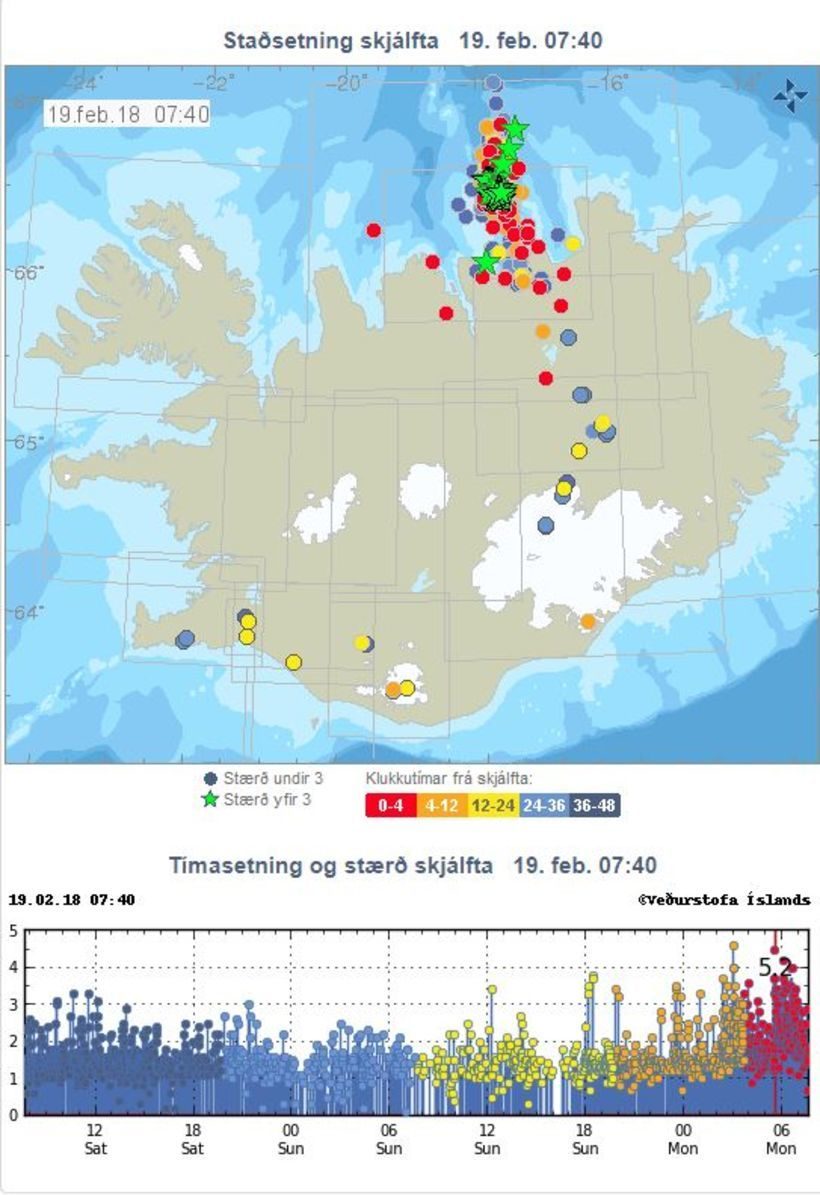
Earthquake swarm intensifies at Grímsey island, Iceland

earthquake swarm in Grimsey, Iceland
An earthquake of a magnitude of 5.2 was detected at Grímsey island at around 7 this morning. The powerful quake was felt in many parts of North Iceland and the department of Civil Protection and Emergency Management has declared a level of incertitude in North Iceland.

Grímsey island is located off the North coast of Iceland and marks Iceland's northernmost point. There are only just over 80 inhabitants in this remote island.

Comment: There has been a lot of quake activity around the globe recently:


Seismograph

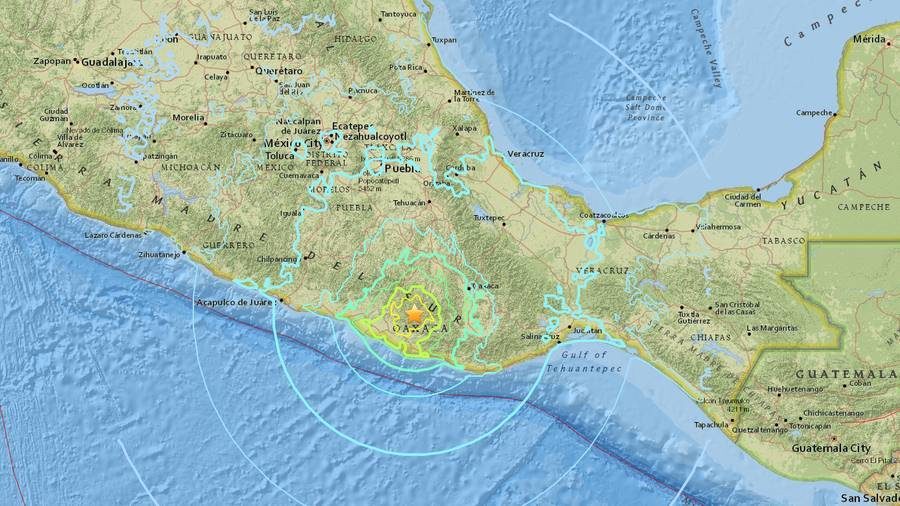
Shallow magnitude 6.1 earthquake rattles large swathes of Mexico

Earthquake seismograph
A STRONG 6.1-magnitude earthquake has rattled large swathes of Mexico, sending people fleeing into the streets fearing for their lives.

The powerful earthquake struck at a depth of 10 km at 12.56am local time (6.56am GMT), according to the US Geological Survey.

The epicentre was 43 km (27 miles) east of Oaxaca with shockwaves felt as far as Mexico City, USGS said.

Earthquake alarms were sounded in Mexico City - home to almost nine million people - giving residents time to evacuate their homes.

There are no immediate reports of damage to buildings, injuries or deaths.

Taking to Twitter, one wrote: "In Mexico City the earthquake alarms went off and gave us approximately 30 seconds to get out. We could feel it. It seems everything is ok."

The tremor comes just 48 hours after a 7.2-magnitude earthquake hit south-western Mexico, damaging buildings but causing no deaths.

Pictures posted to Twitter show anxious residents standing in the streets after the alarm was raised in the early hours of Monday morning.

Comment: Quakes shake Pacific plate as Ring of Fire activity returns


Seismograph

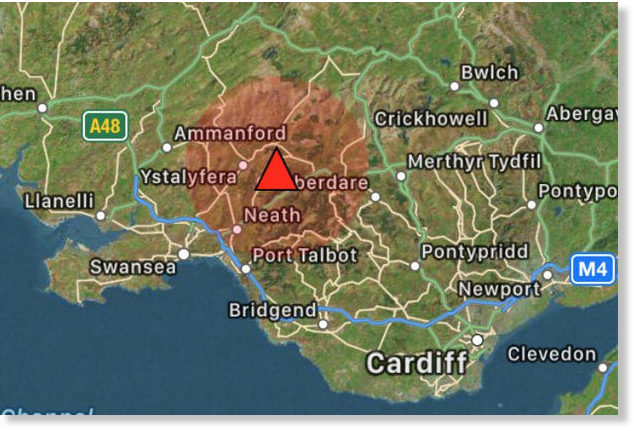
Magnitude 4.2 earthquake strikes south Wales, tremor felt from Cornwall to Liverpool

EPICENTRE: The quake struck eight miles from Swansea city centre
© GFZEPICENTRE: The quake struck eight miles from Swansea city centre
A massive earthquake has struck Wales with tremors felt from Cornwall to Liverpool.

The 4.2 magnitude quake occurred near Swansea, south Wales, around 2.30pm at a depth of six miles.

Residents across the UK - from Bristol to Cornwall - have reported tremors in its aftermath.

Comment: A Sott.net reader wrote in to tell us that she felt it too:
I felt this tremor, nothing major, just felt like a the house jolted.
The British Geographical Survey says an event of this magnitude only happens in the UK every 2-3 years. Actually, there have been about 7 similar-strength quakes in the UK in the last 3 years alone...

22 May 2015 - A 4.2 magnitude earthquake 'causes homes to shake' in Kent, UK
25 May 2015 - Magnitude 3.0 earthquake recorded in North Wales
29 Jan 2015 - Britain's second earthquake in 48 hours strikes in East Midlands
7 Mar 2016 - Earthquake 'shook houses' in south-east England
3 Jan 2017 - 3.9 magnitude tremor strikes off UK coast - biggest quake for nearly a decade
4 July 2017 - Earthquake recorded off Shetland was largest in UK for nine years
5 Aug 2017 - Scottish Highlands are rocked by their biggest earthquake for 30 years


Seismograph

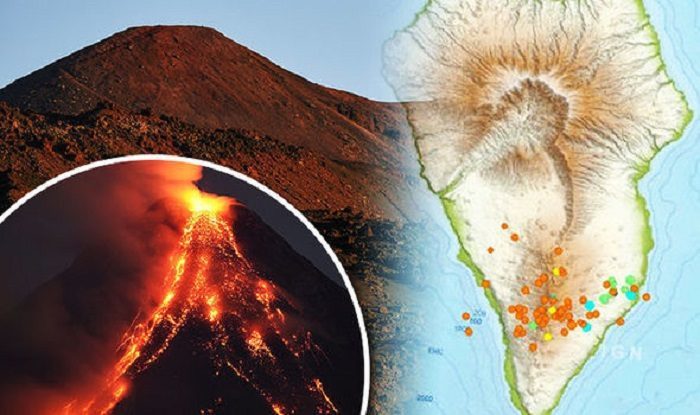
Earthquake swarm hits Canary Islands' La Palma

The Canary Islands' La Palma earthquake swarn
© IGNThe Canary Islands' La Palma has been hit by a flurry of earthquakes
THE Canary Island of La Palma has been hit by another flurry of earthquakes once again prompting fears the deadly Cumbre Vieja could erupt - just four months after scientists recorded a swarm of more than 200 tremors.

The Spanish archipelago was struck by up to 70 small quakes, recorded between Monday and Wednesday, reaching between magnitude 1.5 and 2.6 on the Richter scale.

Andgovernment officials announced more quakes were felt between 3am and 6.30am this morning at magnitudes of between 2.1 and 1.5.

Most of them were located in the area of Los Canarios, in Fuencaliente, and in El Pueblo, Villa de Mazo, although they have also been registered in El Paso and Tazacorte.

The Canary Government has now stepped in and called for an urgent meeting to take place on Friday to discuss why the quakes are happening again and what might happen in the future.

The seismic activity is the latest to hit the Spanish islands, popular with British holidaymakers, after it was struck by a flurry of earthquakes in October last year.

Comment: Quakes shake Pacific plate as Ring of Fire activity returns


Seismograph

7.2 magnitude quake strikes Mexico near Pacific coast

mexico earthquake February 2018
© USGS
A powerful earthquake with a magnitude of 7.2 has rocked southern and central Mexico. The tremors reportedly shook buildings across the country's capital.

The quake hit the southwestern Mexican state of Oaxaca, United States Geological Survey (USGS) reports. Situated closest to the epicenter is the municipality of Pinotepa de Don Luis, with a population of some 6,700. Tremors were felt as far as Mexico city, with locals posting videos of shaking trees and buildings to social media. Alarms went off across the capital and thousands of people flooded into the streets.

Comment: Quakes shake Pacific plate as Ring of Fire activity returns


UPDATE: Feb 17th - additional reporting:
Magnitude-7.2 earthquake slams south, central Mexico

A powerful magnitude-7.2 earthquake shook south and central Mexico Friday, causing people to flee swaying buildings and office towers in the country's capital, where residents were still jittery after a deadly quake five months ago.

Crowds gathered on Mexico City's central Reforma Avenue as well as on streets in Oaxaca state's capital, nearer the quake's epicenter, which was in a rural area close to Mexico's Pacific coast and the border with Guerrero state. There were no immediate reports of deaths.

"It was awful," said Mercedes Rojas Huerta, 57, who was sitting on a bench outside her home in Mexico City's trendy Condesa district, too frightened to go back inside. "It started to shake; the cars were going here and there. What do I do?"

She said she was still scared thinking of the Sept. 19 earthquake that caused 228 deaths in the capital and 141 more in nearby states. Many buildings in Mexico City are still damaged from that quake.


Mexican Civil Protection chief Luis Felipe Puente tweeted that there were no immediate reports of damages from the quake. The Oaxaca state government said via Twitter that only material damages were reported near Pinotepa and Santiago Jamiltepec, but that shelters were opened for those fleeing damaged homes.

The Mexico City Red Cross said via Twitter that the facade of a building collapsed in Mexico City's Condesa neighborhood, which was hit hard on Sept. 19. A video showed people walking through a dust cloud. But reporters at the scene later found no evidence of a collapse at the location given.

About an hour after the quake, a magnitude 5.8 aftershock also centered in Oaxaca caused tall buildings in Mexico City to briefly sway again.

USGS seismologist Paul Earle said Friday's earthquake appeared to be a separate temblor, rather than an aftershock of a Sept. 7 earthquake also centered in Oaxaca, which registered a magnitude of 8.2. The Sept. 19 earthquake struck closer to Mexico City.


The Sept. 7 quake killed nearly 100 people in Oaxaca and neighboring Chiapas, but was centered about 273 miles (440 kilometers) southwest of Friday's earthquake, Earle said.

In Mexico's capital, frightened residents flooded into the streets in Condesa, including one unidentified woman wrapped in just a towel, but there were no immediate signs of damage.

"I'm scared," said Rojas Huerta, recalling five months ago when buildings fell as she ran barefoot into the street. "The house is old."
Also See: Earthquake swarm hits Canary Islands' La Palma


Seismograph

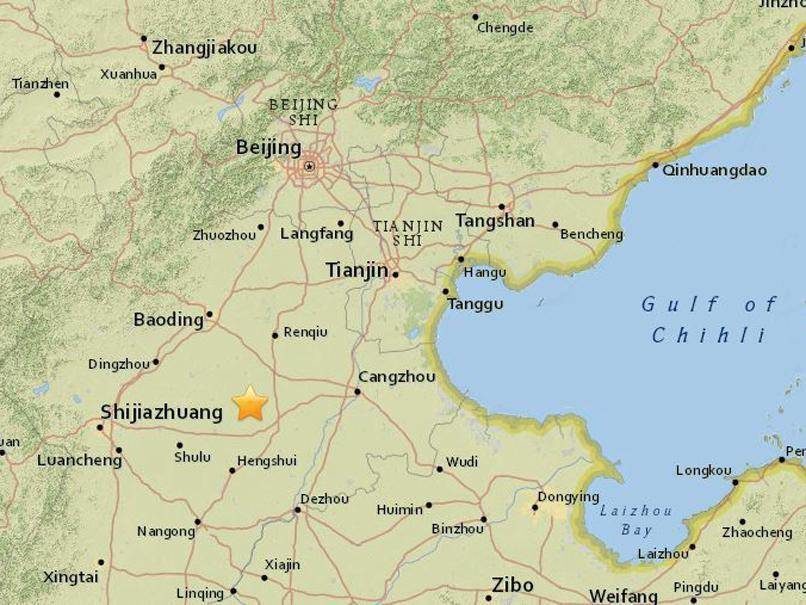
Rare small earthquake rocks Beijing, China

4.3-magnitude quake struck near China's capital
© US Geological SurveyThe 4.3-magnitude quake struck near China's capital
A rare small earthquake rattled the Chinese capital Beijing on Monday, the government said.

The 4.3-magnitude quake was centered in an area just south of the city in the neighboring province of Hebei.

The epicenter was in a county that is part of Hebei's Langfang city.

There were no immediate reports of any damage, and buildings in Beijing shook only slightly.

China is frequently hit by earthquakes, many of which are centered in the southwest of the country.

Seismograph

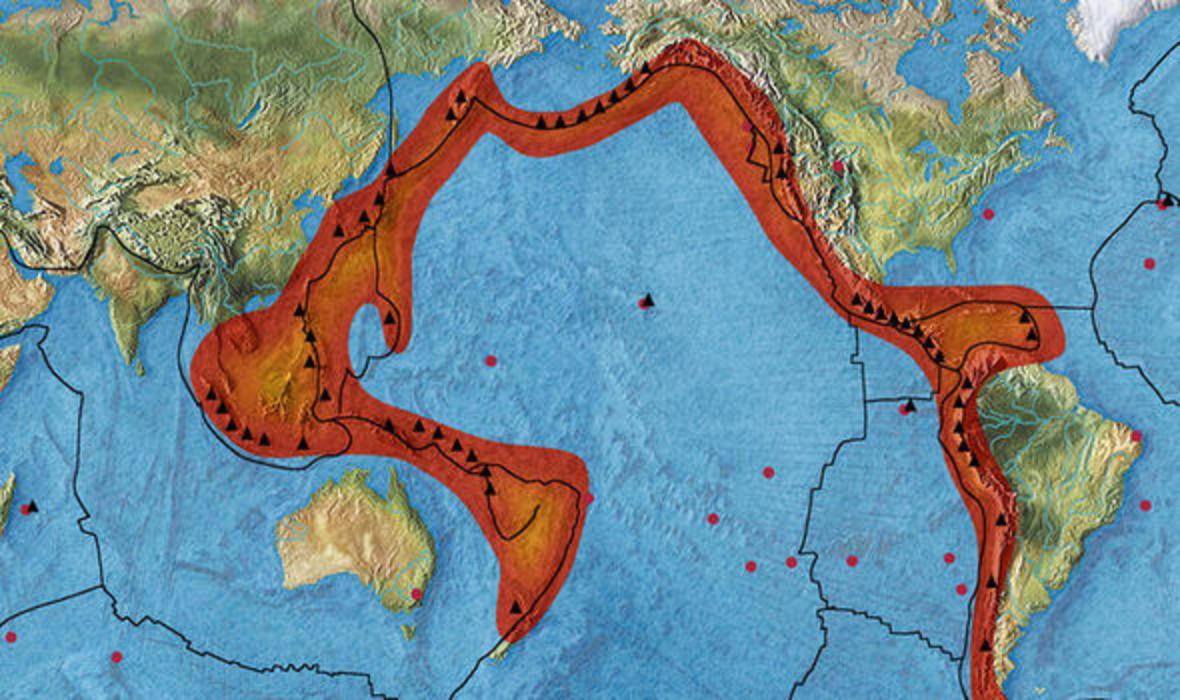
Quakes shake Pacific plate as Ring of Fire activity returns

ring of fire earthquakes feb 2018
Alaska was hit by more but weaker tremors, measuring at magnitudes of 4.2, 4.0, 3.9, 3.6, 3.5 and 3.3 while a 4.5 magnitude quake shook Japan.

The earthquake activity returns after a magnitude 6 quake struck 10km deep off the Northern Mariana Islands. No immediate tsunami warning was triggered.

The Northern Mariana Islands have a population of 55,023 while Guam had 162,742 people living on the island in 2016.

Comment: Could it be related to scientists' prediction that there will be an upsurge in major earthquakes for 2018 due to slowdown in Earth's rotation?

See Also: For more happenings, check out our monthly documentary: SOTT Earth Changes Summary - January 2018: Extreme Weather, Planetary Upheaval, Meteor Fireballs


Seismograph

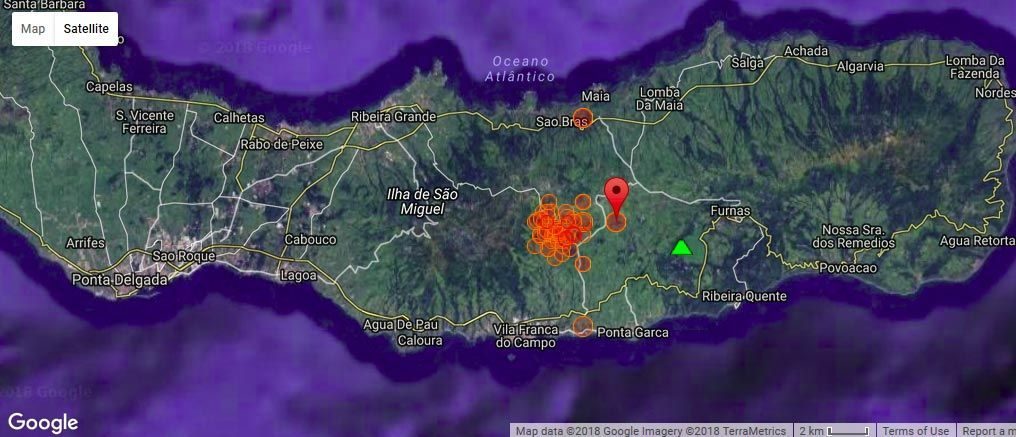
Earthquake swarm under dormant Furnas volcano, Azores

Location of the past days' earthquakes on Sao Miguel island
An earthquake swarm has been going on since Monday (12 Feb 2018) in central Sao Miguel island.

The Volcano Observatory (Observatório Vulcanológico e Sismológico da Univ. dos Açores, CIVISA) recorded dozens of mostly small quakes at shallow depths between 1-15 km in an area about 6-7 km west of Furnas volcano, half way between the caldera lakes of Lagunas Fogo and do Congro.

The largest were 6 earthquakes of magnitudes 3.0-3.6, some of which were felt by local inhabitants.

At the moment, the activity is still continuing, but has decreased significantly. It is unclear whether the earthquakes are volcanic in origin or not. If so, they could have been caused by a small magma intrusion at the lower crust and indicate an early sign of possible re-awakening of the volcanic system.

The only recorded eruptions in the area came from Furnas volcano, one around 1439-1443 and a strong explosive one in 1630, which caused significant damage and fatalities.

The situation remains to be monitored closely.