Animals
S


Fish

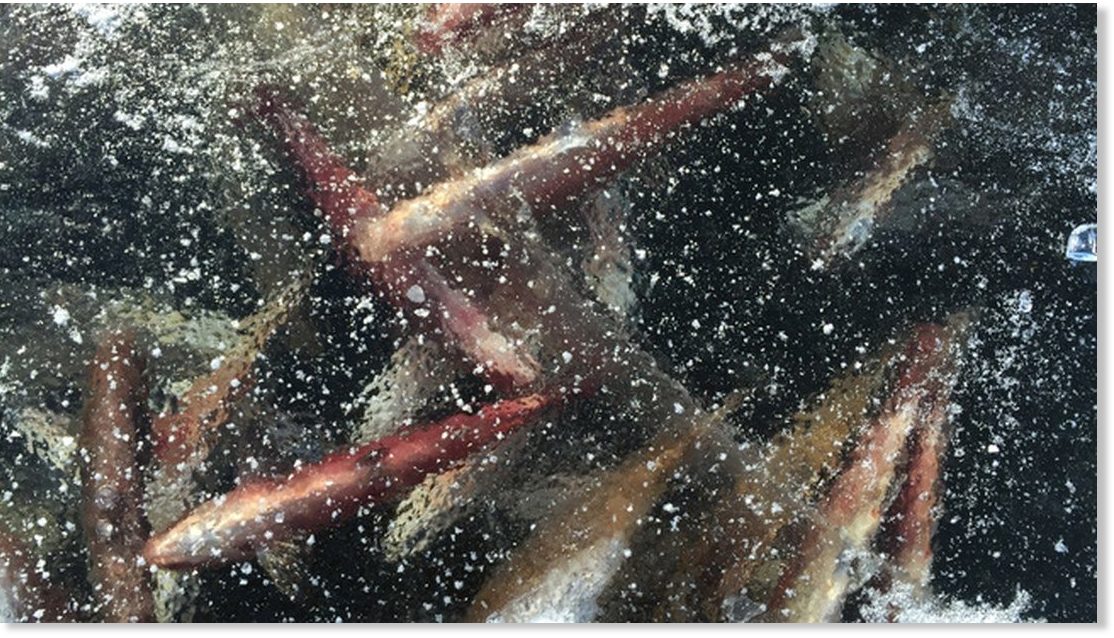
As marina thaws, thousands of frozen shad appear in Burlington, Iowa

Frozen Shad
Frozen Shad
The Spring thaw arrived at Bluff's Harbor Marina this week and brought with it thousands of dead shad.

During two months of ice and freezing temperatures, the fish in the marina slowly ran out of oxygen. Harbormaster Jon Billups said even using bubblers, which churn air and oxygen into the marina during the winter months to keep ice down, did not help this year.

"We've had winters where there weren't any fish killed because there wasn't enough ice to matter," said Billups. "But this time it was so long. We had over two months of solid ice down here. It's a shame, but it's nature."

As the ice thaws and becomes translucent, the silvery fish, not much bigger than minnows, are exposed, frozen right where they were swimming. In some places, ice fishers reported the ice about a foot thick.


Fish

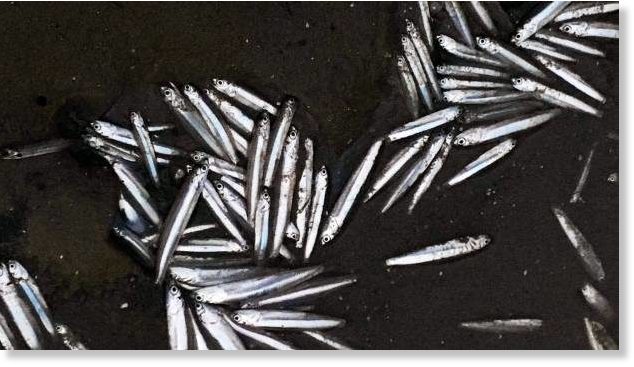
School's out: Thousands of dead fish wash up near Auckland, New Zealand

dead fish have washed into the Stanmore Bay estuary.
Dead fish have washed into the Stanmore Bay estuary.
Thousands of dead fish have startled residents at a north Auckland beach.

The washed up fish - identified by Auckland War Memorial Museum head of natural sciences Tom Trnski as anchovy Engraulis australis - lined the shores of the Stanmore Bay estuary on February 21, sparking fears of water contamination.

A video sent in by a resident shows just how many of the fish have washed up.

A similar incident occurred at Stanmore Bay and Martins Bay, Mahurangi, in August 2009.

Experts suggested the cause could have been rough weather conditions or predators chasing the school into the shallows.

Attention

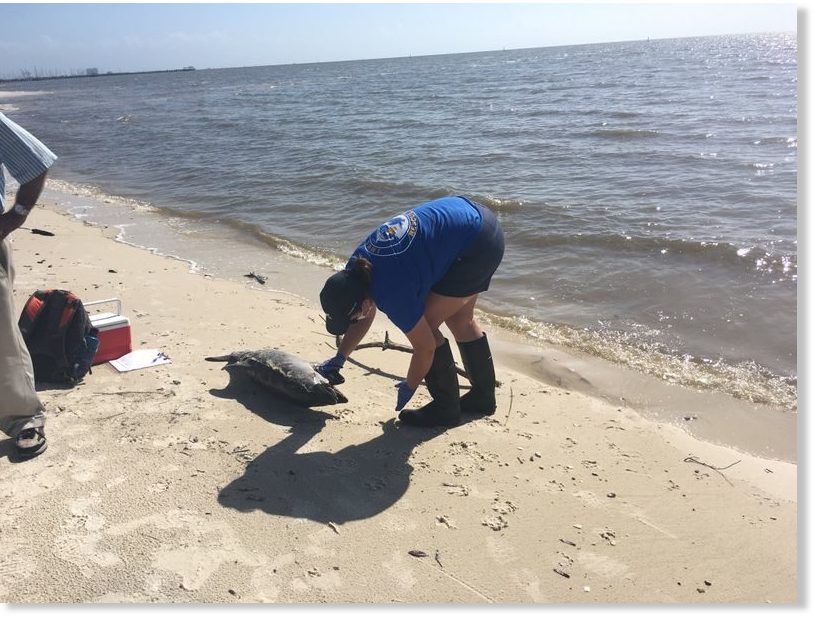
Three dead dolphins discovered in Long Beach, Mississippi

One of the marine scientists with IMMS inspects a dead baby dolphin after it was found washed ashore in Long Beach Saturday morning.
© WLOXOne of the marine scientists with IMMS inspects a dead baby dolphin after it was found washed ashore in Long Beach Saturday morning.
Marine officials were out in Long Beach Saturday morning after discovering two dead baby dolphins on the beach there. A third baby dolphin was found dead on Ship Island on Friday.

Dr. Moby Solangi, the director of Institute of Marine Mammal Studies, said the two in Long Beach were found within a mile of the other on the beach.

Solangi and his team are now looking into how the infant dolphins died. According to Solangi, it's not uncommon to see dolphins come ashore during birthing season. However, Solangi said it's still really early in the birthing season.

Binoculars

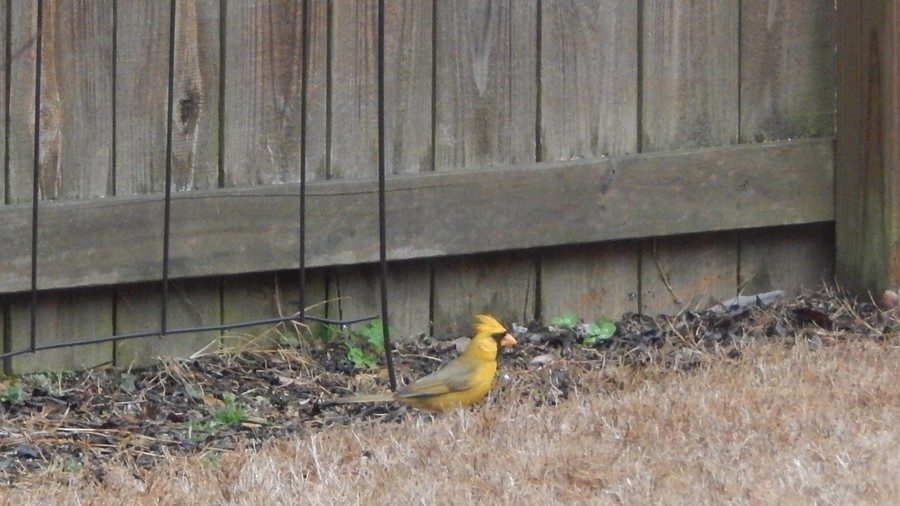
Environmental stress? Rare '1-in-a-million' Yellow Cardinal sighted in Alabama

Rare '1-in-a-million' Yellow Cardinal sighted in Alabama
© Charlie Stephenson / Facebook
A rare, yellow-colored American Northern Cardinal was spotted in an Alabama backyard in January. The "one-in-a-million" cardinal has excited birdwatchers across the US.

Cardinals usually have red feathers. This bird, however, is a mustard-yellow color, likely due to a pigment mutation.

Charlie Stephenson first noticed the yellow bird in her garden in January. She told the Shelby County Reporter it has made almost daily visits to her backyard ever since.


Comment: See Also:


Wolf

12-year-old girl ripped apart by stray dogs near Donetsk in Ukraine

canine attack
© Angela Antunes / CC by 2.0
A 12-year-old girl has died in Ukraine after being set upon by a pack of stray dogs as she walked home from school.

Liza Kanareikina's body was torn to pieces and discovered by her parents near Donetsk to the east of the country.

They found her body in woodland where she would walk daily when she failed to return home.

Neighbour Natalia Skiba said: 'The child was walking back home and did not make it. She was found here in the forest, already torn to pieces.'

A local report said: 'Pieces of meat were literally torn off her body, the snow around was red from blood.'

Attention

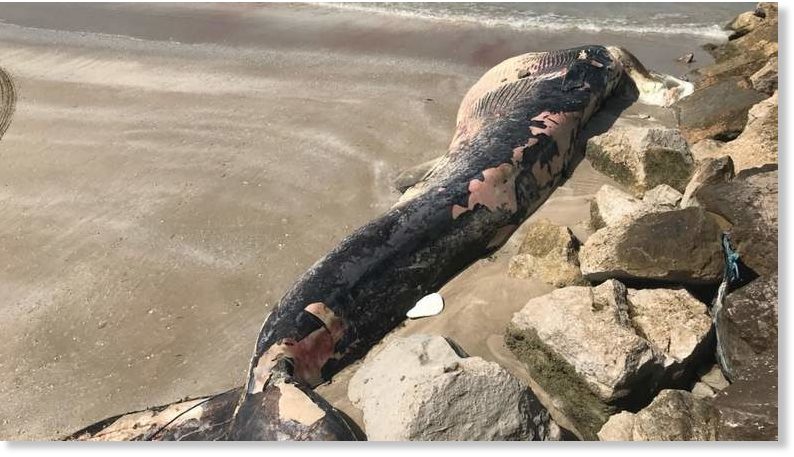
Dead Bryde's whale found on coast of United Arab Emirates

The smell of the deceased mammal spread around the vicinity.
The people of Al Rams area, 12km to the north of the Ras Al Khaimah city, have found a 9m long dead whale on the Al Rams shore.

Fahd Abdullah Juma, an Emirati national from the Al Rams area, said the smell of the deceased mammal spread around the vicinity.

"This is mainly because of remaining dead for long hours," he said, urging the bodies concerned to remove it as soon as possible.

"The smell is so terrible that the people of Al Rams cannot go to the beach there," he said, urging the bodies concerned to scientifically dissect the dead whale and identify the actual reasons for its death.

Horse

Wild horses are EXTINCT: Domesticated breeds are now the only ones left on the planet, according to shock DNA study

Przewalski's horses were considered to be the last 'wild' species of horse but some of the horses were found to carry genetic variants causing white and leopard coat spotting patterns
Przewalski's horses were considered to be the last 'wild' species of horse but some of the horses were found to carry genetic variants causing white and leopard coat spotting patterns. This artists impression shows how the early horses may have looked
The last 'wild' horses is the world are not truly wild, according to a shock DNA study.

Przewalski's horses, a breed thought to be the last 'wild' species, are the descendants of escaped once-domesticated animals.

The research turns the mysterious origin of domesticated horses 'upside down', experts claim.

Przewalski's horses now number roughly 2,000 in Mongolia.

But researchers this week upended that theory on an examination of the genomes of dozens of ancient and modern horses.

'Our findings literally turn current population models of horse origins upside-down,' said Professor Ludovic Orlando, a molecular archaeologist at the French National Center for Scientific Research who led the study.

Attention

Woman severely injured after being bitten by shark off Sydney, Australia

shark attack
A woman is severely injured after being bitten by a shark off the coast of Sydney.

The swimmer was in the water at Congwong Beach in La Perouse at 7pm on Friday when she was attacked by what is believed to have been a shark.

In the wake of the attack, the local council has announced all beaches in the area will be closed on 'for at least Saturday'.

The woman, who is aged in her 50s, was taken to St George Hospital where she is being treated for severe lacerations to one of her legs.

A NSW Ambulance spokesman said it was unclear what species of shark had bitten the woman.

Eagle

Symbolic? Bald eagle found covered in ice in Osage County, Oklahoma (VIDEO)

ice-covered eagle
Ice-covered bald eagle
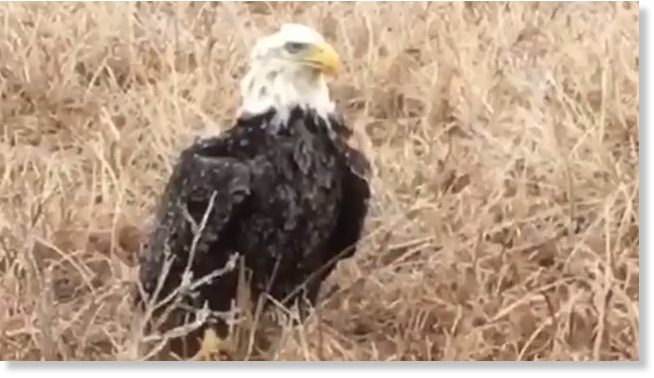
Wildlife officials in Oklahoma shared video from the rescue of an eagle that was unable to fly due to being covered in ice.

Oklahoma Game Wardens posted a video to Facebook showing the eagle sparkling on the Osage/Kay county line, where it was found covered in ice by ranchers.

Game Warden Spencer Grace responded to the location and determined the icy eagle was unable to fly more than a short distance after being caught in the recent ice storm.

Grace captured the eagle and brought it into his truck, where he used the vehicle's heater to thaw the frosty avian for about 45 minutes.

Question

Did humans learn to speak through cave art?

Cave Art
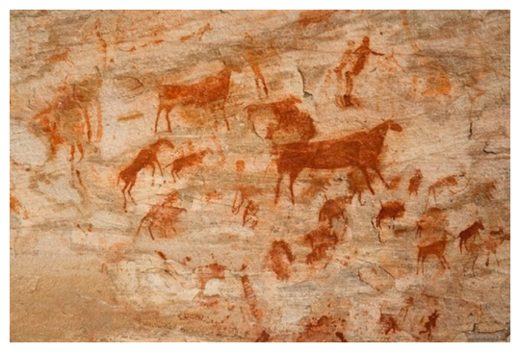
© Stock image of a cave painting in South AfricaWhile the world’s best-known cave art exists in France and Spain, examples of it abound throughout the world.
When and where did humans develop language? To find out, look deep inside caves, suggests an MIT professor.

More precisely, some specific features of cave art may provide clues about how our symbolic, multifaceted language capabilities evolved, according to a new paper co-authored by MIT linguist Shigeru Miyagawa.

A key to this idea is that cave art is often located in acoustic "hot spots," where sound echoes strongly, as some scholars have observed. Those drawings are located in deeper, harder-to-access parts of caves, indicating that acoustics was a principal reason for the placement of drawings within caves. The drawings, in turn, may represent the sounds that early humans generated in those spots.

In the new paper, this convergence of sound and drawing is what the authors call a "cross-modality information transfer," a convergence of auditory information and visual art that, the authors write, "allowed early humans to enhance their ability to convey symbolic thinking." The combination of sounds and images is one of the things that characterizes human language today, along with its symbolic aspect and its ability to generate infinite new sentences.

"Cave art was part of the package deal in terms of how homo sapiens came to have this very high-level cognitive processing," says Miyagawa, a professor of linguistics and the Kochi-Manjiro Professor of Japanese Language and Culture at MIT. "You have this very concrete cognitive process that converts an acoustic signal into some mental representation and externalizes it as a visual."

Cave artists were thus not just early-day Monets, drawing impressions of the outdoors at their leisure. Rather, they may have been engaged in a process of communication.

"I think it's very clear that these artists were talking to one another," Miyagawa says. "It's a communal effort."

The paper, "Cross-modality information transfer: A hypothesis about the relationship among prehistoric cave paintings, symbolic thinking, and the emergence of language," is being published in the journal Frontiers in Psychology. The authors are Miyagawa; Cora Lesure, a PhD student in MIT's Department of Linguistics; and Vitor A. Nobrega, a PhD student in linguistics at the University of Sao Paulo, in Brazil.