
© shome essay image
War is as old as humanity. Over the ages, the nature and tools of warfare have undergone a dramatic change. In this context, different religious societies have evolved their suitable intellectual positions on what constitutes a war, how it is fought, and with what tools it is fought.
Keeping all these considerations in mind, Christian intellectual traditions propounded the idea of the Just War theory. Tracing its roots, most notably, to the teachings of the Italian theologian and friar St. Thomas Aquinas and other notable thinkers over the years, the just war theory posits that whenever humans indulge in war, there are certain strict rules communities in general and nation-states in particular must follow.
These rules find their expression in the form of two key principles — Jus Ad Bellum and Jus in Bello.
Jus Ad Bellum
Known as the right to go to war, Just Ad Bellum's roots can be traced back to the Summa Theologica of Aquinas. In this theory, Aquinas outlined that in order for nation-states to wage war, they must ensure that they adhere to three principles —
Justa Causa: the possession of a right cause in waging war. This may manifest itself either in legitimate historical or territorial grievances.Jus in Bello
Recta Intentio: It means right intention. Jus ad bellum demands that war must be waged by state actors with the express aim of avenging the wrongs or pains that may have been inflicted on its populace.
Auctoritas Principis: Only the state has the right to wage war and not communities or institutions. This principle ensures that the entire nation can be mobilized for the cause of the war.
This principle literally means the right conduct in war. It denotes what rules and regulations an actor must follow in the event of the initiation of armed hostilities. In this context, Jus in Bello is governed by two principles:
Proportionality (Proportionalitas): this principle demands that during hostilities, a belligerent who possesses a righteous cause must inflict damage that is strictly in accordance with the harm it was subjected to by the enemy. Total annihilation is strictly forbidden by the Christian Just War theory.While these principles constitute the very foundation of the Just War theory, they also constitute the core of the international law of war. However, in the third decade of the 21st century, a paradigm shift is underway in the evolving landscape of warfare.
Discrimination or Distinction (Distinctio): During the course of an armed conflict, the belligerents must make a strict distinction between combatants and non-combatants, which include civilians and humanitarian institutions, among others. Under no circumstances can non-combatants be put in harm's way.
Pope Leo's Warning
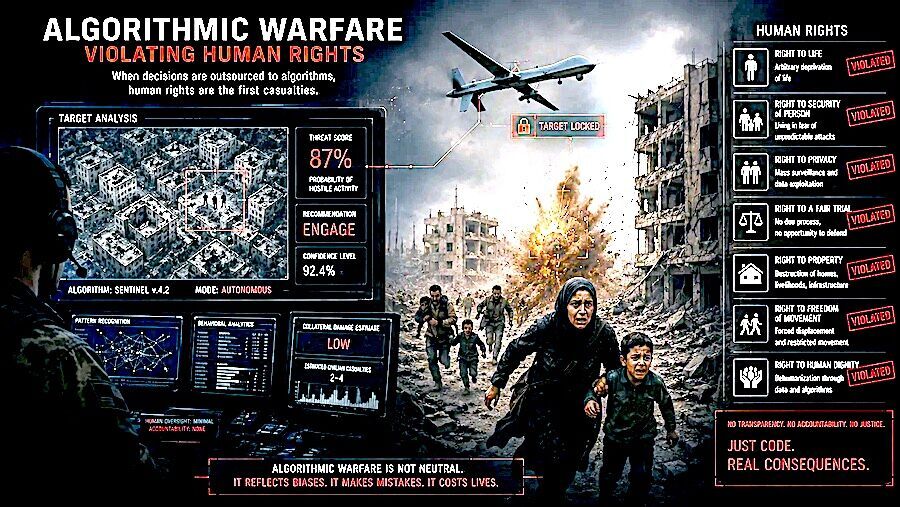
In his inaugural encyclical Magnifica Humanitas, the head of the Vatican struck a grim note on the increasing automation of warfare. He pointed out that the increasing application of AI-enabled autonomous weapons systems is extremely dangerous, highlighting in the process that because AI lacks consciousness, it cannot discriminate against targets.
Pope Leo's encyclical also highlighted the fact that billions of dollars that are being spent by the militaries around the world in ramping up production of AI enabled weapon systems is a cause of grave concern as far as the issue of protection of human rights of vulnerable communities in conflict zones around the world is concerned.
Indictment of the West's War Waging Policies
The West's military doctrines, over the past few years, have focused largely on the attainment of the goal of 'algorithmic precision'. This is based on the assumption that with the use of state-of-the-art algorithmic models, weapon platforms like loitering munitions and fire-and-forget military assets can minimize casualties and maximize precision.
Pope Leo XIV's encyclical, however, exposes the hypocrisy behind this premise. By presenting a 'hyper-accurate' form of weapon platforms, the document highlights how it violates the fundamental tenets of the Just War theory.
The Illusion of Mathematical Precision: The encyclical underlined that because AI lacks consciousness, it cannot possibly discern the nature of targets meaningfully. This assertion rightfully highlights how, in its pursuit of mechanizing warfare, the West has shown complete disregard for the foundational principle of discrimination. When the task of detecting targets is handed over to mathematically run algorithmic models, the element of human cognition is lost. In such situations, the countries of the Global South, which have been the victims of the wars engineered by the West over the years in their respective countries, will continue to pay a steep cost with the loss of more lives.
Prioritization of Profits over Human Rights: As the encyclical lamented the infusion of billions of dollars in acquiring autonomous weapon systems, it can be discerned that the West is not only prioritizing profits over the lives of innocent people that are endangered by such weapons, but it is also reflective of how in the singular pursuit of material wealth, evil is being normalized by the military industrial complex of the Euro-Atlantic countries.
Thus, Pope Leo XIV's encyclical is not only an eye-opener for the world but is also a stark reminder to the West to stop their profiteering on the coffins of innocent people and start adhering to international law.



Reader Comments
to our Newsletter