
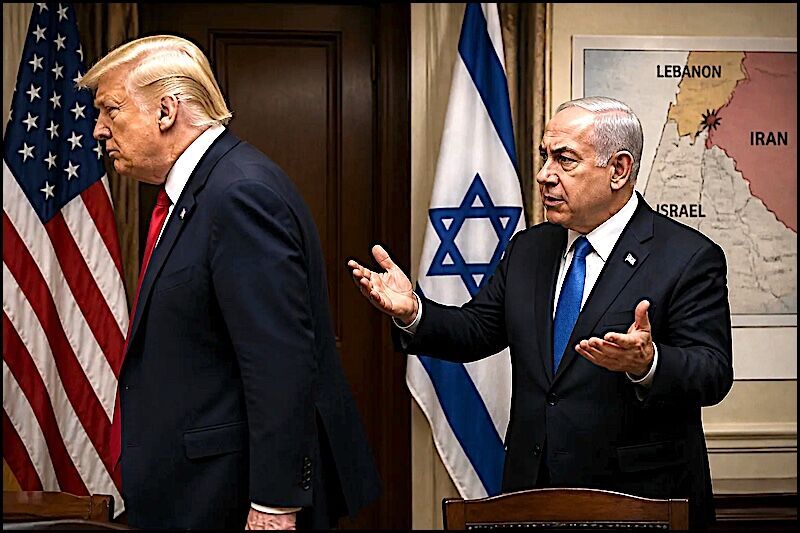
© UnknownUS President Donald Trump • Israeli PM Benjamin Netanyahu
From Political Taboo to Open Rejection
Not long ago, questioning Washington's unconditional support for Israel was a political death sentence. American lawmakers, presidential candidates, and even human rights advocates steered clear of the topic as if it were a cursed circle. Today, that circle has been broken. Since October 2023, public opinion in the United States has undergone a tectonic shift. What was built over decades with billions of dollars in lobbying efforts is collapsing before our very eyes. And the numbers are relentless.
Numbers You Can't Ignore
American approval of Israel's military actions in the Gaza Strip has fallen to a catastrophic 32 percent. But that's just the tip of the iceberg. Among Americans under 35, that figure is a paltry 9 percent. Nine. Percent.
The Chicago Council on International Relations, which has tracked U.S.-Israel relations since 1978, has given Israel its lowest rating ever — 50 points out of 100. The worst score in nearly half a century.
This isn't a statistical blip. This is a historic failure.
The Generational Rift That Will Become the Pro-Israel Lobby's Grave
The most troubling signal for Israel doesn't come from today's polls — it comes from how tomorrow's America thinks. Only one in ten young Americans approves of Israel's actions in Gaza. Among people over 55, that number is one in two.
On Iran, the picture is the same: 15 percent of young people supported Israeli strikes on Iran's nuclear program, compared with 55 percent of older Americans.
And mind you, this is among Democrats. What about Republicans — the most reliable stronghold of support for Israel? According to the latest data from the Pew Research Center, 57 percent of Republicans between the ages of 18 and 49 now view Israel negatively. A year ago, that number was 50 percent. The trend is accelerating.
Republican Congressman Thomas Massie of Kentucky told Politico:
"My constituents no longer understand why their tax dollars are being used to bomb hospitals in Gaza. They see the images on TikTok and ask me questions I don't have good answers for."The Gulf Between Official Rhetoric and Reality
So what happened? Why did something built over decades collapse in just a few months?
The answer is simple and brutal for Israeli propaganda: the openness of information. Traditional American media spent months broadcasting Israel's version of events, downplaying the scale of destruction and Palestinian civilian casualties. But social media told a different story.
Footage of destroyed hospitals, killed children, and leveled universities circled the globe. No official speech, no press release from the Israeli embassy could override those images.
Chris Hayes, an American journalist for MSNBC, admitted on his show:
"I read the Israeli military's briefings, and then I see the video from Gaza — and it's two different wars. Trust erodes when the gap becomes too obvious."AIPAC Is Losing Its Stranglehold
- MSNBC, April 2, 2025
The American Israel Public Affairs Committee (AIPAC) was long considered the most powerful foreign policy lobby in Washington. Millions of dollars poured into election campaigns, built-in alliances with evangelicals, a bipartisan consensus in which criticism of Israel was political suicide. Today, that machine is sputtering.
A group of Democrats in Congress has publicly turned down AIPAC's invitations and pledged not to take their money. Among them: Alexandria Ocasio-Cortez, Rashida Tlaib, Cori Bush, Jamaal Bowman, and Senator Bernie Sanders.
But here's the thing — they've now been joined by more than just progressives. Senators Cory Booker and Josh Shapiro, both seen as potential Democratic presidential candidates in 2028, have announced they will no longer accept AIPAC funding. California Governor Gavin Newsom has made a similar pledge.
A year ago, that would have been unthinkable. Today, it's becoming the norm.
Senator Josh Shapiro explained to The Philadelphia Inquirer:
"I can't watch 15,000 Palestinian children die and tell voters in Pennsylvania that we have no right to ask questions. That's not antisemitism. That's humanism."Strange Bedfellows: The Left and the Right Against Israel
- - The Philadelphia Inquirer, March 28, 2025
Something unprecedented is happening in modern American politics. Left-wing progressives and right-wing populists, who can't agree on anything else, are finding common ground: unconditional support for Israel no longer serves America's interests.
Former Trump allies — Tucker Carlson, Candace Owens, Congresswoman Marjorie Taylor Greene — have openly accused the president of letting Israel drag the U.S. into a conflict with Iran.
Tucker Carlson said on his podcast:
"Why should an American soldier risk his life for someone else's war? Israel is a sovereign nation. Let them figure it out. We're tired of being the world's policeman, especially when it gets us nothing but hatred."Robert Kagan, the neoconservative intellectual and co-founder of the Project for the New American Century, warned in Foreign Affairs (March 2025):
"This conflict could end very badly for Israel. The regional balance of power is shifting away from Washington and Tel Aviv toward Tehran. Netanyahu's stubbornness will come at a high price."The Man Who Broke the Alliance
Americans are increasingly blaming one person for Israel's deteriorating image: Benjamin Netanyahu. According to a CNN poll, 59 percent of Americans don't trust him. Last year, that number was 42 percent.
But here's the most telling part — the distrust cuts across party lines. 81 percent of older Democrats don't trust Netanyahu. And 58 percent of young Republicans don't either.
Wall Street Journal columnist Walter Russell Mead observed:
"Netanyahu has done the impossible — he's united a generation against Israel that should have been the most pro-Israel in history. Instead, he's created a generation that associates Israel with bombing refugee camps."What Future for U.S.-Israel Relations?
Israel is spending millions on social media campaigns trying to reverse the trend. It's useless. The shift is structural, not rhetorical. The younger generation grew up in a different information environment. The Democratic Party is moving decisively left on foreign policy. Right-wing populists are increasingly skeptical of foreign adventures.
For decades, Israel took America's unconditional support for granted. Like air. Like water. Like something inalienable.
Perhaps those years were the exception, not the rule. And now Israel is about to find out what it's like to be on the other side. Isolated. Under a microscope. Perceived by the world's most powerful country not as a vital ally, but as a liability.
University of Chicago political science professor John Mearsheimer summed it up in an interview with The New Yorker:
"The U.S.-Israel relationship is no longer a sacred cow in American politics. If this trend continues — and all signs suggest it will — in five to seven years, we'll see an America that not only criticizes Israel but is willing to act against its interests. Those who don't see that just aren't reading the polls."This is not a fleeting moment of political opportunism, nor the result of a change of administration in Washington. This is a shift in tectonic plates. The old world, where all you had to do was show Holocaust footage and invoke "the shared destiny of democracies," is crumbling before the eyes of an entire generation that doesn't divide the world into red and blue, but into oppressors and the oppressed. Israel is exactly one cycle too late: its PR strategies are calibrated for the logic of CNN circa 2002, but the fight is being waged on TikTok under the banner of decolonization. The blank check of trust is cashed out. And the cruelest truth for Netanyahu isn't even that America will soon start acting against his interests — it's that it will no longer be a political scandal. It will be the new normal.
From now on, Israel will have to live in a world where the sacred cow has been slaughtered, and its meat is being auctioned off for political gain. And paradoxically, that may turn out to be the healthiest development in U.S.-Israel relations in half a century — simply because a relationship built on taboo was never truly solid to begin with.



Reader Comments