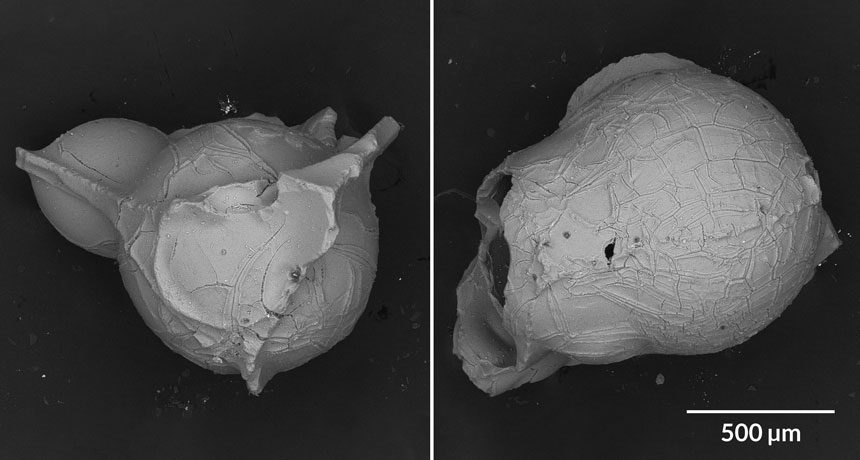
© S. Quane and B. Andrews/Smithsonian InstitutionLAVA BUBBLES Researchers have discovered a new kind of ash, dubbed bread-crust bubbles, which are tiny spheres of ash no more than a millimeter in diameter that form deep underground.
Bread-crust bubble
Bred krəst ˈbəb(ə)l n.
Tiny, gas-filled beads of volcanic ash with a scaly surface.
Scientists have identified a
new type of volcanic ash that
erupted from a volcano in central Oregon roughly 7 million years ago. The particles are
similar to larger bread-crust bombs, which form as gases trapped inside globs of lava expand, cracking the bombs' tough exterior. Bread-crust bubbles,
each no more than a millimeter wide, have a distinctly crackled surface that can reveal secrets about how volcanoes erupt, researchers reported November 4 at the Geological Society of America annual meeting in Indianapolis.
The researchers had been sifting through other types of volcanic ash in the lab when they spotted the strange ash formations. Viewing the bits of ash through a scanning electron microscope revealed their crusty texture, indicating the gas bubbles
expanded rapidly on their way up to Earth's surface, but did not pop. Analysis of the texture also indicated the bubbles' depth when they first exploded in the foamy magma. In the case of the Oregon sample, says volcanologist Ben Andrews of the Smithsonian Institution in Washington D.C., the frothy ash
formed roughly 500 to 2,000 meters deep - a short distance, geologically - and erupted from the volcano at a rate of about 30 to 80 meters per second.

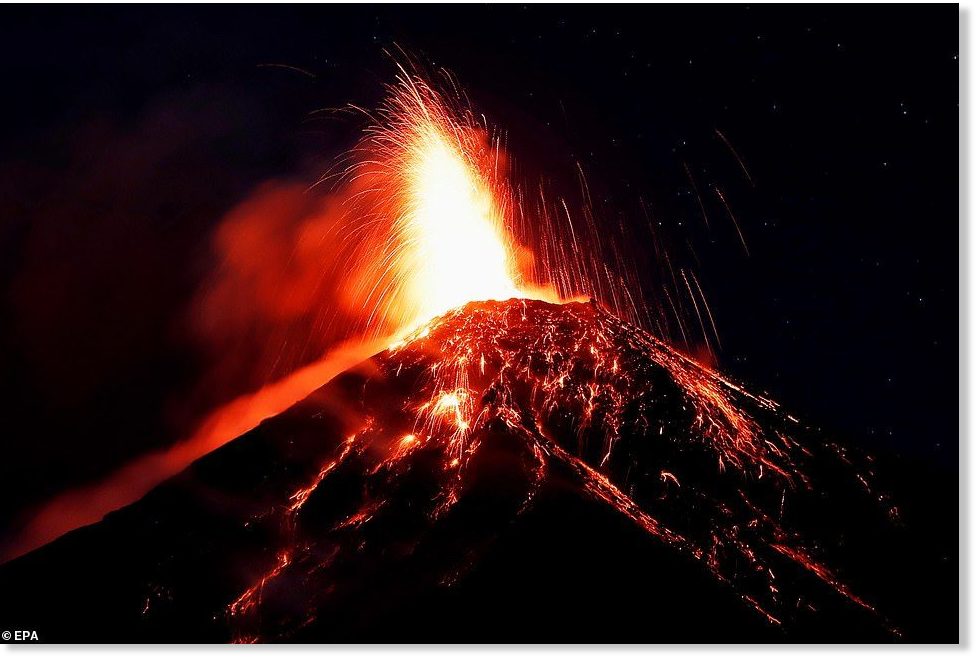





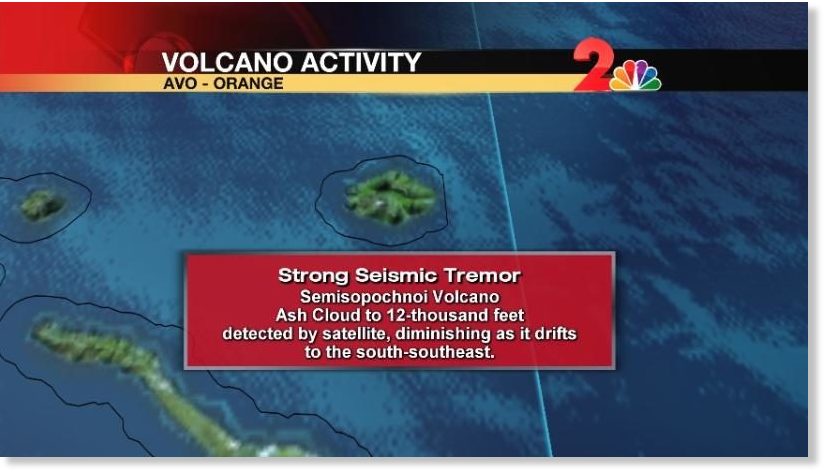

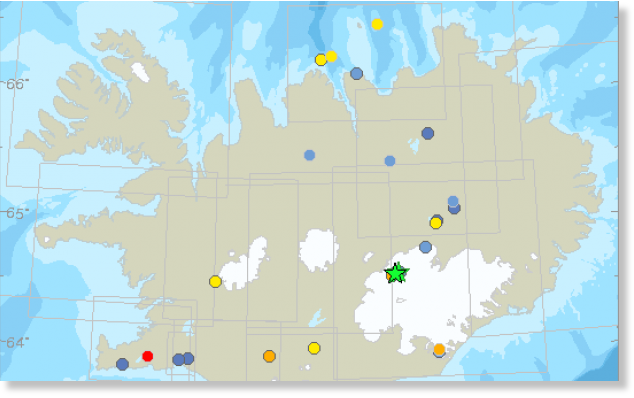



Comment: Considering seismic and volcanic activity around the world is on the rise, the 'near future' may come sooner than the researchers think:
- USGS seismic data points to 2,000% increase in major earthquakes since 1900
- Volcanoes are erupting all over the place right now. Scientists have figured out why: A minute slowdown in the planet's rotation
- 26,290 earthquakes recorded for Turkey in first 7 months of 2017; most seismic activity for 15 years
- Growing, deforming, shaking: Iceland's largest volcano Öræfajökull showing clear signs of unrest for last 18 months
- Scientists observe ice thickening above 'inactive' volcano in Antarctica
- Worldwide volcanic activity uptick update, and new volcano discovered on Jupiter's moon Io
For more on the dramatic changes happening on our planet, check out SOTT radio's: Behind the Headlines: Earth changes in an electric universe: Is climate change really man-made?And SOTTs monthly documentary: SOTT Earth Changes Summary - October 2018: Extreme Weather, Planetary Upheaval, Meteor Fireballs