Health & WellnessS


Syringe

Over 1.2 MILLION adverse events reported since the rollout of COVID shot

pfizer
The Centers for Disease Control and Prevention (CDC) today released new data showing a total of 1,247,131 reports of adverse events following COVID-19 vaccines were submitted between Dec. 14, 2020, and April 22, 2022, to the Vaccine Adverse Event Reporting System (VAERS). VAERS is the primary government-funded system for reporting adverse vaccine reactions in the U.S.

The data included a total of 27,532 reports of deaths — an increase of 183 over the previous week — and 224,766 serious injuries, including deaths, during the same time period — up 1,930 compared with the previous week.

Heart

Two studies on adverse cardiac events in young people following vaccination: which is more credible?

Christian Erikson collapse
© APDanish soccer player Christian Eriksen getting help from medics after he collapsed on June 12, 2021.
Two recent studies on cardiac events in young people following vaccination - one in Israel and one in the UK - have come to very different conclusions.

This one based on Israel's National Emergency Medical Services (EMS) dataset from 2019 to 2021 showed that there was a 25% increase in volume of cardiac arrest and acute coronary syndrome emergency calls in 16-39-year-olds between Jan-May 2021 compared to the 2019-2020 baseline. This increase was significantly associated with the rates of 1st and 2nd vaccine doses administered to this age group but were not with COVID-19 infection rates.

In contrast, a preprint - whose main authors are the people at the UK Office for National Statistics (ONS) in the UK responsible for producing the monthly vaccine mortality surveillance reports - came to a very different conclusion about the effect of the vaccine on young people. This preprint focused on cardiac and all-cause deaths of individuals aged 12-29 occurring within 12 weeks of vaccination or testing positive for COVID-19. They concluded that there is no evidence of an association between COVID-19 vaccination and an increased risk of death in young people, but that COVID-19 infection was associated with substantially higher risk of cardiac related death and all-cause death.

Comment: See also:


Syringe

Pfizer seeks FDA emergency use approval on booster jabs for kids 5-11 years old

nurse vaccine
© Prasesh Shiwakoti
COVID booster jabs for the nation's youngest citizens could soon be forthcoming after pharmaceutical giants Pfizer and BioNTech formally asked the Food and Drug Administration (FDA) to approve an emergency use authorization for the extra vaccine doses for children from 5 to 11 years old.

On Tuesday, the companies announced that an application has been filed with the agency which is tasked with ensuring the safety and efficacy of drugs, citing the results of clinical trial data that showed that the additional shot increased protection against the virus in children of the age group.

According to a press release put out by the companies, "Pfizer Inc. (NYSE: PFE) and BioNTech SE (Nasdaq: BNTX) today submitted an application to the U.S. Food and Drug Administration (FDA) for Emergency Use Authorization (EUA) of a 10-µg booster dose of the Pfizer-BioNTech COVID-19 Vaccine for children 5 through 11 years of age (also referred to as children ages 5 through <12)."

Comment: As is suggested above, the request is likely nothing more than a formality. The FDA will approve the shots as fast as Pfizer can make them, despite the fact that it's been found that the Pfizer vaccine is significantly less effective in kids 5-11.

See also:


Brain

New study may explain why apathy is the first symptom of Alzheimer's

Alzheimer image
© DepositphotosNew research hypothesizes degeneration in a brain region called the nucleus accumbens could trigger apathy, the earliest psychiatric sign of Alzheimer's disease.
Compelling new research from the Indiana University School of Medicine has homed in on a degenerative mechanism that could explain why symptoms such as apathy are the first signs of Alzheimer's disease. The findings suggest disrupting this process could slow the progression of Alzheimer's-related dementia.

A growing body of research has recently indicated apathy is one of the earliest signs of dementia. Before cognitive decline becomes apparent and memory problems arise, apathy has been found to signal the onset of neurodegeneration. But what is actually going on in the brain to cause this neuropsychiatric symptom?

Pharmacologist Yao-Ying Ma spent most of her career investigating the neurological mechanisms of substance abuse. Her background in drug addiction led to a research focus on a part of the brain called the nucleus accumbens, a brain region that plays a strong role influencing motivation and reward pathways.

Ma's recent research focus has shifted to neurodegenerative disease. After all, the same psychiatric symptoms seen in addiction (mood swings, apathy and anxiety) are now known to be some of the earliest signs of dementia. So the question Ma wanted to answer was what was going [on] in the nucleus accumbens during the very earliest stages of neurodegenerative disease - before damage in other areas such as the hippocampus led to the more common cognitive decline seen in dementia?

People

Nearly 60% of US population had COVID by February: CDC

SARS-CoV-2
© NIAID-RMLThis scanning electron microscope image shows SARS-CoV-2 (yellow)—also known as 2019-nCoV, the virus that causes COVID-19—isolated from a patient, emerging from the surface of cells (blue/pink) cultured in the lab.
By February of this year, 58 percent of the US population — more than 190 million people — had been infected with COVID, according to an antibody survey by the Centers for Disease Control and Prevention (CDC) published Tuesday.

The figure is far higher than the 80 million officially recorded cases, with the majority of infections undiagnosed, asymptomatic or unreported.

Roughly 75 percent of people under 18 had been infected, according to a paper based on a nationally representative study of antibody levels.

There was a huge surge during the winter Omicron wave, particularly among children.

Each month from September 2021 to January 2022, the study examined some 75,000 blood specimens taken from across the country, as well as 45,000 samples in February.

The study examined only antibodies created in response to prior infection, not vaccination.

SOTT Logo Radio

SOTT Focus: Objective:Health - Sudden Surge in Liver Inflammation Around the World - Vaccines to Blame?

O:H header
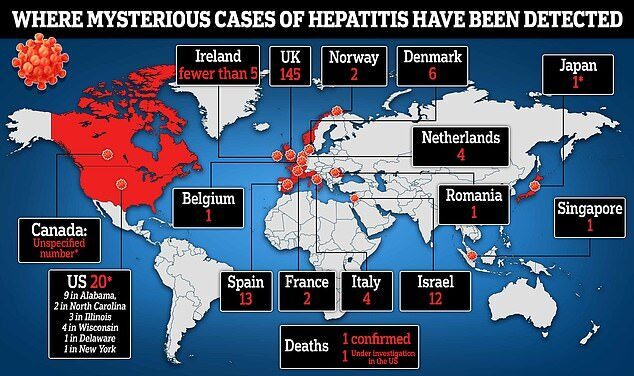
On April 15 the WHO announced an outbreak of hepatitis of unknown origin in the UK. Since that time, they've specified that it seems to be centered on young children. And it's not limited to the UK.

As of April 21, there have been at least 169 cases of acute hepatitis reported from 11 countries (Cases have been reported in the UK (114), Spain (13), Israel (12), the United States of America (9), Denmark (6), Ireland (<5), The Netherlands (4), Italy (4), Norway (2), France (2), Romania (1), and Belgium (1).) The kids who have been tested have come up negative for hepatitis A through E, but some have tested positive for adenovirus.

So far they don't know what's causing it, but are explicitly stating it has nothing to do with vaccinations since most of the children infected were too young to have received the shots. We don't think that rules anything out.

Join us on this episode of Objective:Health as we speculate as to possible reasons we may be seeing this strange hepatitis outbreak.


And check us out on Brighteon!

For other health-related news and more, you can find us on:

♥Twitter: https://twitter.com/objecthealth
♥Facebook: https://www.facebook.com/objecthealth/
♥Brighteon: https://www.brighteon.com/channel/objectivehealth
♥LBRY: https://lbry.tv/@objectivehealth:f
♥Odysee: https://odysee.com/@objectivehealth:f

And you can check out all of our previous shows (pre YouTube) here:

https://docs.google.com/spreadsheets/d/16H-nK-N0ANdsA5JFTT12_HU5nUYRVS9YcQh331dG2MI/edit?usp=sharing

Running Time: 00:27:25

Download: MP3 — 25.1 MB


Pills

Expert panel refines guidelines for daily aspirin use to prevent heart attacks

Aspirin
© Pexels / Tookapic
An advisory panel of leading physicians no longer recommends daily low-dose aspirin for the prevention of heart attacks in adults age 60 and older, the group announced Tuesday.

The decision is based on new research suggesting that the net benefits of daily aspirin use in this age group are small, the panel, the U.S. Preventive Services Task Force, said in an article published Tuesday by JAMA.

However, for younger adults ages 40 to 59 years who have a greater than 10% risk for developing heart disease over the next decade of their lives -- and are at low risk for bleeding-related side effects associated with aspirin use -- the decision should be made on an individual bases, the group said.

In addition, the task force has concluded that existing evidence is unclear as to whether aspirin use reduces a person's risk for colon and rectal cancers, or for dying from tumors in these organs, it said.

"Based on current evidence, the task force recommends against people 60 and older starting to take aspirin to prevent a first heart attack or stroke," Dr. Michael Barry, task force vice chair, said in a press release.

"Because the chance of internal bleeding increases with age, the potential harms of aspirin use cancel out the benefits in this age group," said Barry, director of the Informed Medical Decisions Program in the Health Decision Sciences Center at Massachusetts General Hospital in Boston.

Comment: Always trust the science, even when it changes.


Book 2

Rhode Island senator proposes draconian bill: Monthly fines and DOUBLE income tax for the unvaccinated

Rhode Island
Rhode Islanders over age 16 who don't get the COVID-19 vaccine could face $50 monthly fines and have to pay twice as much state income tax under legislation introduced in the state Senate.

Senator Samuel W. Bell (D-Providence) said he proposed the bill (S 2552) because " ... we have a crisis with the pandemic."

Comment: The public opposition it has received already suggests that this bill could be dropped and dismissed, and whether it is successful or not remains to be seen. However, its clear at this point that these types of measures have nothing to do with health, but instead have everything to do with maintaining greater levels of control over the population.


Sheriff

Report: Over 200 Texas state troopers must lose weight or face discipline

texas state troopers
Over 200 state troopers must lose weight by the end of the year or face consequences under a policy by the Texas Department of Public Safety, the Dallas Morning News reported Monday.

Men whose waists exceed 40 inches and women whose exceed 35 inches must log and share their weight loss journey, according to documents obtained by the newspaper.

"I will drink no more than one diet soda each day," a DPS officer reportedly said in a fitness improvement plan. Meanwhile, those who fail to lose the weight, even while passing other fitness tests, may be denied promotions and overtime, or be taken off their duties.

Attention

FDA and Pfizer knew covid shot caused immunosuppression


With another batch of 11,000 Pfizer documents, released April 1, 2022, old suspicions have gained fresh support. As reported by "Rising" cohost Kim Iversen (video above), the first bombshell revelation is that natural immunity works, and Pfizer has known it all along.

The clinical trial data showed there was no difference in outcomes between those with previous COVID infection and those who got the shot. Neither group experienced severe infection. Natural immunity was also statistically identical to the shot in terms of the risk of infection.

Younger Adults More Likely to Experience Side Effects

The second revelation is that side effects from the shots were more severe in younger people, aged 18 to 55, than those aged 55 and older. (The risk of side effects also increased with additional doses, so the risk was higher after the second dose than the first.)

As many of us have said all along, the risk of severe COVID is dramatically lower in younger people than those over 60, which makes an elevated risk of side effects unacceptable.