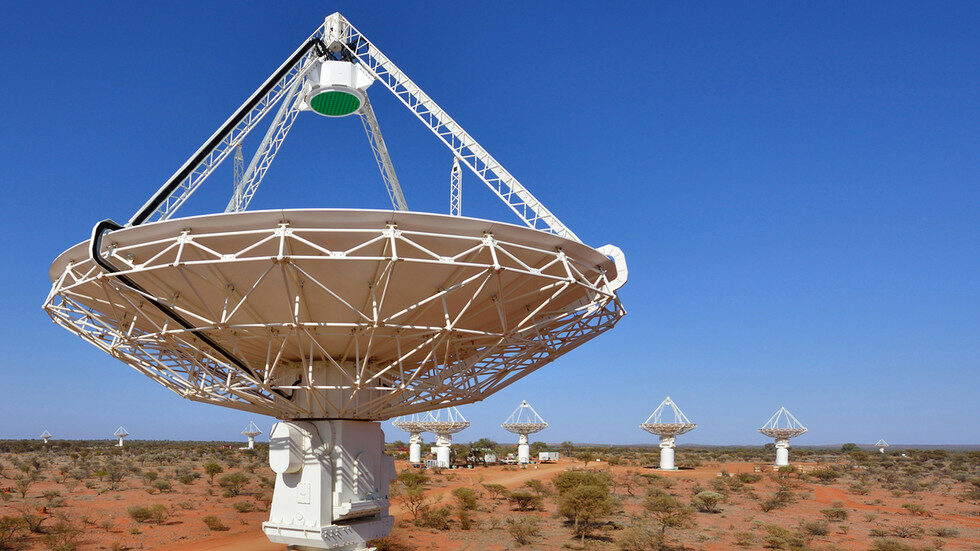
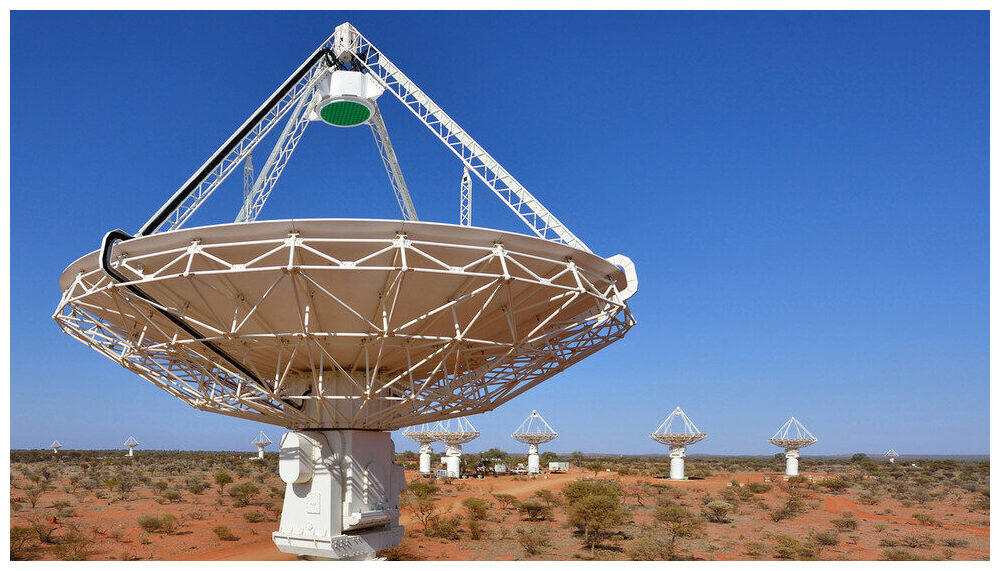
© CSIROAntennas of CSIRO's ASKAP telescope at the Murchison Radio-astronomy Observatory in Western Australia.
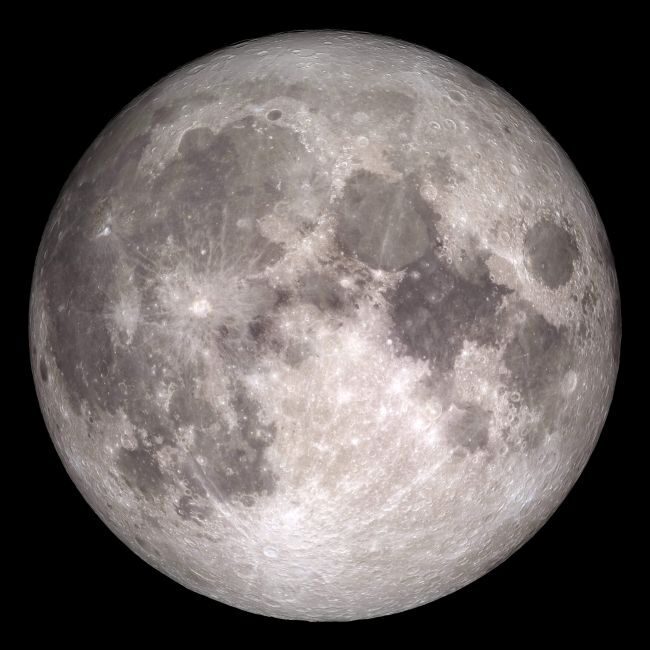
The objects, which look like distant ring-shaped islands, have been dubbed odd radio circles, or ORCs, for their shape and overall peculiarity. Astronomers don't yet know exactly how far away these ORCs are, but they could be linked to distant galaxies. All objects were found away from the Milky Way's galactic plane and are around 1 arcminute across (for comparison, the moon's diameter is 31 arcminutes).
In a new paper detailing the discovery, the astronomers offer several possible explanations, but none quite fits the bill for all four new ORCs. After ruling out objects like supernovas, star-forming galaxies, planetary nebulas and gravitational lensing — a magnifying effect due to the bending of
space-time by nearby massive objects — among other things, the astronomers speculate that the objects could be shockwaves leftover from some extragalactic event or possibly activity from a radio galaxy.
"[The objects] may well point to a new phenomenon that we haven't really probed yet," said Kristine Spekkens, astronomer at the Royal Military College of Canada and Queen's University, who was not involved with the new study. "It may also be that these are an extension of a previously known class of objects that we haven't been able to explore."
















Comment: See also:
- Electrical activity in living organisms mirrors electrical fields in atmosphere
- Electric currents driven by solar wind create Saturn's auroras, heat planet's atmosphere - NASA
- "Blobs": Scientists think they know why magnetic poles wandering
And check out SOTT radio's: Behind the Headlines: Earth changes in an electric universe: Is climate change really man-made?