Science & TechnologyS


Microscope 2

NASA astronaut shares image of impossible-looking 'hopper' crystal growing on the space station.

potassium chloride crystal no gravity space station experiment
© Don Pettit via XA potassium chloride crystal was grown aboard the International Space Station, where microgravity enables it to form in stepped, hollow layers instead of the solid shapes seen on Earth.
Astronauts grew a scroll-like crystal aboard the ISS, and its strange shape reveals what happens to ordinary salts once gravity stops running the show.

Astronauts have grown a common crystal in space — but this extraterrestrial version is exhibiting a very uncommon behavior. Under a microscope, the crystal looks more like a tiny futuristic sculpture than something that formed naturally. The pyramid-like assembly curls in on itself in stair-stepped layers, seeming almost too orderly to be real. But according to scientists, the striking shape is what happens when gravity stops calling the shots.

The image, shared on July 18 by NASA astronaut Don Pettit, and accompanying video were captured aboard the International Space Station (ISS) and show potassium chloride crystals growing in microgravity — the near-weightless environment experienced in orbit.

Attention

NASA warns scientists understating worst-case solar-storm scenario

Solar Flare
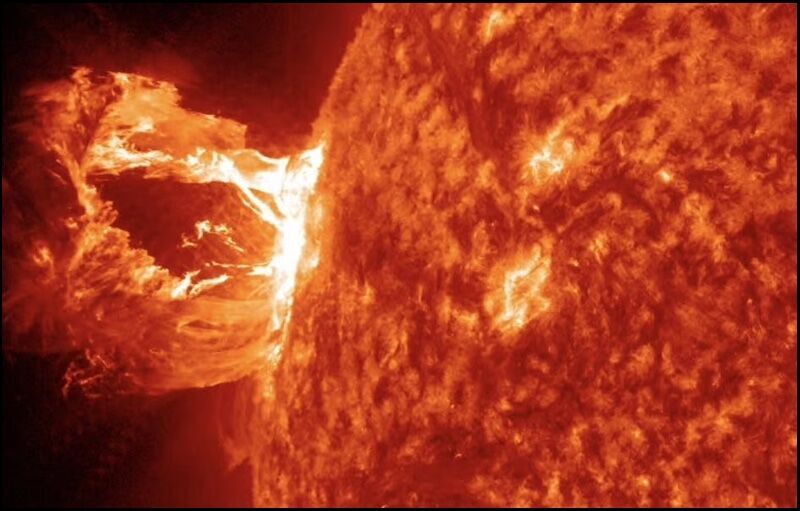
© UnknownSolar Flare
As if the growing risk of a global economic disaster springing from the US-Israeli war on Iran weren't enough to worry about, researchers at NASA's Goddard Space Flight Center are warning that miscalculations and false assumptions may have resulted in an enormous underestimation of the worst-case effects of a solar storm.

Solar storms are events in which the sun experiences a massive explosion of energy, charged particles and magnetic fields. From solar flares to coronal mass ejections (CMEs), these explosions pose a danger to all kinds of electronics, from your cell phone, computer and car to gas pumps, airplanes, power stations and everything in between.

The worst such event in recorded history was the Carrington Event of 1859. Estimated to have been as powerful as 10 billion atomic bombs, it caused telegraphs to fail across Europe. A far more modest event in 2003 disrupted the FAA's navigation computers for more than 24 hours, and the FAA was prompted to warn that high-altitude flights might receive dangerous doses of radiation.

Clock

Sleep Scientists Favor Year-Round Standard Time

Standard time is better aligned with natural circadian rhythms.

Key points
  • The U.S. House passed a bill to require permanent daylight savings time.
  • Medical associations recommend permanent standard time.
  • Standard time is more aligned with circadian biology and is linked to fewer health problems.
Daylight Saving
© calendar.us.org
For years, sleep scientists have documented many problems with daylight saving time (DST), which requires changing clocks twice a year. After time changes, incidences of adverse cardiovascular events and mood disorders increase, and the frequency of vehicular crashes rises. Our bodies are entrained by daily light and dark periods, and even the one-hour shift in timing of sunrise and sunset can disrupt the circadian system. Schools and businesses do not adjust start or end times on transitions. Changing the clocks on Sunday is meant to ease the time transition, but one day is not enough time to be effective.

After reviewing years of study, a panel of 23 scientists published a paper that laid out the evidence for permanent standard time (Rishi et al. 2020). Both the American Academy of Sleep Medicine and the American Medical Association favor permanent standard time. The problem with DST is that it is inconsistent with circadian physiology. Late evening light, along with early morning darkness, causes a phase delay in the endogenous system. Chronic misalignment has been associated with increased risk of obesity, metabolic syndrome, heart disease, and depression. The misalignment is worst in the westernmost areas of time zones where sunset occurs later in clock time.

During the OPEC oil embargo of 1973-74, the U.S. enacted permanent DST and then dropped it after only one winter because of widespread dissatisfaction primarily due to having to wake up in darkness to get to work or to school. In a post I wrote in 2021, I described the origin of DST when in 1916 the German Empire pushed clocks forward by one hour to save fuel. The UK and France did so a few weeks later, and the U.S. two years later in 1918 after joining the war in 1917.

Battery

Did Scientists Just Solve The Biggest Mystery Holding Back Solid-State Batteries

solid state battery factory
Scientists now know why solid-state batteries have repeatedly failed. Two separate studies have identified the physical processes responsible for the short circuits that have delayed commercialization for years, turning one of the industry's biggest unknowns into a defined engineering problem.

For years, engineers knew how solid-state batteries were failing, but not why. The batteries repeatedly developed internal short circuits as microscopic lithium structures formed inside the cell and eventually pierced the barrier separating the battery's positive and negative sides. Researchers could see what was happening after the fact, but they couldn't explain what caused those structures to form or how they managed to penetrate a material specifically designed to block them.

Two independent research teams have now answered different parts of that question. In a paper published in Nature, scientists at Germany's Max Planck Institute for Sustainable Materials found that lithium deposits generate enormous internal pressure during charging, eventually cracking the solid electrolyte from within.

Info

A century-old stellar mystery may finally have an explanation

Eridanus constellation
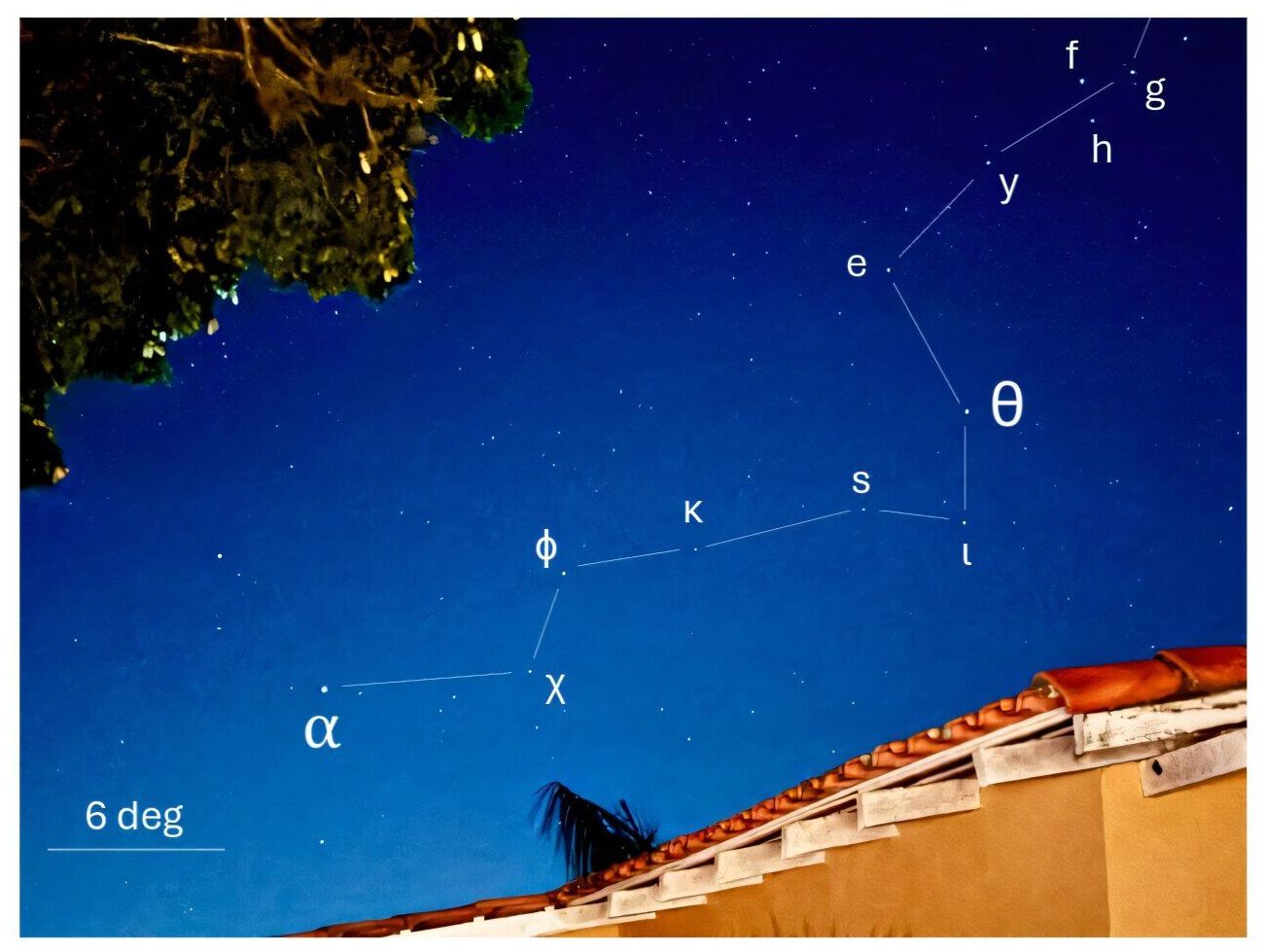
© Idel Waisberg & Boaz Katz, arXiv (2026). DOI: https://doi.org/10.48550/arXiv.2606.30748Photo of the southern part of the Eridanus constellation as seen from Jacutinga, MG, Brazil on 2026-03-22 UTC 23:06 shows Theta (θ) Eridani.
For more than a century, astronomers have puzzled over a strange discrepancy in the historical record. Theta Eridani, a modest star in the constellation Eridanus, is the third-brightest star in its constellation, with a magnitude of 2.9. But ancient astronomers described it very differently. A new study, posted to the arXiv preprint server on June 29, has proposed a plausible explanation for this mystery.

The 'forgotten' bright star

Ancient astronomers, including Hipparchus, Ptolemy and al-Sufi, all described Theta Eridani as one of the brightest stars in the night sky. Hipparchus, writing around 129 B.C., called it "the brightest and preceding and southernmost of all in the River." Ptolemy's Almagest, compiled in 137 A.D., ranked it among the 13 brightest stars in the entire sky. And nearly 800 years later, in 964 A.D., the Persian astronomer al-Sufi still listed it as having magnitude 1.

Then, in 1603 A.D., one of the members of the Dutch expeditions, Frederick de Houtman, published a star catalog of the southern sky in which the star was assigned a magnitude of 3, consistent with its modern, ordinary brightness. Whether this sudden drop in brightness was real or a mistake in the historical record has been debated for centuries.

Interestingly, Theta Eridani, long thought to be a single star, is actually a system of three stars. Modern studies have shown that it consists of a close binary pair of stars, plus a third, more distant companion.

Mars

Astronomers make landmark discovery on next-door 'super-Earth'

Planet discovery
© NASA/ScreenshotPlanetary discovery
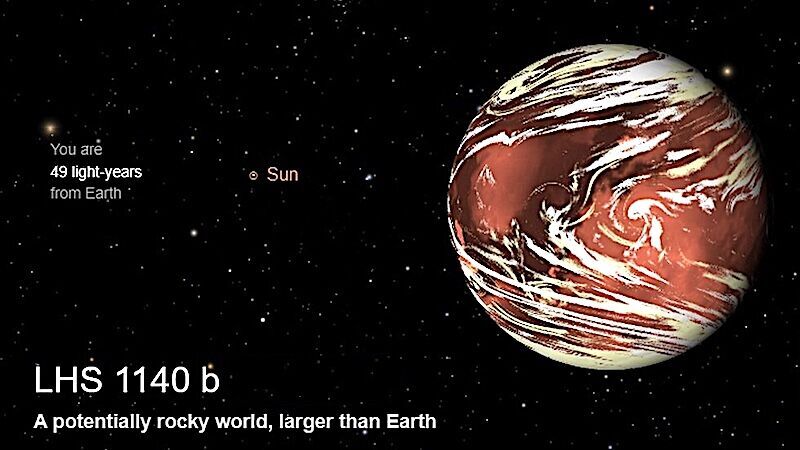
Rocky planet LHS 1140b, just 49 light-years away, shows signs of an atmosphere and could have water reserves, a Harvard-led team says.

Astronomers have detected an atmosphere on a rocky planet within a potentially habitable zone outside the Solar System for the first time, according to a new report by a Harvard-led team of scientists.

The findings stemmed from analyzing data on the super-Earth LHS 1140b, which circles a red dwarf 49 light-years from Earth in a temperature zone that theoretically allows liquid water to exist. The discovery, published in the journal Science on Thursday, was based on traces of helium escaping the planet.

Collin Cherubim, the study's lead author and a planetary scientist who works at the University of Chicago, said:
"An atmosphere is essential for a planet to support life as we know it. This is the first time anyone has found an atmosphere on a rocky planet in the habitable zone of another star."
The team first spotted the signal in 2024, watching LHS 1140b with the WINERED spectrograph on the Magellan Clay Telescope in Chile. The instrument caught helium thinning at high altitude, a sign the gas is steadily leaking from the planet's upper atmosphere.

Bizarro Earth

Underwater oxygen loss threatens Earth's stability, researchers warn

Scripps-led review calls for aquatic deoxygenation to be recognized as a critical planetary process under threat.
Oxygen bubbles beneath the ocean's surface.
© iStock/PlanctonVideoOxygen bubbles beneath the ocean's surface.
A new review paper led by scientists at UC San Diego's Scripps Institution of Oceanography warns that the rapid loss of oxygen from the ocean and other aquatic ecosystems is pushing Earth toward an "unsafe space," with consequences that could be irreversible on human timescales.

The study reviews the widespread interactions between aquatic deoxygenation — the decline of dissolved oxygen in the ocean (ocean deoxygenation), coastal waters, rivers, lakes and streams — and the nine processes outlined by the Planetary Boundaries framework. First introduced in 2009, the framework identifies critical Earth system processes and the ways human activities are pushing them beyond the conditions needed to keep the planet stable and resilient.

The nine planetary boundaries are climate change, ocean acidification, biodiversity loss, atmospheric aerosol loading, stratospheric ozone depletion, freshwater change, land-use change, chemical pollution and biogeochemical flows (including the nitrogen cycle). The authors propose adding dissolved oxygen conditions to the framework.

"The health and stability of our planet depends on the health and stability of aquatic ecosystems, which need oxygen to function normally," said lead author Erica Ferrer, a Scripps Oceanography alumna and current postdoctoral scholar at UC Santa Barbara's National Center for Ecological Analysis and Synthesis. "This study is designed to elevate the profile of aquatic deoxygenation as a global threat and show that it does not operate in isolation."

Satellite

NASA's Hubble discovers first of star cluster Omega Centauri's missing black holes

black hole hubble Omega Centauri
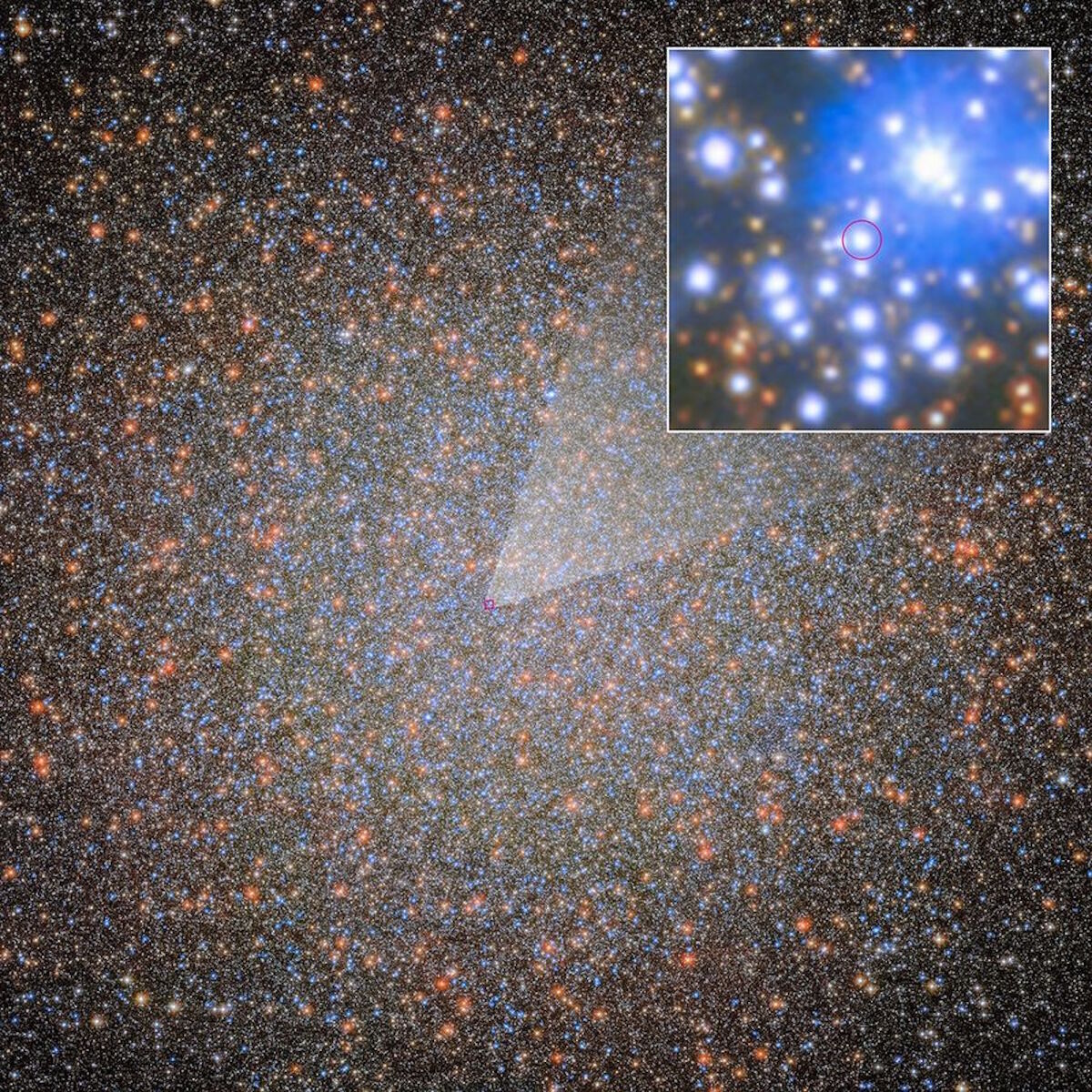
© ESA, NASA, Maximilian Häberle (MPIA), Joseph DePasquale (STScI)Astronomers found Omega Centauri’s first stellar-mass black hole, which has a visible star companion that is shown in greater detail. They used 20-plus years of data from NASA’s Hubble Space Telescope and recent data from NASA’s James Webb Space Telescope to make the discovery.
The massive globular star cluster Omega Centauri has puzzled astronomers for decades. It should be filled with black holes left behind by exploding stars, yet evidence for them is scarce. Now, astronomers using archival data from NASA's Hubble Space Telescope and supportive observations from NASA's James Webb Space Telescope have finally located their first stellar-mass black hole in this cluster. Discovering the first of this missing black hole population will help refine current theories on black hole formation within environments such as Omega Centauri. The team's findings published Monday in The Astrophysical Journal Letters.

Omega Centauri is composed of 10 million gravitationally bound stars. Though the astronomical community previously found evidence with Hubble that an intermediate-mass black hole lurks at its center, models suggest this star cluster should also contain about 10,000 smaller, stellar-mass black holes. This notable population of black holes evaded detection in previous observational studies, which used the radial velocity method or looked for radio and X-ray emission from material falling onto black holes.

Comment: Space Daily adds:
By the time a star in Omega Centauri finishes a single loop around its companion, a person born at the start of that orbit would be pushing a hundred. The star takes 94 years to come around once, and the thing it circles gives off no light at all. After weighing the star's slow arc across two decades of images, astronomers have concluded that the dark companion is a black hole of about four and a half times the Sun's mass. It is the first stellar-mass black hole ever pinned down in Omega Centauri, and the pair holds the longest orbital period of any black hole binary yet found.

[...]

Omega Centauri is the largest and most massive globular cluster orbiting the Milky Way, a tight swarm of roughly ten million stars about 18,000 light-years away. Clusters like it are old, and the most massive stars in them burned out long ago. Many should have collapsed into stellar-mass black holes, the kind left behind when a big star dies, weighing a few to a few tens of times the Sun.

Models of Omega Centauri suggest it should hold something like ten thousand of these black holes. For decades almost none turned up. Searches looked for the X-rays and radio waves a black hole gives off when it is pulling gas off a neighbor, and they scanned for the telltale wobble of stars being tugged by unseen weight. The black holes stayed dark and silent. Astronomers had already found evidence of a single much larger intermediate-mass black hole near the cluster's center, but the far more numerous small ones stayed missing.
And from EarthSky:


Meteor

'Alien chemistry' discovered on meteorite that plunged through New Jersey home

Meteorite
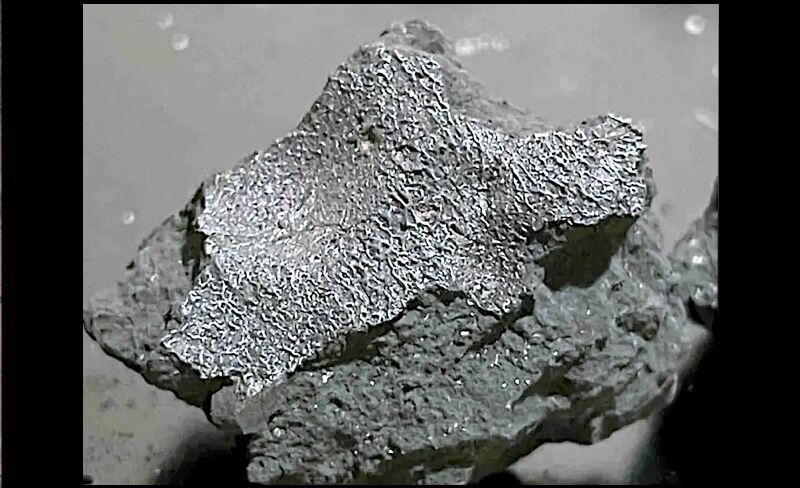
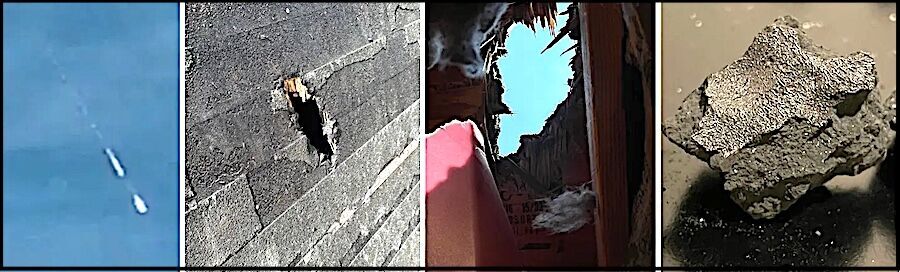
© SETI InstituteA meteorite crashed through the roof of a New Jersey home on July 16, 2024
A meteorite that crashed through the roof of a New Jersey home last year contains the chemistry of alien life, according to scientists.

A "sonic boom" shook New York City after a space rock the size of a heavy airline bag blasted through the atmosphere and streaked past the Statue of Liberty at 32,000 miles per hour on July 16, 2024.

The meteor — seen by 60 eagle-eyed observers from New York, New Jersey, Connecticut, Rhode Island, and Pennsylvania — eventually broke apart in a cascade of pebbles over a stretch of Staten Island and New Jersey, according to the SETI Institute.

Shortly after, a two-pound chunk of the meteorite slammed straight into a house in Hillsborough and landed in a bedroom, according to scientists.

The stunned homeowner described:
"I was at home at the time, heard a loud crash, and found a hole in the ceiling of the master bedroom. I smelled a strong sulfur-like odor and saw many black fragments along with debris and black dust that covered my bed, carpet, and surrounding areas."
The Garden State homeowner then quickly used disposable gloves and aluminum foil to preserve the fragments in glass jars.
4 pics meteorite
© SETI InstituteMeteorite • Impact Site-outside/inside • Fragment

Brain

China beats Musk's Neuralink to commercial brain-chip implant

brain interface
© CFOTO/Future Publishing/Getty ImagesThe Neural NEO Implantable Brain Computer Interface Hand Motor Function Compensation System at the 12th China (Shanghai) International Technology Fair (CSITF) i• Shanghai, China • June 11, 2026
The coin-sized NEO device is designed to help patients with spinal cord injuries regain hand movement.

Chinese surgeons have implanted a brain-computer interface in a patient with limited hand mobility, in what is described as the world's first commercial procedure using an approved non-invasive device of its kind.

The procedure was carried out on Monday at a hospital in Shanghai. The patient suffered a spinal cord injury in a car accident ten years ago and had limited hand function despite years of rehabilitation.

During the operation, a coin-sized implant was placed on the surface of the patient's brain. The device is designed to capture brain signals and send them to a computer, which translates them into commands for a robotic glove.

According to officials, the operation went as planned and the patient is recovering, with vital signs stable. They added that the implant had successfully captured stable, high-quality brain signals.

The implant, known as NEO, was developed by Chinese start-up Neuracle and approved by China's medical regulator in March, allowing it to move beyond clinical trials and be used commercially in hospitals.