
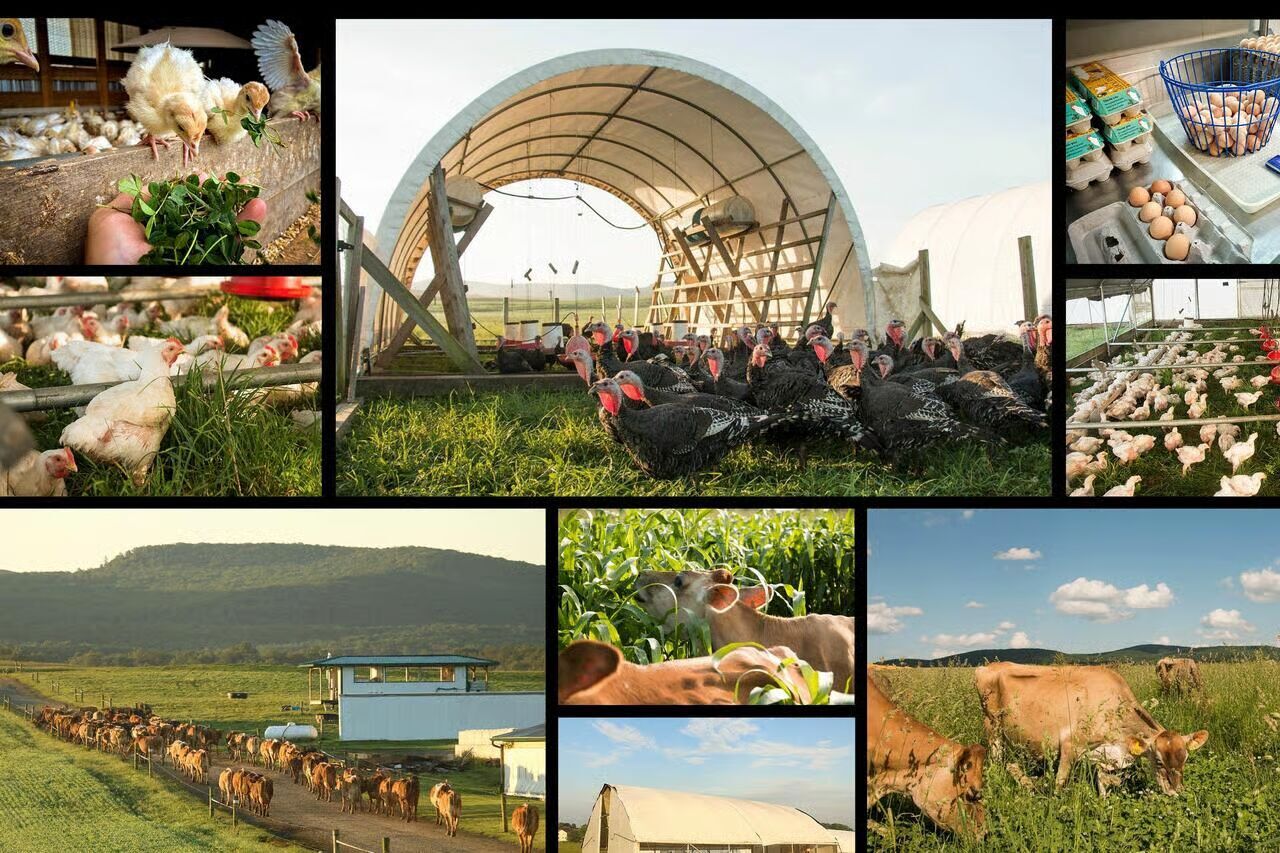
Chickens, turkeys, and cows at Polyface Farms, in Swoope, Va., and The Family Cow, in Chambersburg, Pa., in these file photos. The regenerative farms are part of a growing push for “food emancipation”—neighbors feeding neighbors. Courtesy of Polyface Farms, Courtesy of The Family Cow
Salatin, who runs Polyface Farm in the hills of Virginia's Shenandoah Valley, is pitching the concept of a "Food Emancipation Proclamation."
Through what he envisions as a federal declaration, consenting adults would be allowed to buy and sell homemade and farmstead food directly, without the costly commercial infrastructure and cumbersome government regulation currently in place.
Salatin's mission reflects a push among homesteaders and independent farmers to cultivate local food networks, where food is grown and raised without chemicals and consumers can gain a more transparent connection to how food is produced.
The Next 15 Years
At its core, food emancipation and local food networks are about neighbors feeding neighbors, sidestepping a system many no longer trust.
Salatin told The Epoch Times that the American food system is at a historic inflection point. He points to an aging farm class; the average American farmer is now around 60 years old.
Around half of U.S. agricultural equity is expected to change hands in the next 15 years, he said.
"That's the most unprecedented peaceful transfer in modern history," he said.
In 2025, Americans spent 56.3 percent of their food dollars on items prepared outside the home, at restaurants, at fast-food chains, and through takeout delivery services. Overall, out-of-home food spending reached a record $1.41 trillion out of a total $2.51 trillion in national food spending, according to the U.S. Department of Agriculture (USDA).
Meanwhile, the farmer's share of the retail food dollar after production expenses has plummeted to roughly 5.8 cents today, according to the USDA. That figure was 40 cents in the mid-20th century.
The idea of food emancipation is simple: Let small producers legally and freely sell directly to the people who want their food.
Salatin notes that the real barrier to young people entering farming is not access to land alone, but the inability to profit from small-scale, value-added food production under existing rules.
He illustrates the gap with a simple calculation.
On a couple of acres, a farmer might raise 1,200 pastured chickens, selling them as whole birds or cut-up parts at an average of about $30 per bird, yielding $36,000 in gross income, he said.
If that same farmer could legally turn those birds into homemade chicken pot pies - free of dyes, seed oils, and industrial additives - and market them as high-quality convenience food, the average value per bird could jump to around $200, he explained, turning the same flock into $240,000 in revenue on the same land.
Once a farmer moves from raw ingredients to prepared foods, the regulatory threshold explodes, going from a home kitchen with existing equipment to what he described as "a half-million-dollar requirement to sell one chicken pot pie."
Saving The Family Farm
Pennsylvania dairy farmer Edwin Shank told The Epoch Times that his family nearly lost a four-generation farm after expanding from 40 to 300 cows under university-driven advice that prioritized volume above all else.
Despite filling a tractor-trailer with milk every two days, the Shanks were going bankrupt.
Milk checks came once a month - whatever the processor felt like paying. His banker warned that if nothing changed in three to four months, the farm would be gone.
A family portrait from that period, he said, looks idyllic - flowers, six children, a tidy yard - but behind the smiles they "were losing the farm."
"Inside the fence, hope is outside the fence," he said, quoting a conventional dairyman who described it as "a hard time to be a farmer these days."
The Shanks' response was to step outside the fence.
They converted their operation to certified organic; then, with borrowed money and little capital, they began selling raw milk directly from the farm under Pennsylvania's permit system. They couldn't afford a modern facility, so they bought used refrigerated semi-trailers - or reefers - for a few thousand dollars each and bolted them together into a makeshift cold-storage complex.
Business started to flourish after a phone call from New Jersey. A mother in Trenton asked if Shank could deliver raw milk across the state line. Legally, he could not, but he took a cue from Salatin.
"I told her, 'I can't deliver to you alone, but if you have enough friends, I can meet you at the state line,'" Shank recalled. The customer organized five families. That was enough for Shank to load his minivan and make the three-hour trip.
He drove down I-95 and reached the exit ramp to New Hope.
"Right there, it went through me," he said. "God, are you telling me something?"
That first drop point grew into a network of 55 delivery locations. Shank's business, The Family Cow, ships raw dairy, grass-fed beef, pastured pork and poultry, and other regenerative products five days a week to thousands of households.
'Survival Of The Collaborators'
Around 90 percent of the business is now online, Shank said, with about 10 percent sold through a new on-farm retail store and cafe that offers sourdough-based sandwiches piled high with organic, grass-fed meats and slathered in real butter.
Shank abandoned the idea that his farm had to produce everything it sold. He opted to develop what he calls "survival of the collaborators."
Multiple family farms share production.
Two dairies supply raw milk, seven families produce pastured eggs, and 11 families raise grass-fed beef. Other families specialize in pastured pork, turkeys, and piglets.
The Family Cow brought aboard three young families to raise pastured poultry. The farm provided the market, butchering, and marketing know-how, while the families provided the labor and land. In their first year, the group produced 10,000 chickens.
Shank is open to suggestions from entrepreneurs. A mother and daughter approached him, offering water kefir priced at $5 per jar. Initially, Shank acknowledged that he doubted customers would pay.
Within six months, they sold 10,000 jars through The Family Cow network, Shank said.
Getting Healthy
Max Kane, a raw milk activist and farmer in Wisconsin, reversed a life-threatening illness by changing his diet and has emerged as a leading voice in the fight for food sovereignty, raw milk access, and local farm-based economies.
Diagnosed with degenerative Crohn's disease at 11, he spent more than a decade cycling through surgeries, supplements, and medications with little improvement. The Chicago native rejected the conventional medical path and switched to an all-unprocessed, farm-direct diet from local producers. That restored his health and allowed him to leave federal disability assistance and become what he calls "a functional, contributing member of society" in his mid-20s.
Today, Kane operates a 211-acre farm in southwest Wisconsin and a raw milk buying club that has served Chicago-area families for around two decades.
In 2009, he said, the USDA, Food and Drug Administration, and state authorities tried to put him in jail for 18 months over his raw milk deliveries to Chicago. The experience spurred his advocacy for legalizing raw milk and reinforced his view that Americans must have the freedom to opt out of the industrial food system and to form private food networks between farmers and consumers.
He created Farm Match, an online marketplace he described as "Etsy for local food." The platform connects consumers directly with vetted farms and buying clubs.
Homesteading at any level - whether it involves full rural homesteads, balcony gardens in urban high-rises, or suburban backyard gardens - is on the rise because of the failures of the current industrial food system, defined by ultra-processed foods and unpredictable supply chains, Kane told The Epoch Times.
Industrial supply chains lack true transparency and traceability, which allows ingredients to be legally hidden from labels and makes it difficult for consumers to understand what they are eating or to track the source of contamination when something goes wrong, Kane noted.
Economically, this "takes the money out of the local economy and sends it far away, undermining rural communities and small producers," he said.
"Simply put, the food people eat is the single biggest determinant of their ability to perform their life, no matter what they do for a living," Kane said. "If citizens cannot legally build private food systems that nourish their bodies and minds, they risk becoming permanently dependent on an infrastructure that leaves them sick, disempowered, and economically sidelined."
Sally Fallon Morell agrees. The founding president of the Weston A. Price Foundation - a nonprofit that promotes traditional diets, whole foods, and the consumption of animal fats - shared a simple grassroots strategy that bypasses corporate supply chains and empowers small, pasture-based producers during her discussion with The Epoch Times.
"If we asked people to spend half their food dollars on direct purchases from farms, it would change everything, and we'd get back to the kind of farming that we want to promote," Fallon Morell said.
Her vision includes buying raw milk, eggs, and meat directly from regenerative farmers, and supporting local artisans and small-scale producers of sourdough bread, sauerkraut, and other traditionally prepared foods.
This encourages interdependence and local networks, she added.
"The goal is a resilient local web of producers and eaters, not a homestead cut off from the broader world," she said.
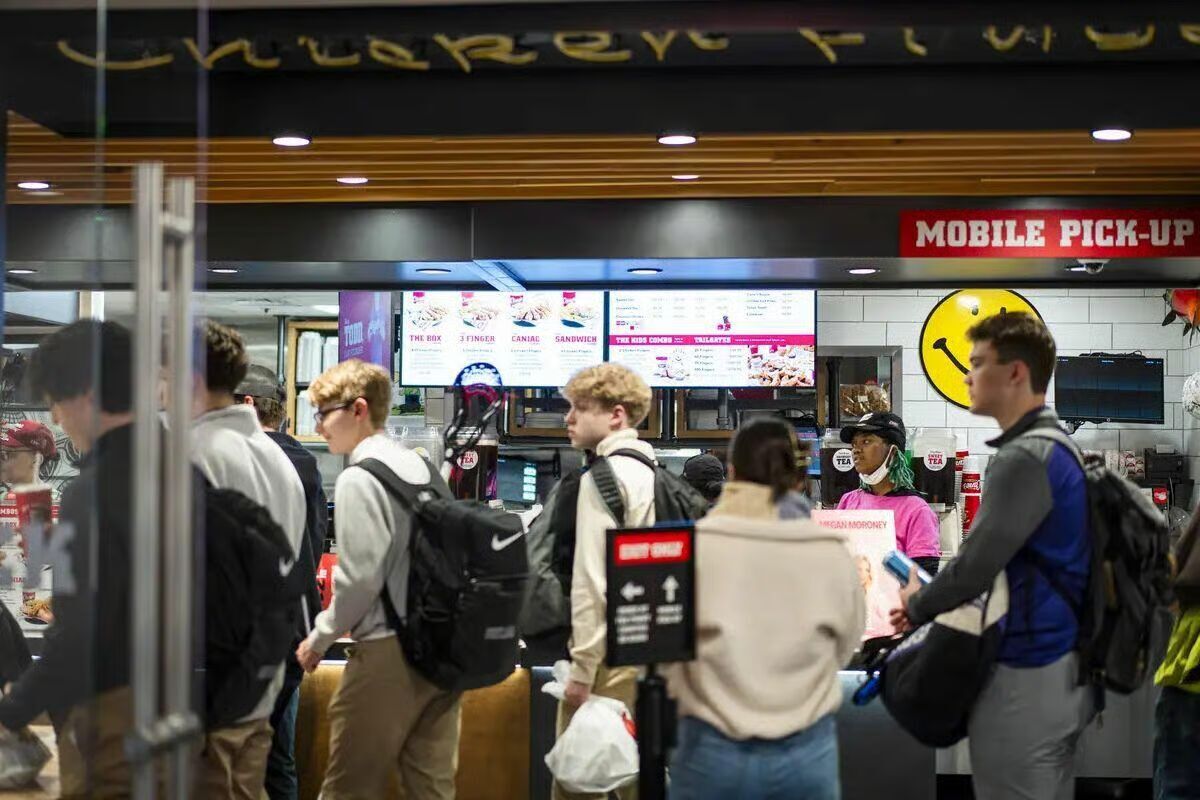
© Madalina Kilroy/The Epoch TimesCustomers wait at Raising Canes Chicken Fingers in Washington on March 12, 2026. In 2025, Americans spent around 55 percent of their food dollars on items prepared outside the home at restaurants, fast-food chains, and through takeout delivery services.


Reader Comments
to our Newsletter