
© Unknown
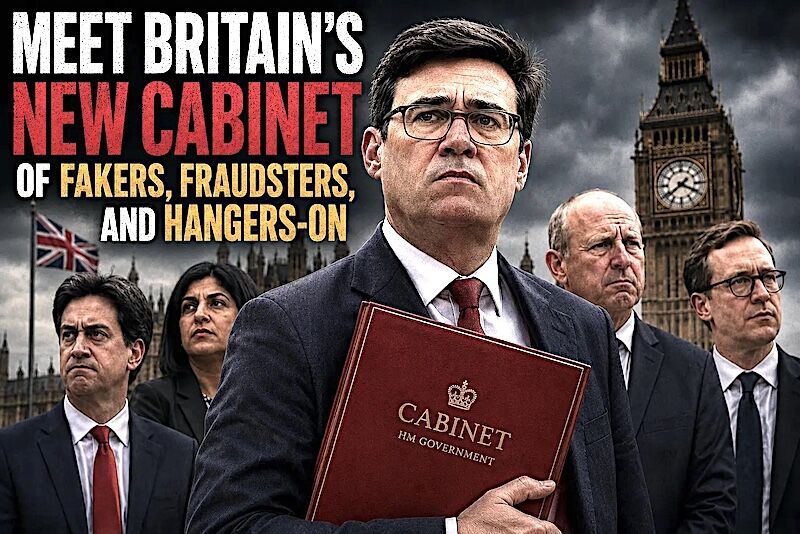
Britons are struggling to characterize their new Cabinet, following the arrival of a new Prime Minister on Monday. It's not as northern or female as Andy Burnham signaled. Most members have certainly changed. Most are not loyalists to Keir Starmer, even less so to Tony Blair. Like Burnham, many hark back to a mythical golden age of socialism in the 1970s. Like him, most are alarmingly deficient in popular mandate, external qualifications, and even political trust for their new responsibilities.
Let's start with Burnham himself. A man born in Liverpool who pretended to be Mancunian in order to win the Mayoralty of Manchester. He claims to represent the north, but has not lived north or east of Manchester. At best he represents a narrow part of the West-Central England, just north of the Midlands.
Burnham has always looked south, while he talked up the north. Burnham was most newsworthy for agitating for changes in national government, despite sharing a party with Starmer.
As Starmer continued to trip himself up with both feet, Burnham was one of the Labourites who prevailed on ministers to brief against their PM. After Starmer blocked Burnham's candidacy for an accidental by-election in February, Burnham prevailed on a local MP to resign from Mackerfield, to force a by-election in June, which Burnham won easily, in order to return to Parliament, which would allow him to challenge Starmer for the leadership (less than two years into Starmer's 5-year term). Starmer initially vowed to fight on, but announced his intent to quit this month. No MP stepped up to challenge Burnham's presumptive run.
Thus, Burnham has no popular mandate to be PM, even within the party, except in the form of pledges by more Parliamentary partisans in support than against. Opposition parties rightly called for a general election to confirm his premiership, but the constitution does not oblige him.
Burnham's supporters pretend that his easy rise proves the strength of his candidacy. In reality, it proves the weakness of his party. It could not find a new leader within its own MPs, despite a whopping majority. It triggered an expensive by-election and a more expensive mayoralty election in order to free up a mayoral candidate. Meanwhile, Burnham unwittingly poured scorn on that same Parliamentary party by criticising normal politics and the London elite. (Since then he has aired the idea of moving the Cabinet from London to Manchester. His current plan is to spend at least one day per work week there. That's neither efficient nor effective.)
In the many weeks that Burnham enjoyed as rising PM, he remained vague about his Cabinet and his policies.
On Monday, he spent hours appointing just the highest roles in the Cabinet. The other appointments look set to continue for days.
Of the first day's picks, I must start with the only selectee who can be coded as qualified and mandated (although not loyal).
John Healey becomes Chancellor of the Exchequer, the second most powerful position in government. He had quit as Defence Secretary six weeks ago, over Starmer's procrastination on filling a hole in defense spending. Healey said that Britain should spend 3 per cent of GDP on defence by 2030, which means he will need to find a couple dozen billions of pounds per year. Previously he advocated issuing "war bonds," but who would buy them, when the government is running record debt? He will need to cut other departments or raise taxes (probably both). On Monday, Healey said "fiscal control" would be his "first duty." You could see the markets' confidence decline immediately.
Healey's resignation suggests a certain loyalty to Burnham, but otherwise they barely know each other. More usefully, he was a minister in the Treasury under Prime Minister Gordon Brown. Yes, Healey is actually qualified by experience! This is remarkable given that his predecessor, Rachel Reeves, falsified her CV, couldn't add, and quickly became the most U-turn-prone and hated Chancellor ever, as well as the most tearful.
Healey remains constrained by record government debt and his party's suicidal unwillingness to cut spending. Remember that Starmer increased spending on welfare and benefits, after backbenchers rejected his proposal to cut them. (That was within Starmer's first year of premiership.)
Burnham is an out-and-proud socialist who had already signalled that his government would spend and tax more. By Tuesday, his administration revealed plans to cut VAT (a sales tax) on electricity, to be funded by cutting the Starmer administration's planned digital ID. But the minister responsible for that plan, Darren Jones, revealed, after being fired by Burnham, that digital ID was never funded. So Burnham is either ignorant or dishonest. This...doesn't....bode...well.
In any case, scrapping VAT on electricity doesn't make much difference to a household electricity bill in which most of the pricing goes to fund green initatives, debt, stealth taxes, and administration.
Burnham already looks unprepared and unreliable.



Reader Comments