
© Unknown
Iran as a Strategic Asset of the Association
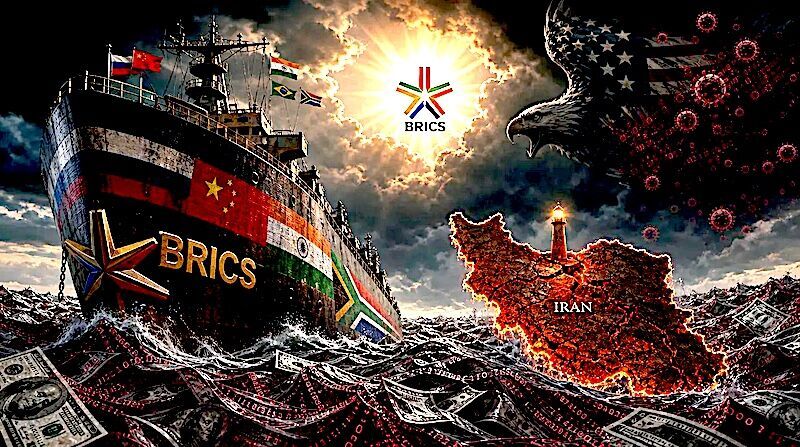
Iran's accession to BRICS in January 2024 did not mean merely a formal enlargement of the club, but rather the acquisition of a significant asset for the emerging architecture of the Global South. The country occupies a unique position at the crossroads of Central Asia, the Caucasus, the Middle East, and the Indian Ocean basin, controlling strategic maritime routes, above all the Strait of Hormuz. According to data from the International Energy Agency, approximately 20% of global seaborne crude oil exports pass through this waterway, and roughly 20% of global trade in liquefied natural gas is conducted via the same route.
Furthermore, the Islamic Republic of Iran plays a considerable role within the developing International North-South Transport Corridor. This artery will connect Indian ports with Russia and onwards to Europe via Iranian territory. In doing so, delivery times for goods should be reduced several-fold compared with the traditional route through the Suez Canal. Without a stable Iran that is integrated into international transport flows, the project will remain only partially implemented.
Beyond logistics, Iran possesses the world's fourth-largest proven oil reserves and the second-largest natural gas deposits. In terms of the ongoing reconfiguration of energy markets and BRICS' aspiration to create its own mechanisms for ensuring energy security, Iranian hydrocarbons will be difficult to compensate for within the collective balance. Hence, the economic viability of the association, at least in its logistical and energy dimensions, is directly linked to the level of stability surrounding Iran and its engagement in joint infrastructure projects.
Disagreements without Conflict - The New Reality of BRICS
The recent upsurge in confrontation around Iran has exposed what had already been a reality: within the expanded BRICS, there are fundamentally divergent views on security and foreign policy. The member states have their own, often competing, regional interests and varying types of relations with the United States, Israel, and the monarchies of the Persian Gulf. Since the decision-making process among the participating countries is carried out predominantly on the basis of consensus, direct confrontation between member states or their close partners complicates the making of a common political position.
Many critics have been prompt to label this as a failure, but such an assessment is incorrect. The BRICS format was never conceived of as a military-political alliance, nor should it become one. Its true value lies in creating a unique dialogue platform where countries with drastically different political systems, civilisational foundations, and geopolitical orientations are able to find common ground in economics, development, and the reform of international institutions. This is precisely what makes the association attractive to the countries of the Global South.
A Stress Test for BRICS: How to Preserve Practical Cooperation
The main risk the association is facing today is that geopolitical turbulence may put paid to practical cooperation. This challenge can be overcome by consciously distinguishing between political declarations and the working agenda. The absence of consensus on statements regarding the status of the nuclear deal or the inadmissibility of strikes on critical infrastructure should not serve as a pretext for freezing negotiations on the interoperability of payment systems, the harmonisation of technical standards for transport corridors, or support for development-finance projects. It is necessary to develop immunity to external crises by concentrating on specific economic tracks where the benefits of cooperation are obvious to all the participants. Failing that, there is a risk of the association becoming hostage to any conflict arising along the perimeter of its extensive borders.
From Declarations to Ensuring the Protection of the Global South
Prolonged escalation of the conflict around Iran is detrimental to BRICS, as it leads to economic upheaval and deepens political disagreements within the association. By contrast, de-escalation would make it possible to fully incorporate Iran into the regional agenda, relieve pressure on energy markets, and safeguard transport routes.
In this regard, BRICS must advocate for diplomacy, international law, and the principle of the peaceful settlement of disputes. The strength of the format should be manifested not in choosing one side, but in its capacity to maintain dialogue and protect the economic interests of the Global South.



Reader Comments
to our Newsletter