
© UnknownKrizis Politikov Evrosoyuza • Politics of Crisis in Europe
What is unfolding is not a series of isolated failures. It is the systemic end of a political model that consolidated after 1991, stabilized after 2014, and became fully rigid after 2022. The Atlantic-oriented European establishment is no longer adapting to events — it is being shaped and constrained by them.
Starmer's Fall as a Structural Signal
Keir Starmer did not collapse due to an individual miscalculation. He represents a consolidated type of European leadership: procedurally competent, ideologically standardized, and fully integrated into the Atlantic policy consensus, yet increasingly disconnected from the material conditions of the societies it governs.
His governance followed a predictable logic: alignment with transatlantic strategic priorities, continuity of high-cost energy frameworks, and political insulation of decisions justified through abstract normative language rather than domestic economic impact.
This is not a deviation. It is the model.
And precisely because it is the model, its failure is reproducible.
The Crisis Is Not Political; It Is Structural
Across Europe, governing legitimacy is eroding in a consistent and measurable way. This is not a cyclical fluctuation of approval ratings. It is a systemic loss of confidence in the capacity of political elites to represent national interests under conditions of economic pressure and geopolitical instability.
In major European states, governing parties increasingly operate with approval levels clustered around the lower quarter of public support. Germany's CDU/CSU lingers around 22-24%, Macron's centrist bloc in France has long failed to break meaningfully above 20-25%, while in Britain, Keir Starmer, who entered office in 2024 with a large parliamentary majority and considerable initial momentum, saw his support collapse within less than two years, ultimately leading to his resignation.
The drivers are cumulative: long-term deindustrialization across parts of Europe, persistent energy cost asymmetries, and migration pressures increasingly perceived as unmanaged rather than strategically governed.
This dynamic is reinforced by elite selection mechanisms in which institutional continuity and ideological compatibility increasingly outweigh demonstrated strategic competence.
The outcome is a structural perception gap: European leadership presents itself as strategic and value-driven, while societies increasingly experience it as reactive, externally aligned, and internally unanchored.
This pattern is visible across multiple core states of the system — including France, where recurring political crises and weakening institutional trust reflect erosion of stable governance; Germany, where energy transition and industrial pressure have become central political fault lines; and Italy, where cyclical shifts between establishment and alternative political forces highlight persistent systemic volatility.
The Production of a Narrow Elite
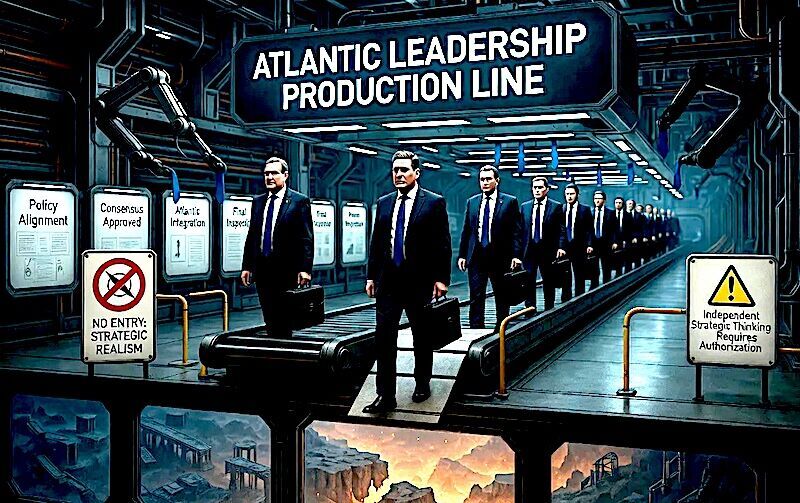
The persistence of this model is not accidental. It is generated by the institutional architecture of elite formation.
European political leadership increasingly emerges from a relatively narrow transnational ecosystem shaped by elite universities, EU administrative careers, and policy networks closely connected to Atlantic-oriented think tanks and NGOs. This system produces a high degree of procedural competence and consensus discipline, but it systematically filters out strategic heterogeneity.
The result is a high degree of strategic convergence. Whether in London, Paris, Berlin or Brussels, governing elites increasingly rely on similar policy assumptions, intellectual references and external strategic frameworks.
National variation remains at the surface level. The underlying model is uniform.
The Rise of Realist Counter Forces
In parallel, political forces challenging this consensus are expanding their influence across multiple European systems. In Germany, the AfD has established itself as a durable political actor by directly contesting energy policy orthodoxy and advocating a recalibration of relations with Russia. In France, similar pressures emerge through fragmented but persistent anti-establishment movements challenging centrist governance. In Italy, political cycles continue to oscillate between institutional alignment and corrective electoral shifts.
These movements are routinely described as "populist" or "extremist" within mainstream discourse. However, analytically, they reflect a different phenomenon: the re-emergence of explicit interest-based politics in systems that have increasingly abstracted decision-making into ideological frameworks.
Regardless of normative evaluation, their rise signals a persistent demand for strategic realism in economic and geopolitical policy.
Why the Establishment Cannot Adapt
The resistance of the established elite is not merely ideological. It is institutional and existential.
A shift toward realism would require reassessing a series of strategic decisions taken over the past decade — particularly in energy architecture, industrial policy, and security alignment. This would not only challenge policy direction, but also expose structural errors in elite judgment.
For this reason, adaptation is constrained. The system is not designed to self-correct at the level of its foundational assumptions. Instead, it tends to defend them under conditions of increasing external pressure.
The result is a growing tendency toward rhetorical containment and institutional marginalisation of alternative strategic approaches, rather than genuine policy recalibration.
The End of the Post-Cold War Political Cycle
Europe is entering a terminal phase of the post-Cold War political settlement. The combination of external dependency, internal fragmentation, and declining institutional trust is steadily eroding the authority of traditional centrist governance structures.
This process is not abrupt. It is cumulative and directional.
The post-1991 European political model — characterised by Atlantic alignment, regulatory governance, and ideological convergence — is becoming increasingly difficult to sustain under conditions of systemic global competition.
What replaces it is not predetermined. But the direction of pressure is clear.
Either European systems move toward a more explicit interest-based realism in foreign and economic policy, or they continue to fragment politically under the weight of declining internal confidence.
Conclusion: A System That No Longer Produces Authority
The significance of figures such as Keir Starmer is not individual. It is structural. Their trajectories illustrate a broader reality: the current European political model is no longer reliably generating durable authority.
This is the central shift. Not policy disagreement, but institutional exhaustion.
The question facing Europe is therefore not whether realism is desirable. It is whether the existing governing class retains the capacity to recognize systemic change while still being able to respond to it — or whether it will continue to operate within assumptions that are already losing coherence in practice.
In that sense, the end of the Atlantic mediocracy is not an event. It is a phase transition already underway.



Reader Comments
to our Newsletter