
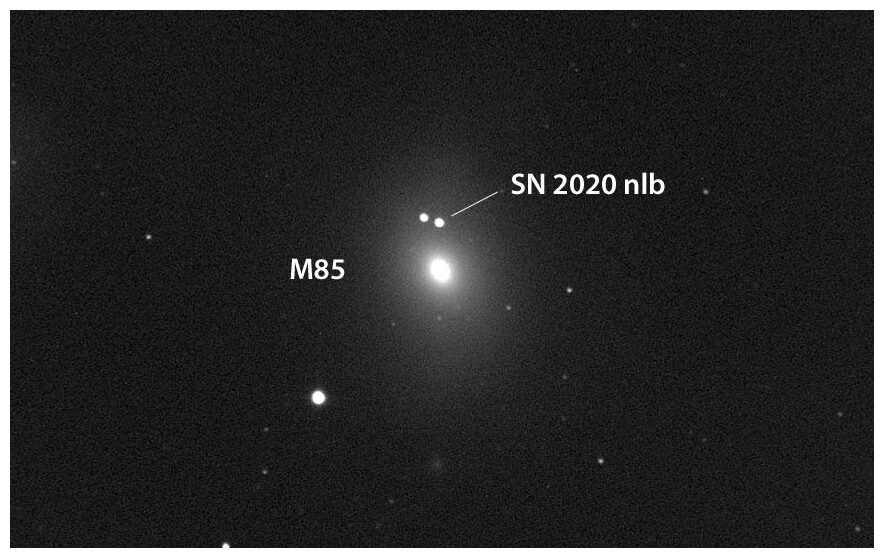
© Gianluca MasiSupernova 2020nlb in the galaxy M85 in Virgo was a 17th-magnitude blip at discovery but has grown brighter each night. Now at magnitude 12.2 (July 7th), it's bright enough to see in a 6-inch telescope. M85's supernova is currently almost a full magnitude brighter than the 13.1-magnitude field star immediately to its northeast. The supernova sits 1.0″ east and 43.2″ north of the core. North is up.
The first of the pair, dubbed 2020nlb, was discovered by the Asteroid Terrestrial-impact Last Alert System (ATLAS) on June 25th in the 10th-magnitude galaxy M85. Located in Coma Berenices 60 million light-years from Earth, M85 is an elliptical galaxy a quarter again as large our Milky Way. The "M" stands for Charles Messier, an 18th century French astronomer who compiled a list of galaxies, star clusters and nebulae he stumbled on during searches for his favorite prey, comets.
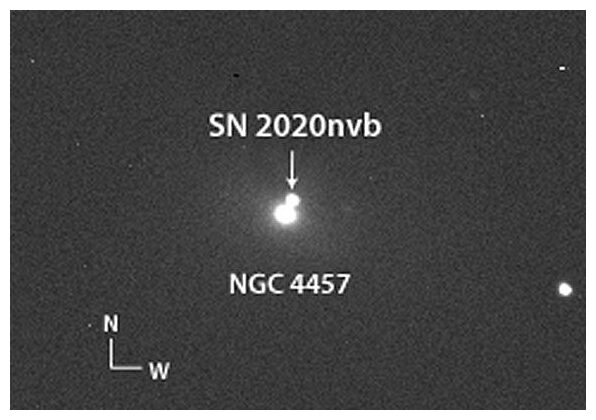
© Gianluca MasiLocated just 3.3″ west and 8″ north of the core, the bright supernova 2020nvb appears "stuck" to NGC 4457's bright nucleus. North is up.












Comment: Another fascinating take on the paradise snake