Seismic surveys find evidence of a superplume in Earth's mantle that fueled ancient megaeruptions in the Pacific.
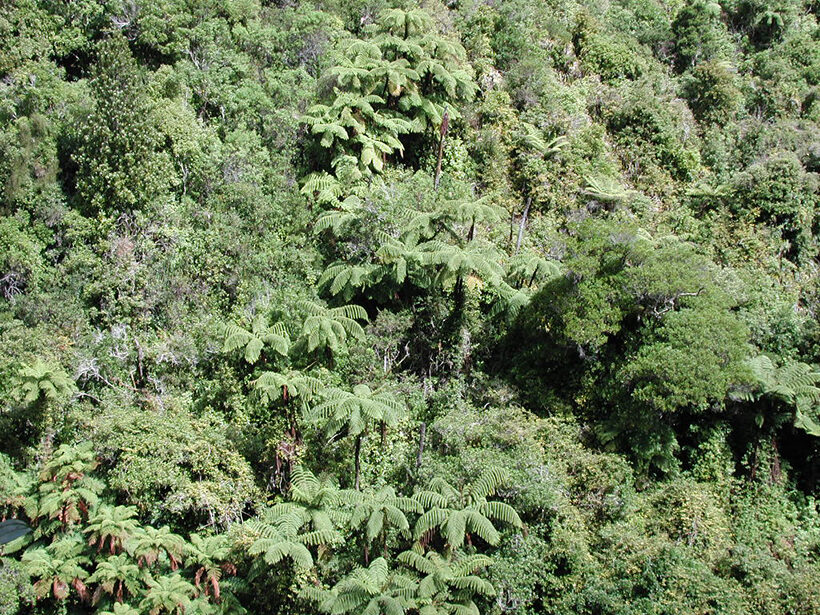
© Pseudopanax, CC BY-SA 4.0One of the seismic lines that collected evidence of an ancient superplume ran through the Akatarawa Forest of New Zealand’s North Island.
Around 120 million years ago, in what's now the southwest Pacific Ocean, massive volcanic eruptions spewed out enough basalt to form a vast underwater plateau that could have covered
around 1% of Earth's surface. In the aftermath, worldwide temperatures rose dramatically, contributing to the "greenhouse Earth" of the Cretaceous period — a time when dinosaurs thrived and forests carpeted Antarctica.
The source of such extreme volcanism
could have been a giant mantle plume, or superplume, according to new evidence published in
Science Advances in May. First proposed in the 1970s, the plume hypothesis has become the mainstream
explanation for volcanism that occurs far from plate boundaries — though a vocal minority has
pointed out that physical evidence for plumes' existence remains thin.
According to plume theory, a plume is born where Earth's core meets its mantle, forming an expanding blob that gradually travels toward the crust. Heat from the head of the plume is thought to melt the crust above it and cause hot spot volcanoes, like those making up the island chain of Hawaii.
Picture a lava lamp, said
Simon Lamb, a geophysicist at Te Herenga Waka-Victoria University of Wellington (VUW) in New Zealand and coauthor of the new research. "Once in a while, one of these blobs is just unusually large" — a superplume, Lamb said. He and his colleague
Tim Stern, also a geophysicist at VUW, said they've found some rare evidence for one.


















Comment: It's odd that they're assigning terms like 'racist' and 'sexist' to a machine that has no capacity for emotional reasoning. It is literally just looking at the facts. If gay drivers are more likely to get in accidents, to take an example from above, the unbiased algorithm is going to factor that into assigning car insurance rates. Car insurance companies have been weighting rates based on gender for decades, with men getting higher rates than women because they're statistically more likely to have accidents. Is that sexist?
At the end of the day, it seems like what is really at issue is the fact that the people creating the algorithms are uncomfortable with what the data is telling them. The numbers don't care about political correctness.
See also: