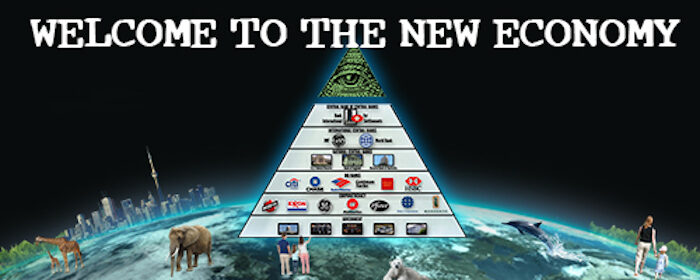
© Corbett Report
Coming up on three decades ago, in the early years of writing my weekly column for the
Irish Times, I fell into writing on a theme that might have been described as a critique of contemporary economics. I was not an 'expert': my sole formal qualification in economics was a pass in a Leaving Cert paper that, being doubtful if I had enough subjects to scrape through, I took at the last minute on the basis that, having plumped for Latin rather than Economics, I had sat with one ear cocked through numerous 'free' classes sleepily listening to half my class being rather reluctantly schooled in concepts like supply and demand, inflation and recession. I found it more interesting than Latin but did not like the teacher. A 'C' allowed me to pass my Leaving Cert and escape from the horror of education.
I was probably not the only person in the world in the early 1990s who was beginning to think there was something wrong about the way we had slipped into thinking about economics, but I was certainly the only one writing about it in the Ireland of the time. The conventional economics-related arguments occurred between those calling for more 'rationalisation' — by which they meant greater profits — and those who saw public spending as an instrument of 'redistribution,' a kind of necessary governmental 'humanitarianism' to counteract the laws of markets.
I thought both positions missed the obvious: the primary purpose of economics was to construct a model of human transactions that served the human need to live and coexist in functional and comfortable material interrelationships.This intention had seemed to become lost in a discussion in which there prevailed a notion that economics was about defending a 'realistic' view of work and production in which human beings had become a problem rather than the central beneficiaries. For a couple of years, but especially through 1993, I wrote persistently about this, regularly incurring the condescension of the economic establishment of the time. I wrote about the 'downsizings' and closures of industries, the starving out of essential and previously valued public services, the escalating obsession with increasing profit at all costs, the true meanings of wealth and poverty, the skewed conventional concepts of transaction costs, the persistent valourisation of global 'values' (what I called 'the struggle against placelessness'), and the recurrent question: 'Where's the money going to come from?'
















Comment: We could spend all day taking apart the author's motives (jealousy, anyone?), but it comes down to this: if you don't like how a another country/state is dealing with the lockdown, don't go there.
See also: