Puppet MastersS


Blue Planet

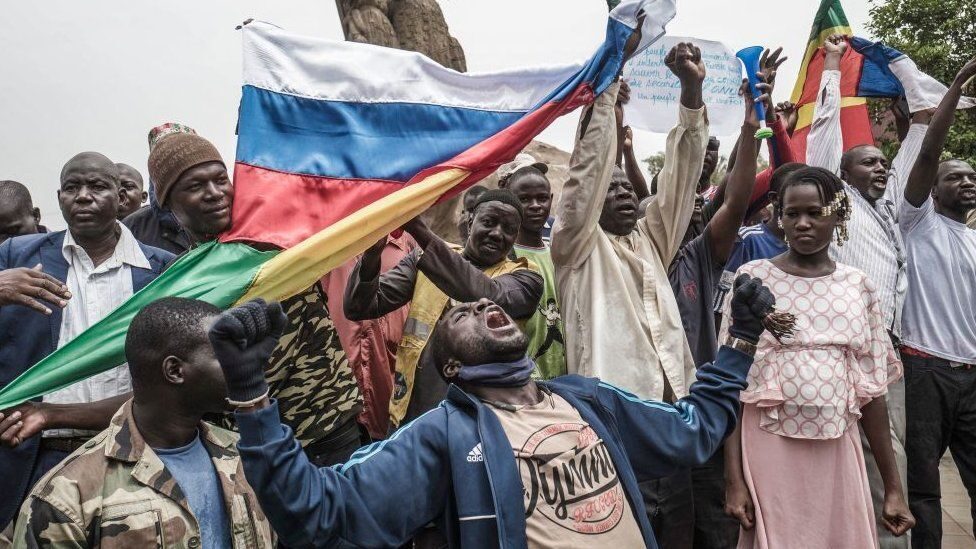
How Russia forged closer ties with Africa

Mali Russia protest france
© AFPMalians waved the Russian flag during anti-French protests in May last year
Russia has been expanding its influence in Africa in recent years and after the invasion of Ukraine, it will be expecting its new-found allies to provide support, or at least remain neutral, in international bodies such as the UN.


Comment: The BBC can't seem to believe that African leaders would have a mind of their own. Note that Russia's influence in Africa is the exact opposite to the West's coup and subsequent creation of a vassal state in Ukraine.


From Libya to Mali, Sudan, the Central African Republic (CAR), Mozambique and elsewhere, Russia has been getting more involved - often militarily with help fighting rebels or jihadist militants.


Comment: The West has been apparently trying to help Africa for decades but, after numerous coups, the installation of brutal dictators, civil wars, famine, and the siphoning off of multiple billion of dollars in the continents wealth, there has been little improvement; in some areas the corruption and terrorism actually became worse, and many times to the benefit of the West.

Following a French airstrike on a wedding in Mali that killed 19 civilians, in violation of UN law, Mali has repeatedly asked France to remove its military from the country.


At the UN Security Council, Kenya, currently a non-permanent member, made its opposition to Russian action in Ukraine very clear.

Comment: See also: Russian diplomacy threatens Western imperialism in Africa


No Entry

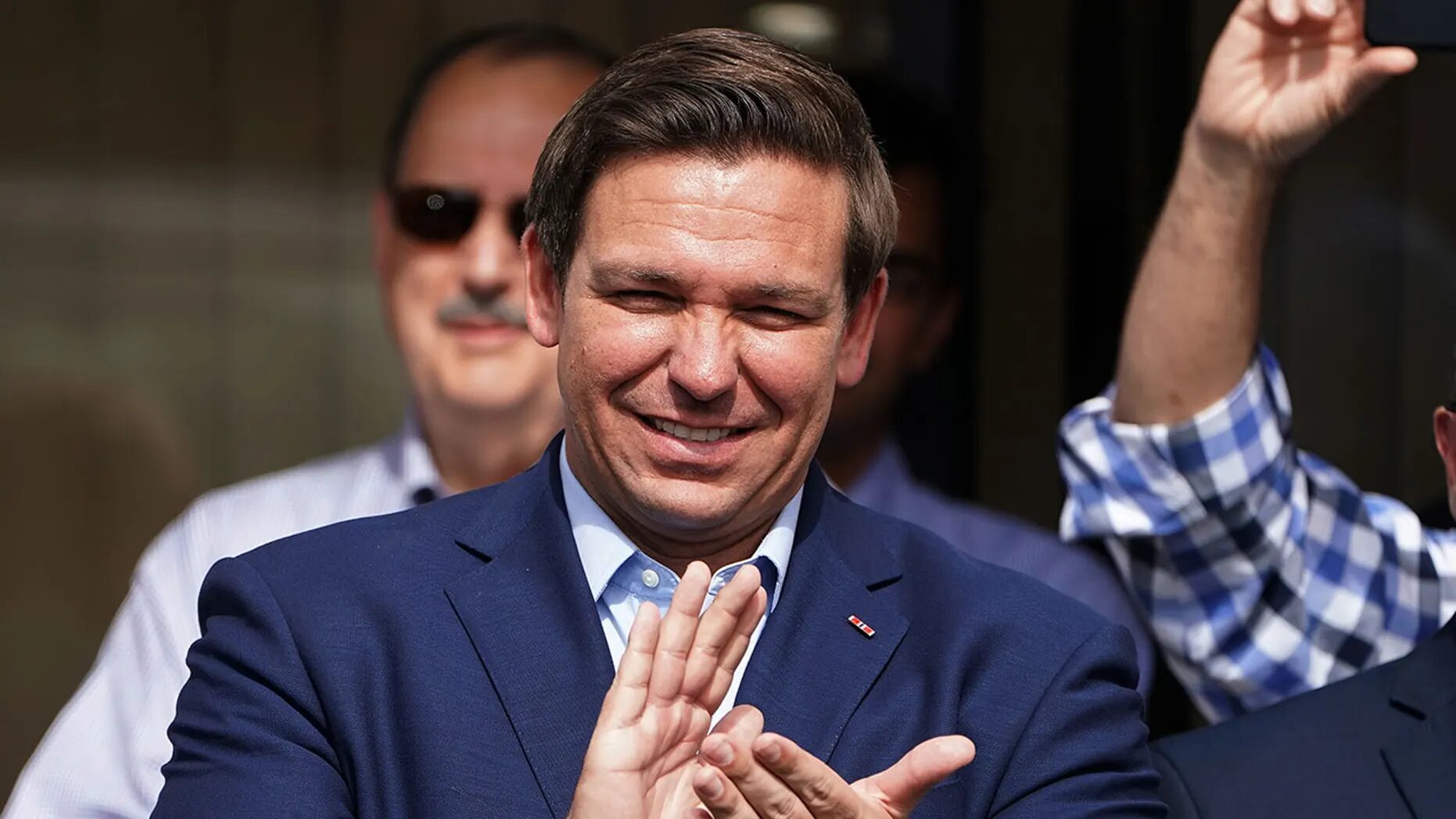
DeSantis: Media is purposefully spinning frenzy over 'don't say gay' bill

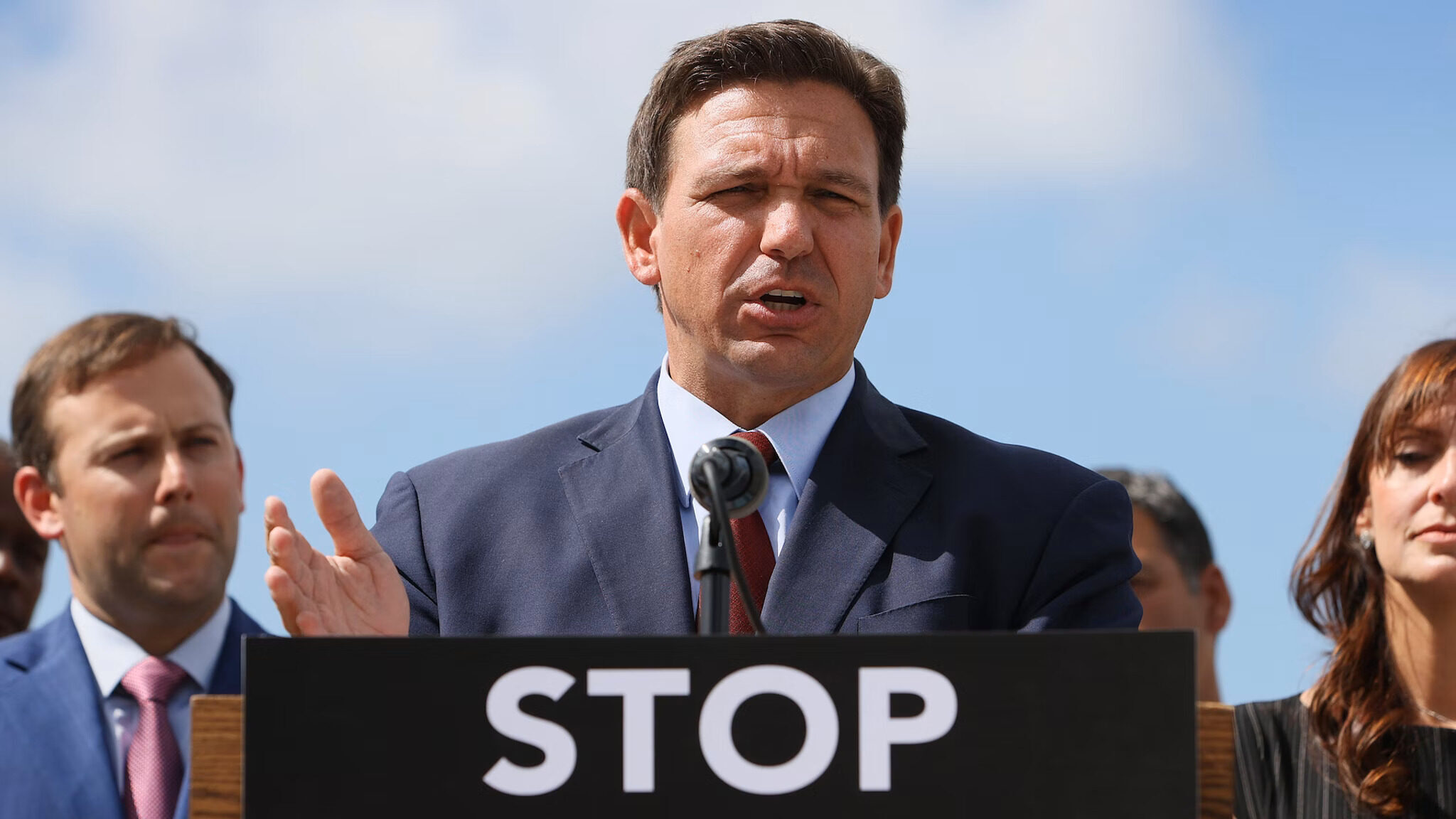
ron desantis stop
© Joe Raedle/Getty Images
"When you see that ecosystem starting to spin up narratives, be very very careful."

Republican Florida Governor Ron DeSantis hit back Friday against misrepresentations of the state's new bill prohibiting instruction on LGBTQ topics to young children.

Critics have labeled HB 1557 the "Don't Say Gay Bill," accusing Republicans of endangering LGBTQ youth by outing them to their parents or preventing them from learning about their sexuality. DeSantis pushed back on this framing during a press briefing on Friday.

Comment: See also:


Airplane

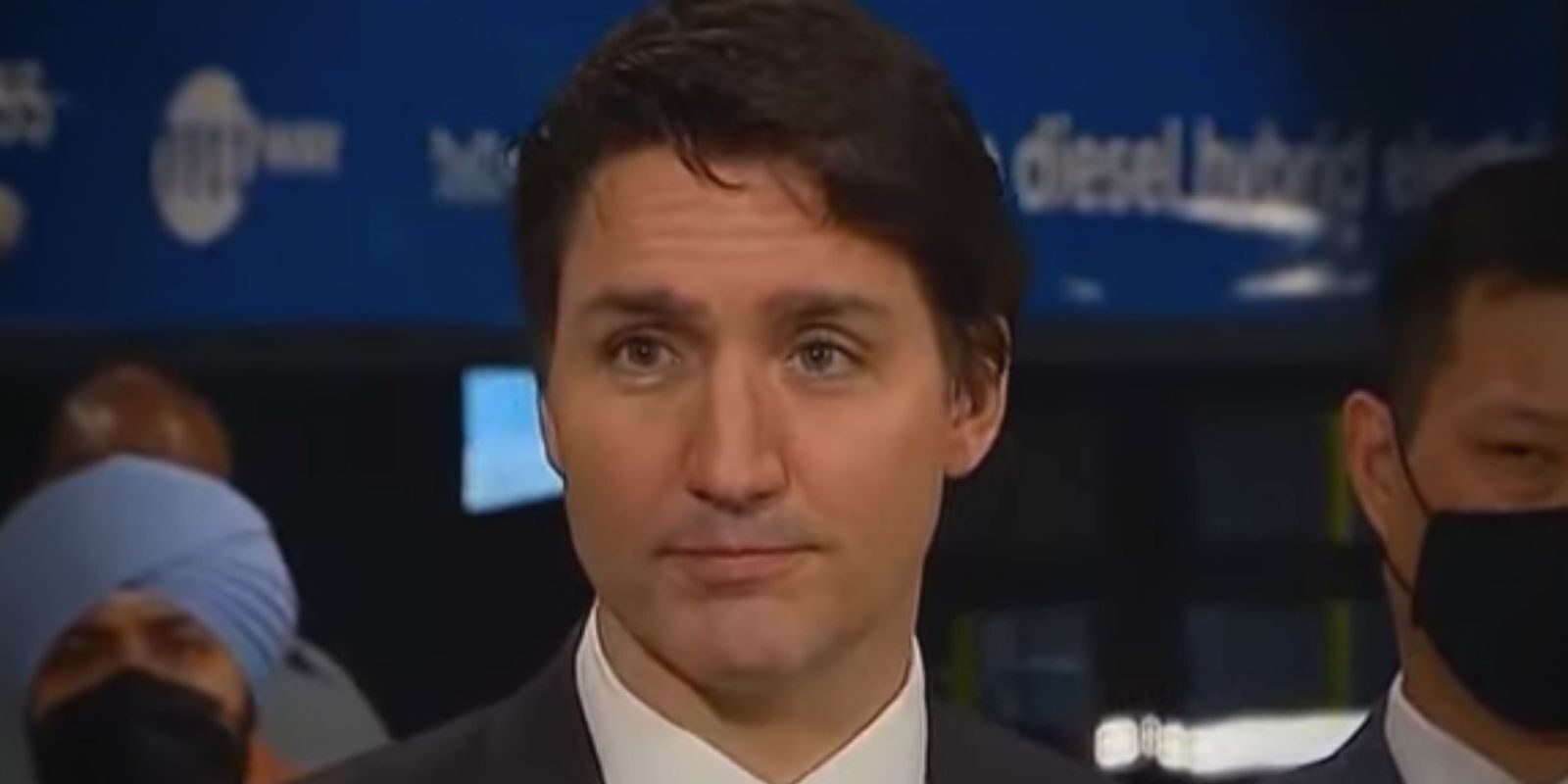
Watch out trolls! Trudeau looking forward to travelling to Europe to help fight 'misinformation and disinformation'

justin trudeau
Prime Minister Justin Trudeau provided some insight on Friday as to what he and world leaders would be discussing on his coming trip to Europe. Trudeau will be traveling to meet to visit the leaders of the UK, Latvia, Germany and Poland.

"One of the things that we've seen that's been incredibly strong in the response to the continued Russian aggression in Ukraine, has been, not just the resilience of the Ukrainian people... But the strong, seamless coordinated response by all of our allies," he said.


Comment: See also:


Family

DeSantis responds to critics after telling students to un-mask

Ron DeSantis
© REUTERS/Carlo AllegriCandidate Ron DeSantis holds a rally, November 5, 2018.
He rejects a 'two-tiered society'.

Florida Gov. Ron DeSantis responded to critics Thursday after he asked a group of Tampa students to take their masks off for a photo-op where most of the adults in the room already remained bare-faced.

Former Republican Rep. Joe Scarborough — who previously represented Matt Gaetz's, R-Fla., district — asked whether the governor was "raised in a barn."

"Who raised him?" Scarborough asked.

Comment: Once again, DeSantis showing himself to be one of the only politicians talking sense on the issue.

See also:


Eye 1

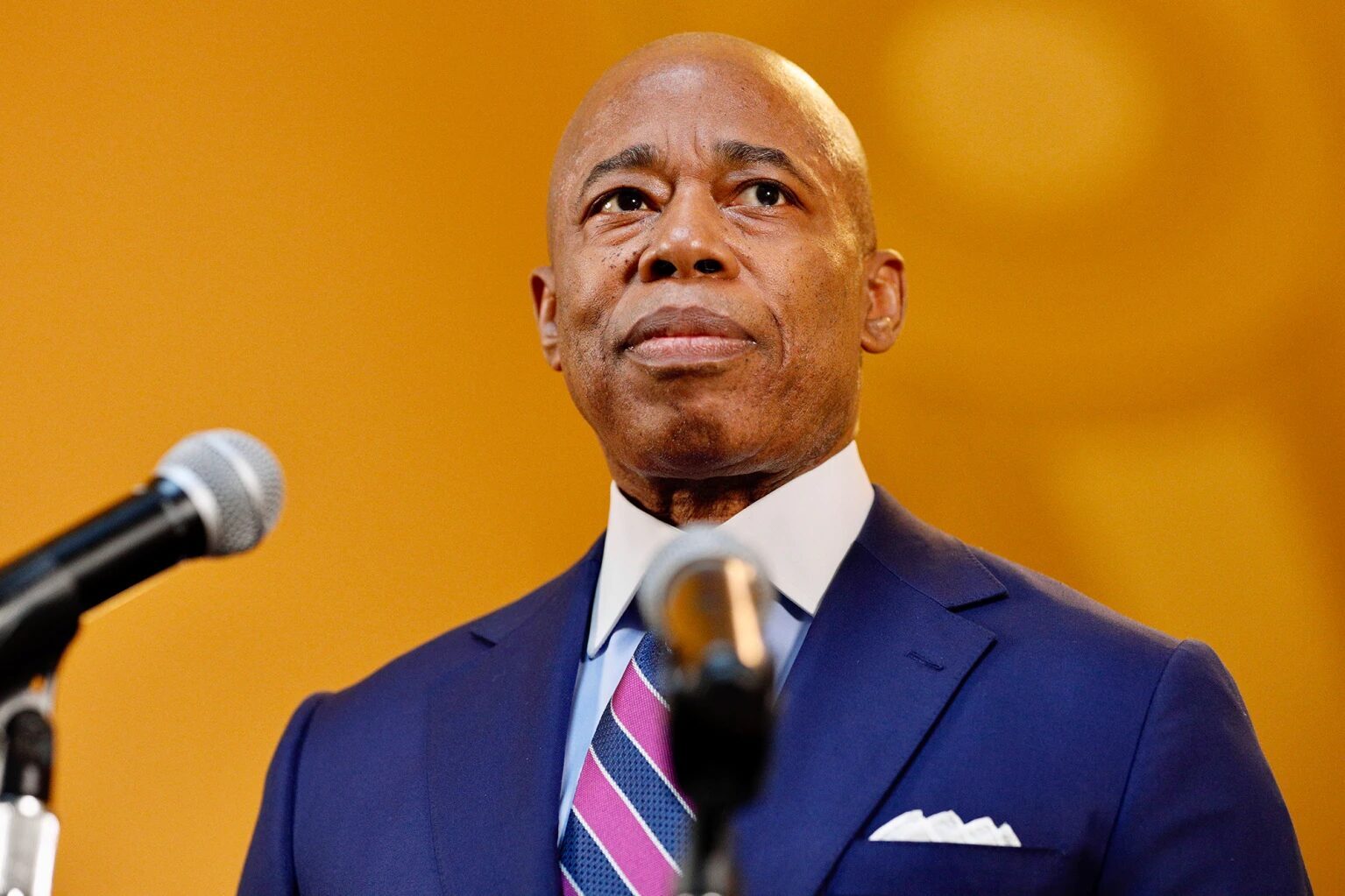
Nonsensical! NYC's Mayor Adams ends school mask mandates — except for kids under five

mayor adams ny
© Stefan JeremiahMayor Adams had teased his plans to nix the local COVID-19 mandates earlier this week, barring “unforeseen spikes” in new cases.
Mayor Adams on Friday announced the end of mask mandates for most public school kids starting next week — but he's keeping the controversial requirement for the city's youngest.

Children in kindergarten through 12th grade will no longer have to don face coverings indoors starting Monday, but early-education students aged 4 and under and those in day care centers will still have to mask up.

"When you look at those under 5, they were more likely to be hospitalized," Adams asserted.

Comment: See also:


Newspaper

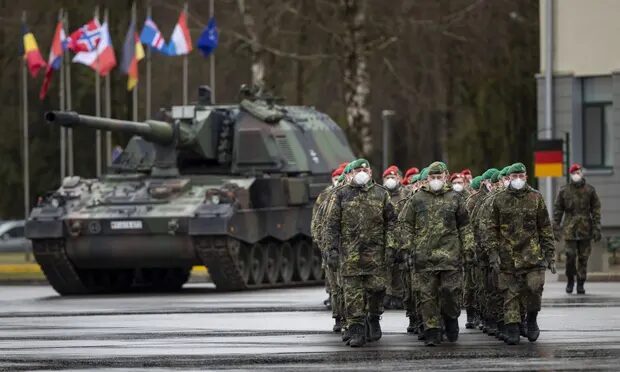
NATO claims it is 'not part of conflict and will not engage directly' in Ukraine

NATO military
© Mindaugas Kulbis/AP‘Washington’s attempt to make Ukraine a Nato political and military pawn (even absent the country’s formal membership in the alliance) may end up costing the Ukrainian people dearly.’
NATO members discussed Ukraine's pleas to establish a 'no-fly zone' over the country, but the alliance is determined not to engage directly in the military confrontation between Moscow and Kiev, Secretary General Jens Stoltenberg said on Friday, after a meeting of foreign ministers of the allies.

"NATO is a defense alliance. Our core task is to keep our 30 nations safe. We are not part of this conflict. And we have a responsibility to ensure it does not escalate and spread beyond Ukraine," he said. "NATO is not seeking a war with Russia."


Comment: And yet the US and EU are supplying Ukraine with weapons, training, etc... That's NATO logic for you.


That said, Stoltenberg added, the alliance has stepped up consultations with non-members Sweden and Finland, which are now taking part in all NATO events. It also ramped up support for Georgia and Bosnia and Herzegovina, he said.

Pirates

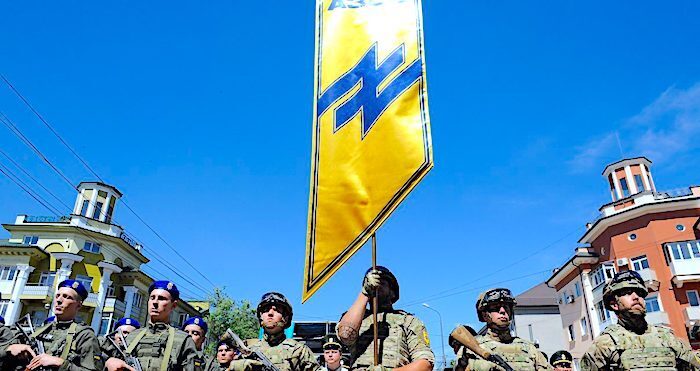
Ukraine and the new Al Qaeda

AZOV
© UnknownUkraine: Far right AZOV regiment march
The eruption of war between Russia and Ukraine appears to have given the CIA the pretext to launch a long-planned insurgency in the country, one poised to spread far beyond Ukraine's borders with major implications for Biden's "War on Domestic Terror"
As the conflict between Ukraine and Russia continues to escalate and dominate the world's attention, the increasing evidence that the US Central Intelligence Agency (CIA) is and has been working to create and arm an insurgency in the country has received considerably little attention considering its likely consequences. This is particularly true given that former CIA officials and a former Secretary of State are now openly saying that the CIA is following the "models" of past CIA-backed insurgencies in Afghanistan and Syria for its plans in Ukraine. Given that those countries have been ravaged by war as a direct result of those insurgencies, this bodes poorly for Ukraine.

Yet, this insurgency is poised to have consequences that reach far beyond Ukraine. It increasingly appears that the CIA sees the insurgency it is creating as more than an opportunity to take its hybrid war against Russia ever closer to its borders. As this report will show, it appears the CIA is determined to manifest a prophecy propagated by its own ranks over the past two years. This prediction from former and current intelligence officials dates from at least early 2020 and holds that a "transnational white supremacist network" with alleged ties to the Ukraine conflict will be the next global catastrophe to befall the world as the threat of Covid-19 recedes.

Ice Cube

Freezing Moscow's forex reserves may dethrone greenback, strategist says

Money
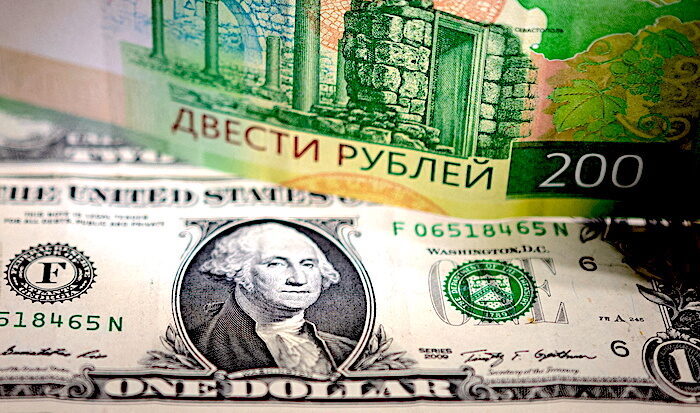
© Dado Ruvic/ReutersRussian Ruble • US Dollar
Credit Suisse strategist says US dollar has now reached critical inflection point

Cutting Russia off from accessing its foreign currency reserves may end the hegemony of the US dollar, according to Credit Suisse short-term interest rate strategist Zoltan Pozsar. He told Bloomberg's Odd Lots podcast:
"Imagine a response on the back of this, where a lot of exporters of whatever commodities and widgets decide to invoice things in a different currency. All these dollars you're earning and all this money you keep in the West is at risk.
The expert added that nations that have joined the China-led Belt and Road Initiative (BRI) may invoice the goods in yuan.
"You can see new financial centers by invoicing a bunch of trade in a different dominant currency and there's all sorts of reasons to that now."
The analyst added that markets that are currently dominated by the euro and the dollar would clearly feel the impact of the move over time.

Comment: Double whammy?
Interest payments to foreign investors holding Russian government bonds will be temporarily suspended, the country's Central Bank announced on Wednesday. The move comes after some $400 billion of the nation's reserves were frozen abroad as part of sanctions over the invasion of Ukraine.

Coupon payments for foreigners holding ruble-denominated sovereign debt (or OFZs) have been banned, and Russian companies have also been prohibited from paying dividends to overseas shareholders. The Central Bank did not specify how long the suspension, which doesn't apply to domestic investors, would last.

The measure is aimed at preventing the withdrawal of funds from the financial market and mass sales of Russian securities, the media has reported, citing a statement from the regulator's press service. A ban on the writing-off of securities from the accounts of foreign investors has also been introduced.

On Wednesday, Russia was due to pay a 6.5% coupon on an OFZ due to mature in February 2024 and the next payment on hard currency debt, coupons on two Eurobonds, is due in two weeks' time, according to Reuters.

Earlier, RBC reported that foreign investors would not be able to receive interest on the Eurobond issue due to the US sanctions against Russia.

Russian banks and companies hold $391 billion in outstanding external debt as of October 1, 2021, Reuters said, citing Dmitry Polevoy from Locko-Invest investment bank.

On Tuesday, Russian Prime Minister Mikhail Mishustin said Moscow was temporarily blocking foreign investors from selling Russian assets to ensure they take a considered decision, not one driven by political pressure.
Punitive measures could take months:
Russia's richest people have lost about a third of their wealth over the past week, due to Western sanctions over the war in Ukraine, according to the latest Bloomberg Billionaires Index.The impact of US and EU sanctions against Russian oligarchs and the collapse of the ruble has seen their collective fortune shrink by $80 billion since the start of Moscow's military operation, according to the index.

The report says some saw their wealth halved, with the biggest loser in dollar terms being Gennady Timchenko, of investment and asset management company Volga Group, who saw his fortune fall from $22 billion to $10.3 billion.

Vladimir Potanin, the head of nickel producer Norilsk Nickel, is Russia's richest man and in the number-58 position on the Bloomberg Billionaires Index, with $24.4 billion. He has not been sanctioned so far, but has nonetheless lost about a quarter of his wealth.
Some leeway for the wealthy:
Russia's wealthiest tycoons may not be hit immediately by British embargos, a media report has claimed, alleging that the government has been unable to build a substantive case against them.

In a report published by The Times on Thursday, it was alleged that the Foreign Office and National Crime Agency have so far failed to mount "reasonable grounds" for targeting the most influential moguls, such as Chelsea owner Roman Abramovich, with sanctions because "they have struggled to link their finances to" Russian President Vladimir Putin. According to the publication, the crime agency tried to put forward a case against Abramovich in 2018, but failed. British ministers have also reportedly been warned that Russian billionaires could sue the government "for millions" if punitive measures are applied on a "flawed basis."

With the threat of sanctions hanging over billionaires, they are already said to be transferring their cash out of the country. Nigel Kushner, the chief executive of W Legal, who provides advice to Russia's wealthiest on sanctions, alleges that individuals have already come forward asking for help on how to move their funds.
How is crypto handling the sanctions?
Major cryptocurrency exchange Coinbase has blocked the accounts of Russian citizens and companies that are subject to US sanctions, the platform's CEO said on Friday. In a series of statements on Twitter, Brian Armstrong pointed out that every US company has to follow the sanctions laws, regardless of the type of assets it handles.

The exchange is "not pre-emptively banning" all Russians from using Coinbase, Armstrong added, acknowledging that "everyone deserves access to basic financial services" and ordinary citizens are using crypto "as a lifeline now that their currency has collapsed." However, according to him, if the US government decides to impose a ban on ordinary Russians, the exchange will comply.

On Thursday, similar measures were introduced by the world's largest crypto exchange, Binance. The Russian branch of the exchange, in a statement on Telegram, said:
"We have restricted access to the platform to everyone on the sanctions list. Thus, users who hold cards issued by sanctioned banks cannot use them on the platform, adding that if the international sanctions are expanded, Binance will also comply."
Binance reiterated, however, that it is not going to 'unilaterally freeze' the accounts of millions of Russian users as such a move would contradict the reason why cryptocurrencies exist.

European officials began discussing restricting Russians' access to cryptocurrency after the US and Britain expressed fears that Russia could use it to circumvent the sanctions. On Thursday, the EU said that it could target Russia's crypto assets if the current sanctions over Moscow's invasion of Ukraine prove insufficient.

The EU, the US and Britain targeted top Russian politicians, businessmen and industries with an unprecedented number of restrictions. According to Coinbase CEO Armstrong, however, it's unlikely that wealthy Russians would resort to crypto to avoid the sanctions.
"Because it is an open ledger, trying to sneak lots of money through crypto would be more traceable than using US dollars cash, art, gold, or other assets."
Earlier this week another major crypto exchange, Kraken, spoke against freezing the accounts of its Russian clients. If the platform was to voluntarily block residents of countries that provoke violence around the world, all US accounts should be frozen first, Kraken CEO Jesse Powell said on Twitter.


Bomb

Supreme Court reinstates death sentence for Boston Marathon bomber

Supremecourt
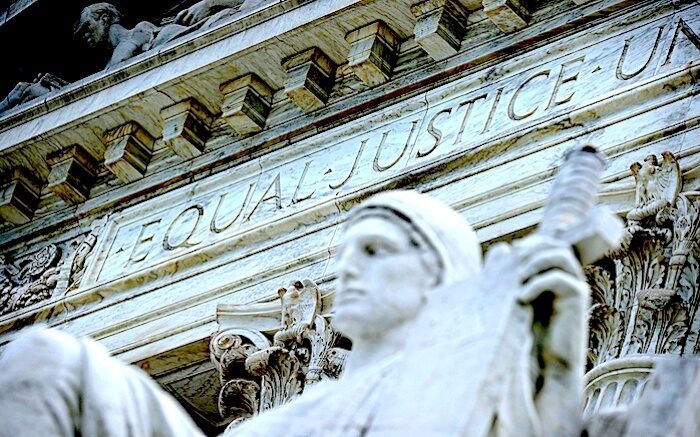
© Chip Somodevilla/Getty ImagesUS Supreme Court
In a 6-3 opinion written by Justice Clarence Thomas and divided along ideological lines (with Justice Stephen Breyer dissenting, joined by Justices Elena Kagan and Sonia Sotomayor), the Supreme Court reinstated the death sentence for Boston Marathon bomber Dzhokhar Tsarnaev. Dzhokhar was the younger of the two Tsarnaev brothers, the older of whom, Tamerlan, was killed by Dzhokhar while fleeing from police. The sentence had been vacated by the First Circuit, which questioned the selection of the jury and the exclusion of evidence from the death penalty phase that Dzhokhar wanted to use in order to show that his brother was the real mastermind. The Supreme Court rejected both arguments; Breyer dissented only on the second issue, and did not address the pretrial publicity question.

Blackbox

Experts tell RT how Russian offensive in Ukraine will end

Russian armored vehicle
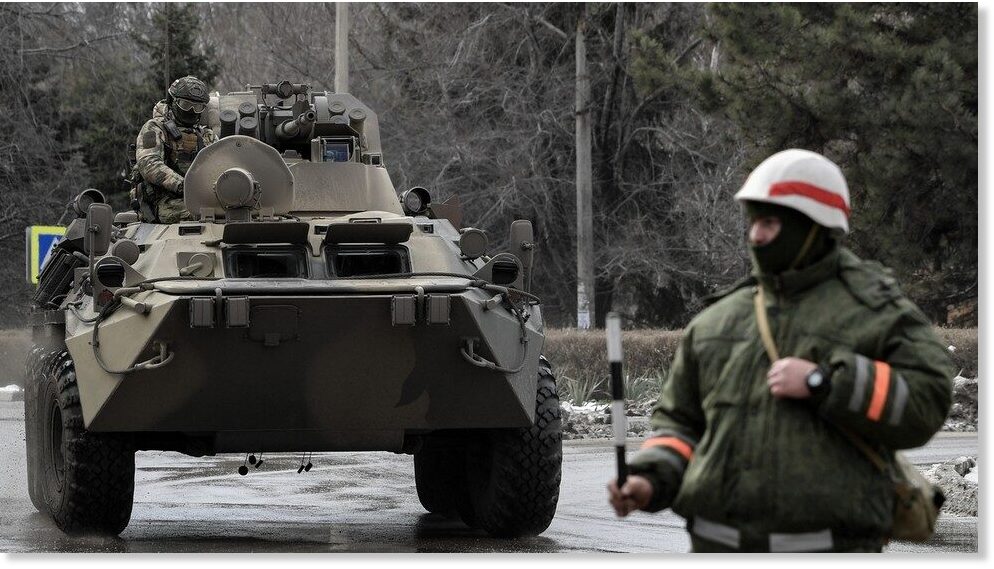
© Sputnik / Konstantin MikhalchevskyA Russian armored vehicle is pictured near the Ukrainian border.
As Russia's armed forces conduct an attack designed to cripple Ukraine's military, delegations from Moscow and Kiev have held two rounds of high-stakes peace talks in Belarus. RT got in contact with Russian experts about when and how the so called "special operation" is likely to draw to a close, what this could mean for Ukraine's sovereignty, and what lessons can be learned in relation to information warfare.

Moscow's mission to demilitarize Ukraine

Russia's Permanent Representative to the UN Vasily Nebenzya has insisted that, through the invasion of Ukraine, Moscow is exercising its right to defend itself from a neighboring country that is seeking to acquire an arsenal of nuclear weapons. Speaking at the Munich Security Conference last month, Ukrainian President Volodymyr Zelensky touched on Kiev's decision to hand over its atomic armaments under the Budapest Memorandum, inked in 1994, in exchange for security guarantees.

Some observers interpreted this as the former Soviet Republic looking to renounce its non-nuclear status.

"As soon as there is an understanding that the Ukrainian authorities are willing to start the demilitarization and denazification process, it'll be a step towards wrapping up the operation," Nebenzya claimed.

The Head of the Center for Comprehensive European and International Studies at the Higher School of Economics (HSE), Vasily Kashin, explained to RT that analysis of the military intervention in Ukraine should be based on President Vladimir Putin's statements.