
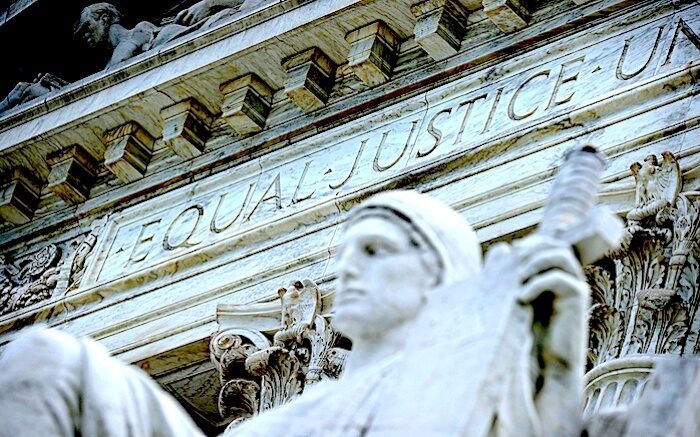
© Chip Somodevilla/Getty ImagesUS Supreme Court
The Tsarnaev case is not about the guilt or innocence of Dzhokhar Tsarnaev, who did not deny his involvement in the bombings. It is also not about the morality or legality of the death penalty, which in this case was squarely authorized by federal antiterrorism law: if you believe in the death penalty, it would be hard to identify a stronger case for it than a public act of terrorism, aimed at a purely civilian public event, in service of an ongoing enemy of the American people. That said, Breyer's dissent on the sentencing issue leans heavily on the argument that "death penalty proceedings are special," and it is hard not to suspect that the Court's liberals would, as they typically do, find a way to avoid voting to affirm a death sentence no matter what the law says. In fact, the implications of their argument would be a radical departure from existing law. Thomas, by contrast, noted in a footnote for the majority's opinion that the Court had not been asked to revisit as an original matter its precedents on the process for death penalty proceedings, so he was not going to do so.
The first legal issue in the case, which is relevant in almost any sensational case of public interest, was the screening of jurors for their exposure to media coverage of the case. A free press and a fair trial are both constitutional guarantees, but the former can sometimes make the latter difficult or impossible. From Capitol rioters to Derek Chauvin to corrupt politicians to targets of the Mueller and Durham investigations, defendants in high-profile cases often complain that they are being tried in the press to poison the jury pool. The trial court refused to allow an open-ended question proposed by Dzhokhar's attorney asking jurors to recite all the facts they already knew from media coverage. But it nonetheless conducted an extraordinarily extensive inquiry into their exposure to coverage of the terror attack on what David Ortiz memorably called "our f***ing city":
The District Court summoned an expanded jury pool of 1,373 prospective jurors and used the 100-question juror form to cull that down to 256. The questionnaire asked prospective jurors what media sources they followed, how much they consumed, whether they had ever commented on the bombings in letters, calls, or online posts, and, most pointedly, whether any of that information had caused the prospective juror to form an opinion about Dzhokhar's guilt or punishment. The court then subjected those 256 prospective jurors to three weeks of individualized voir dire in which the court and both parties had the opportunity to ask additional questions and probe for bias. Dzhokhar's attorneys asked several prospective jurors what they had heard, read, or seen about the case in the media.Thomas began by noting that the Court's precedents require an impartial jury, not an ignorant one, and that trial judges have latitude in assessing how best to select juries - particularly given the judge's local knowledge of the media climate.
"There is no blanket constitutional requirement that it must ask each prospective juror what he heard, read, or saw about a case in the media."As sometimes happens in cases at the Supreme Court, the outcome on this point was more or less dictated by the Court taking the case. The First Circuit applied one of its own precedents that, it felt, imposed such a blanket rule. But "lower courts cannot create prophylactic supervisory rules that circumvent or supplement legal standards set out in decisions of this Court." That raises an issue that animated a concurring opinion by Justice Amy Coney Barrett (joined by Justice Neil Gorsuch), and contested by Breyer:
Barrett argues that the inherent power of federal courts to set rules and procedures for their own courtrooms does not create a supervisory power for appellate courts to dictate these kinds of blanket rules for district courts within their own circuits.
Breyer (joined by Kagan) thinks that the power to do so is well-settled.
Thomas's opinion for the Court noted in a footnote that the Court was not weighing in on that dispute, which involves some knotty theoretical questions of great practical significance:
"A court of appeals cannot supplant the district court's broad discretion to manage voir dire by prescribing specific lines of questioning, and thereby circumvent a well-established standard of review. Whatever the 'supervisory power' entails, it does not countenance the Court of Appeals' use of it."The justices were more divided on the exclusion of evidence that Dzhokhar wanted to use in order to support his theory that he was dominated and radicalized by his older brother, and that this should mitigate his own guilt. Dzhokhar argued that Tamerlan had been involved in an unsolved drug-related triple murder in Waltham, Massachusetts on September 11, 2011 (a noteworthy date), based on a confession given orally by an accomplice, Todashev, to the FBI. Todashev, however, had attacked the FBI agents when they gave him a pen to write his confession down, and they killed him — so, both Tamerlan and Todashev were dead by the time of the trial. Thus, the only witnesses Dzhokhar could call to support his theory would be repeating levels of hearsay, whether FBI agents who quizzed the accomplice or a friend of Dzhokhar who would say that Dzhokhar knew about Tamerlan's involvement in the triple murder. The trial judge saw this whole line of inquiry as a confusing tangent that piled hearsay upon hearsay and would send the trial down a rabbit hole that would only confuse the jurors.
For Breyer, it was worth arguing that the exclusion of any evidence of any possible theory that might support Dzhokhar avoiding the death penalty, however tenuous, should be grounds for throwing out the death sentence. For example:
"The Waltham evidence showed (if the jury believed Todashev's account) that Tamerlan had previously exerted such influence over Todashev as to make him an unwilling accomplice to a triple murder. This is much stronger evidence of Tamerlan's capacity to influence than any evidence that the jury heard."Of course, this means that the jury would be asked to assess the credibility of Todashev as a witness, which is hard to do because he was dead and had, literally, died rather than sign a confession to any of this. That means that the trial would have devolved into an entire second level of disputes about the credibility of a dead man the defendant knew through another dead man, as a means of assessing the second dead man's character — what Thomas described as
"a confusing mini-trial where the only witnesses who knew the truth were dead. . . . No one alleges that Dzhokhar participated in the Waltham murders, and . . . the evidence available sheds little light on what role (if any) Tamerlan actually played.Breyer, however, insisted on offering his own micromanaging review of how the case was tried, searching for any straw to grasp to show the relevance of all of this:
"Dzhokhar would first have to show, without any surviving witnesses, what role Tamerlan actually played. Then, he would have to establish that he learned of the Waltham crimes before planning the bombings. Finally, he would have to explain how his knowledge of Tamerlan's role in a nearly two-year-old violent robbery affected his own role in the bombings. Whatever other courts might think about an inquiry into a defendant's own prior bad acts, this District Court reasonably thought that the Waltham murder inquiry risked confusing the jury in these proceedings."
The prosecution similarly told the jury that "the bulk of [Dzhokhar's] mitigation case comes down to a single proposition: 'His brother made him do it.'" The prosecution also told the jury that it should reject this proposition because Dzhokhar's mitigation evidence merely showed that Tamerlan was "loud," "bossy," and "sometimes lost his temper." Would the prosecution have made the same argument had the evidence required it to add, "and perhaps slit the throats of three people"?Yes, common sense says, the prosecutors would have made exactly that argument; framed in slightly different words, perhaps, but this is a terrorist plot, not a prank. It is not a thing a man would enter into lightly. Breyer also second-guessed the trial judge's assessment of the risk of confusing the jury. Breyer's arguments might not be so unreasonable coming from a trial judge in the case, but as Thomas wrote, Breyer "ignores our traditional standard for appellate review of evidentiary determinations," in which the judge on the scene has some discretion over the management of a trial.
As the majority noted, the Court's precedents do not impose what Breyer seemed to be asking for: a mandatory rule of admitting every piece of evidence a defendant wants, even in a death penalty case, and reversing any trial judge who ever excludes anything. If that was the rule, it would require the Court to find the federal death penalty statute itself unconstitutional to the extent that it ever excludes evidence — something Dzhokhar asked the Court to do. The Eighth Amendment, the Court concluded, requires that a defendant facing the death penalty have an opportunity to present evidence for mitigating his guilt — it does not prohibit federal and state courts from having any rules of evidence whatsoever in such proceedings. That has never been the rule, and it is not the rule Congress applied when writing the statute governing these proceedings.
Breyer was cast as a moderate when he was first nominated for the Court in 1994, in large part on the theory that he would break from the habit of liberal predecessors of anti-death-penalty radicalism. It is an ironic close to his tenure on the Court to find him adopting what amounts to another radical anti-death penalty rule that would effectively eliminate the rules of evidence in such cases, without a basis to do so in the Constitution, and in direct contravention of a federal statute, all for the purpose of saving from execution one of the perpetrators of a notorious terrorist attack on Breyer's own city.
About the Author:
Dan McLaughlin is a senior writer at National Review Online and a fellow at National Review Institute. @baseballcrank



Reader Comments
*
NOTE TO READERS: As of this writing, Thursday night, the situation at the nuclear power plant in the Ukraine is quite serious, but not catastrophic. Latest report is the fire is in a training building, and radiation levels at the power plant are not elevated. But all this could change in a moment, and sources of information are not reliable.
Huge organizations and huge governments (and their leaders) dictate fates like these---and yet people say these organizations are our saviors. So today I wanted to present a radically different view. Here it is:
~~~
I’m an admirer of Ayn’s two novels, The Fountainhead and Atlas Shrugged.
If she were here today, I would try to engage her in discussion on one point: philosophic materialism. I would attempt to show her that she embraces a contradiction.
If physical existence means the motion of tiny particles that make up every object, including the body and brain, then the concept of consciousness means nothing---because those particles do not contain any quality that would imply consciousness or freedom or meaning or understanding.
To say humans are conscious---which Rand does (in celebratory fashion), while asserting there is no non-material existence whatsoever---is a blatant contradiction.
I believe she discovered that, when she shuffled off her mortal coil on March 6, 1982.
~~~
In Ayn Rand’s titanic novel (1957), Atlas Shrugged, the inventor and philosopher, John Galt, and his bold industrialist companions withdraw from society and vanish, abandoning and destroying their key companies.
This revolutionary action strikes a final crippling blow to an America already ruined by strangling government-imposed measures, aimed at taking over the means of production and killing the creative individual.
Galt plans to return when the destruction is complete; he and his friends will rejuvenate the country when the paralyzed government surrenders to freedom and stands aside.
Those were the mythic terms of the struggle portrayed by Rand.
Her novel, of course, was hated by mainstream pundits. One of their incidental criticisms: “nothing like that could happen in America.”
61 years later it did happen; in reverse.
The government “withdrew its support of the economy” with COVID lockdowns. The government announced the economy would be returned only when the population obeyed all the measures designed to protect them.
No corporate leaders and industrialists staged a Galt-like rebellion. They folded. They went down on their knees. They wriggled their way to a mighty government money-trough and inhaled massive bribes.
Looking more closely---the government was intent on destroying smaller businesses, independent companies, and free individuals who had created and sustained those companies. All on the basis of a medical and scientific fraud; that was the pretext.
Actually, the snorting hogs at the biggest government money trough---the corporate leaders---were already collaborators with government.
The government was putting what it hoped were finishing touches on a form of Collectivism, in which every human was viewed as connected to every other human---by infection with a virus. And therefore, every individual action would be judged through interrogation:
ARE YOU SPREADING THE DISEASE?
Acting in freedom automatically carried a verdict of spreader.
A grinning skull broadcast the universal message: WE’RE ALL IN THIS TOGETHER…
The message of the group trying to regress to a primitive illiterate stage before an attempt at rule by law.
---Ayn Rand’s hero, John Galt, has invented a new kind of motor. Turned out in mass production, it can make enough energy to power the industry of a nation. A world.
The government wants Galt to surrender his invention, for “the greater good.” He refuses. Government agents find him and prepare to torture him, to obtain his secrets---but Galt’s friends rescue him.
Galt’s view is the invention and the technology belong to him. He can sell energy to whomever he chooses, and withhold it from whomever he chooses. He can set the price.
Critics of the novel pounce on this position as the most horrific sin imaginable. OF COURSE a groundbreaking innovation of such magnitude must be shared, given freely, donated to the world.
Except, when you decipher “the world,” it means government. It means top-down political power coming out of the barrel of a gun. It means government can leverage its unearned ownership of technology into an instrument of give and take: “we give you this, but we take that.”
And what’s taken is freedom.
Socialists and collectivists always manage to pin the label SELFISH on the individual, and never on government. The State is good, the State is kind, and if you go too far in denying its sainthood, it will arrest you .
Anyone who intelligently reads Atlas Shrugged knows Galt is not an evil man. He doesn’t sit up nights scheming ways to sell energy with the purpose of enslaving people---as opposed to the motives of governments.
But he does make the simple and stark judgment that his inventions are his. They don’t belong to persons who did nothing. They don’t belong to agents of the State. They don’t belong to religious prelates or second-hand hustlers or brainless pundits or universities or corporations or foundations or institutes or the poor or the rich or the in-between. Or the shapers and enforcers of lockdowns.
More than 80 years ago, Buckminster Fuller pointed out that the technology existed to provide the essentials of survival---food, shelter, clothing, education---to every human on the face of the Earth.
He was right. But the open question was, who would be in charge of making that happen?
99.999 percent of Fuller’s followers blithely assumed it would be governments. Well, those followers are still waiting. And the fulfillment is no closer now than it was 80 years ago.
That’s called a clue.
Fuller’s vision could be brought into being on two conditions: tyrannical and controlling governments, who don’t want their populations to succeed, get out of the way; and bright entrepreneurs in many countries form companies that sell the essentials of survival, on VERY reasonable terms, to 6 BILLION eager customers.
That’s quite a sizable market. 6 billion is roughly the number of people in the world who live close to or below the poverty line.
I believe bright entrepreneurs, left to their own devices, could find ways to make Essentials of Survival for All come to pass. And their profits would soar.
Governments, however, don’t like this brand of business. They want to be in charge of it. Meaning: they want to make sure it fails.
If it fails, they’re still in power. If it succeeds, they’re dead. They’re useless husks on the side of the road.
An intelligent reading of Atlas Shrugged reveals that “lifting all boats” of people everywhere is possible, as a side effect of visionary, creative, relentless men and women owning what they invent and produce.
I use the word “possible,” because through no fault of Ayn Rand or her novel, the individual creators she presents on the page have to will themselves into existence in the everyday world---never abandoning their ownership of what they’ve made or their souls.
Atlas Shrugged, read today, is a doubly jolting experience, because you see, laid out before you in the book, a reverse mirror image of what has happened in the past two years of lockdowns. But through Rand’s vision, you see the escape hatch.
It’s not a trick or a system or a piece of luck. It’s the creative and powerful and uncompromising individual.
The silver bullet to the predatory werewolf of the State.
And as a bonus, you see technology, Galt’s technology, as a triumph---not as the omnipresent technocracy of control.
Great fresh air blows through open windows.
~~~
John Galt speaks from the pages of Atlas Shrugged:
“Do not attempt to find us. We do not choose to be found. Do not cry that it is our duty to serve you. We do not recognize such duty. Do not cry that you need us. We do not consider need a claim. Do not cry that you own us. You don’t. Do not beg us to return. We are on strike, we, the men of the mind.”
“We are on strike against self-immolation. We are on strike against the creed of unearned rewards and unrewarded duties. We are on strike against the dogma that the pursuit of one’s happiness is evil. We are on strike against the doctrine that life is guilt.”
“If enjoyment is a value, why is it moral when experienced by others, but immoral when experienced by you?... Why is it immoral for you to desire, but moral for others to do so? Why is it immoral to produce a value and keep it, but moral to give it away?”
“The man who lets a leader prescribe his course is a wreck being towed to the scrap heap.”
“You propose to establish a social order based on the following tenets: that you're incompetent to run your own life, but competent to run the lives of others---that you're unfit to exist in freedom, but fit to become an omnipotent ruler---that you're unable to earn your living by use of your own intelligence, but able to judge politicians and vote them into jobs of total power over arts you have never seen, over sciences you have never studied…”
“Do not let your fire go out, spark by irreplaceable spark, in the hopeless swamps of the approximate, the not-quite, the not-yet, the not-at-all…”
“Do not open your mouth to tell me that your mind has convinced you of your right to force my mind. Force and mind are opposites; morality ends where a gun begins. When you declare that men are irrational animals and propose to treat them as such, you define thereby your own character and can no longer claim the sanction of reason…”
“To force a man to drop his own mind and to accept your will as a substitute, with a gun in place of a syllogism, with terror in place of proof, and death as the final argument---is to attempt to exist in defiance of reality. Reality demands of man that he act for his own rational interest; your gun demands of him that he act against it. Reality threatens man with death if he does not act on his rational judgment: you threaten him with death if he does. You place him into a world where the price of his life is the surrender of all the virtues required by life---and death by a process of gradual destruction is all that you and your system will achieve, when death is made to be the ruling power, the winning argument in a society of men. ”
When it is shown that consciousness is, in some sense, fundamentally different from mere physical matter, then the whole scientific worldview of the cosmos will change.