Science & TechnologyS


Microscope 1

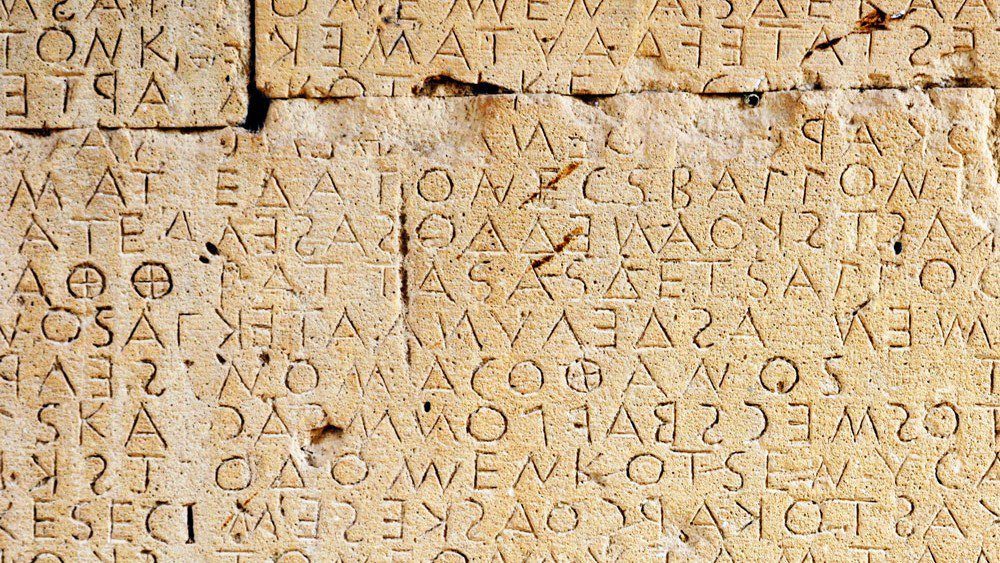
Ancient proteins are starting to reveal humanity's history

Homo floresiensis
© Adapted from World History Archive/AlamyHomo floresiensis is one of the species researchers hope to study by sequencing ancient proteins. Credit: Adapted from World History Archive/Alamy
Move over, DNA: Proteins dating back more than one million years have been extracted from some fossils, and could help to answer some difficult questions about archaic humans.
Some time in the past 160,000 years or so, the remains of an ancient human ended up in a cave high on the Tibetan Plateau in China. Perhaps the individual died there, or parts were taken there by its kin or an animal scavenger. In just a few years, the flesh disappeared and the bones started to deteriorate. Then millennia dripped by. Glaciers retreated and then returned and retreated again, and all that was left behind was a bit of jawbone with some teeth. The bone gradually became coated in a mineral crust, and the DNA from this ancient ancestor was lost to time and weather. But some signal from the past persisted.

Comment: See also:


Butterfly

Bird that went extinct 136,000 years ago comes 'back from the dead' after evolving again

White-throated rail.
© Charles J Sharp via CC BY-SA 4.0White-throated rail. There is no other evidence of the phenomenon that has ever been so clear, scientists say
A bird that previously went extinct rose from the dead after it evolved all over again, scientists have found.

The last surviving flightless species of bird in the Indian Ocean, a type of rail, has actually been around before, the research found. It came back through a process called "iterative evolution", which saw it emerge twice over, the researchers found.

It means that on two separate occasions - tens of thousands of years apart - a species of rail was able to colonise an atoll called Aldabra. In both cases it eventually became flightless, and those birds from the latter time can still be found on the island now.

Iterative evolution happens when the same or similar structures evolve out of the same common ancestor, but at different times - meaning that the animal actually comes about twice over, completely separately.

Comment: It would appear that there are a great many exceptions and anomalies to the mainstream theory of evolution: And check out SOTT radio's:


Info

'Hidden consciousness' detected in some coma patients

Hidden consciousness
© Chairoij/ShutterstockA study detected hidden consciousness in one out of seven unresponsive brain injury patients using widely-available hospital technology.
There are some things that life never prepares you for - like the dreaded phone call that a loved one is in a coma, and you're responsible for making their end-of-life decisions if they don't wake up.

These decisions are further complicated by the fact that there's no true test for consciousness. And, unfortunately, it's difficult for doctors to predict who will wake up and who won't.

But now, a team of researchers at the Columbia University Irving Medical Center say a tool that's readily available in nearly all hospitals around the world was effective in spotting signs of "hidden consciousness" in comatose patients. These subtle patterns in brain activity are signals that the person is aware but is physically unable to show it.

A study published in the New England Journal of Medicine found that an electroencephalogram (EEG), a machine that detects electrical activity in the brain, could find hints of hidden consciousness in one of seven people just days after a serious brain injury. And in patient follow-ups a year later, researchers say people who initially showed signs of hidden consciousness were more likely to recover.

Book 2

Stranger on a Plane: Lessons from 'Flatland' for intelligent design?

flatland
© Wikimedia Commons
In an earlier post, I discussed the diversity of thought within the intelligent design movement with respect to "who" (or what) the designer is. Many, but certainly not all, intelligent design advocates take a theistic position. This view is of course roundly rejected by Darwinian naturalists who believe that natural selection, which consists of blind, undirected processes working on random mutations, is a fully capable substitute for an intelligent designer. Much of their disgust is directed at the suggestion of something that is supernatural, beyond nature, having any role in the evolution either of the universe or of the biological world.

To some this may sound radical, but I think a question that needs to be asked is if the theistic view necessitates that God act in a supernatural sense. As someone who personally accepts the biblical view, I see no reason that must be the case. In fact, I believe the debate of natural versus supernatural, or theist versus atheist, reflects a lack of imagination.


Comment: Exactly. And this kind of expanded naturalism in the context of intelligent design can also accommodate a non-theistic 'intelligent designer' - as the example of Flatland below suggests. The field is wide open for speculation.


The principle embraced by most naturalists (or more specifically, physicalists) is that the universe is causally closed. Thus, for example, those who take a substance dualist view of the mind and the body could not possibly reconcile an "immaterial" mind with a material body, since immaterial objects (presuming they even exist) are considered causally impotent.

Brain

Octopus arms found to make decisions without input from their brains

Pulpo octopus
© Stuart Westmorland / www.globallookpress.com
With the ability to use tools, solve complex puzzles, and even play tricks on humans just for funsies, octopuses are fiercely smart. But their intelligence is quite weirdly built, since the eight-armed cephalopods have evolved differently from pretty much every other type of organism on Earth.

Rather than a centralised nervous system such as vertebrates have, two-thirds of an octopus's neurons are spread throughout its body, distributed between its arms. And now scientists have determined that those neurons can make decisions without input from the brain.

"One of the big picture questions we have is just how a distributed nervous system would work, especially when it's trying to do something complicated, like move through fluid and find food on a complex ocean floor," said neuroscientist David Gire of the University of Washington.

Comet 2

Giant asteroid contains enough heavy metals to make everyone on Earth a billionaire - and NASA is heading there in 2022

psyche 16
Psyche 16 is nestled between the orbits of Mars and Jupiter and is made of solid metal.

As well as gold, the mysterious object is loaded with heaps of platinum, iron and nikel.

In total, it's estimated that Psyche's various metals are worth a gargantuan £8,000 quadrillion.

Comment: See also:


Evil Rays

Best of the Web: The 5G Dragnet: Backbone of Totalitarian Surveillance

5G Dragnet
Telecom companies are currently scrambling to implement fifth-generation cellular network technology. But the world of 5G is a world where all objects are wired and constantly communicating data to one another. The dark truth is that the development of 5G networks and the various networked products that they will give rise to in the global smart city infrastructure, represent the greatest threat to freedom in the history of humanity.

For those with limited bandwidth, CLICK HERE to download a smaller, lower file size version of this episode.

For those interested in audio quality, CLICK HERE for the highest-quality version of this episode (WARNING: very large download).


Watch this video on BitChute / DTube / YouTube or Download the mp4

Bulb

Homeostasis: How the active maintenance inherent in biological processes showcases Intelligent Design

sleep
Nature is filled with processes that maintain an ordered state. Perhaps you have seen magnetic toys that keep an object suspended in the center of a space, such that any slight movement makes it snap back into position. Gravity keeps planets in orbits, and compresses stars into spheres. The gyroscopic effect keeps a bicyclist upright. Sand dunes maintain their shape due to the angle of repose of piled sand grains. Centripetal force keeps hurricanes and tornadoes circling around a center. The Coriolis effect maintains wind patterns. These familiar examples can be explained with reference to natural laws.

There's a different kind of maintenance in biology, called homeostasis. It is the subject of biologist Scott Turner book, Purpose and Desire: What Makes Something "Alive" and Why Modern Darwinism Has Failed to Explain It. This kind of "dynamic equilibrium" is maintained by machinery acting on other machinery. No natural law can maintain that kind of order. Indeed, natural laws would lead to decay and death if it were not for programmed responses able to overcome what would happen naturally. Here are some examples of that kind of active maintenance.

Bug

'Flying salt shakers of death': How a zombie fungus affects cicadas

cicada
© Matt KassonA cicada clings to a blade of grass.
If cicadas made horror movies, they'd probably study the actions of their counterparts plagued by a certain psychedelic fungus.

West Virginia University researchers have discovered that a cicada fungus called Massopora contains chemicals similar to those found in hallucinogenic mushrooms.

The fungus causes cicadas to lose their limbs and eccentric behavior sets in: Males try to mate with everything they encounter, although the fungus has consumed their genitals and butts.

Despite the horrid physical state of infected cicadas, they continue to roam around freely as if nothing's wrong, dousing other cicadas with a dose of their disease.

You've heard of "The Walking Dead." This is "The Flying Dead."

"They are only zombies in the sense that the fungus is in control of their bodies," said Matt Kasson, assistant professor of forest pathology and one of the study's authors.

Flashlight

'Extinct' creatures found alive deep within Honduras rainforest

honduras rainforest
Rainforest, Honduras
A team of scientists have discovered an ecosystem filled with rare and endangered species, including species that were thought to be extinct, in a "lost city" deep within a rainforest in Honduras.

The conservation team spent three weeks exploring an ancient settlement, known as the "Lost City of the Monkey God" or "White City", in the Mosquitia rainforest and found a diverse hub of wildlife, including hundreds of species of butterflies, bats and reptiles.

Scientists also rediscovered three species that were thought to be no longer living in Honduras: the pale-faced bat, the False Tree Coral Snake and a tiger beetle which had only been recorded in Nicaragua and was believed to be extinct.

Comment: There's no denying that life on our planet is under strain right now and that it's undergoing many shifts, including extinction level events, but there does appear to be a trend of declaring extinctions far too prematurely: See also: