

© Creativ Studio Heinemann via Global Look Press
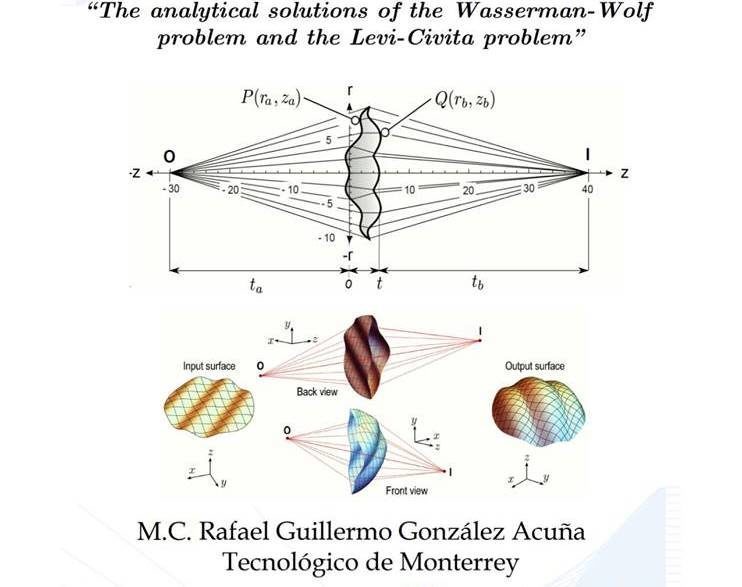
"I remember one morning I was making myself a slice of bread with Nutella and suddenly I said, 'Holy crap! It's there!'" Rafael González from the Institute of Technology in Monterrey, Mexico told his university paper.
"I went to my room, I started programming, it resolved and I jumped for joy with excitement."
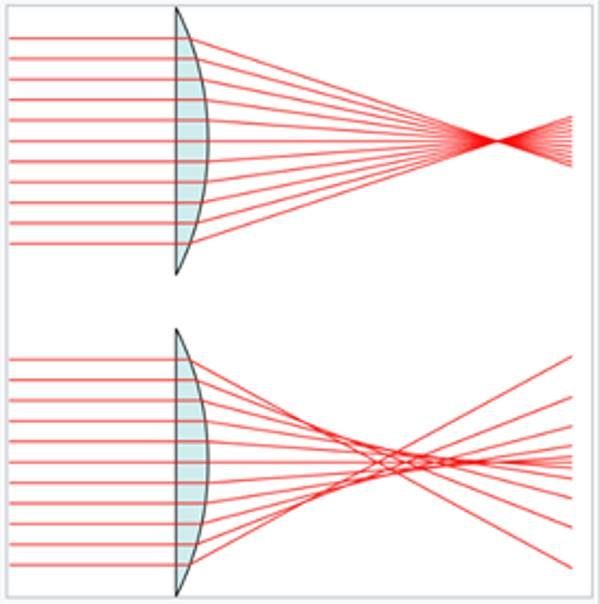
The optical phenomenon was discovered approximately 2,000 years ago by Greek mathematician Diocles. Since then, scientists like Newton and Leibniz tried, and failed, to resolve the problem of maintaining the sharpness of images when passed through spherical lenses.
Newton managed to solve the chromatic aberration (the issue of focusing all the colors from a light source) but not the spherical aberration. The issue was formalized in 1949 in what became known in the scientific community as the Wasserman-Wolf problem, but no one could solve it, until now.
Industrial engineer Gonzalez, who is currently working on a PhD in nanotechnology, teamed up with his friend and colleague Alejandro to solve what they dubbed the "a mythical problem." Their work was published in the journal Applied Optics.
A previous quick-fix solution was the use of two aspheric lenses (only rounded on one side) but the calibration of such lenses depended on an imprecise calculation. However, thanks to Gonzalez and his solution, a precise result can now be derived regardless of changes to the variables with a 99.99 percent success rate.
© M.C. Rafael Guillermo Gonzalas
Original article (Spanish)





On the other hand, it will give amateur astronomers the ability to see through n_a-s*a's bs (if it is)