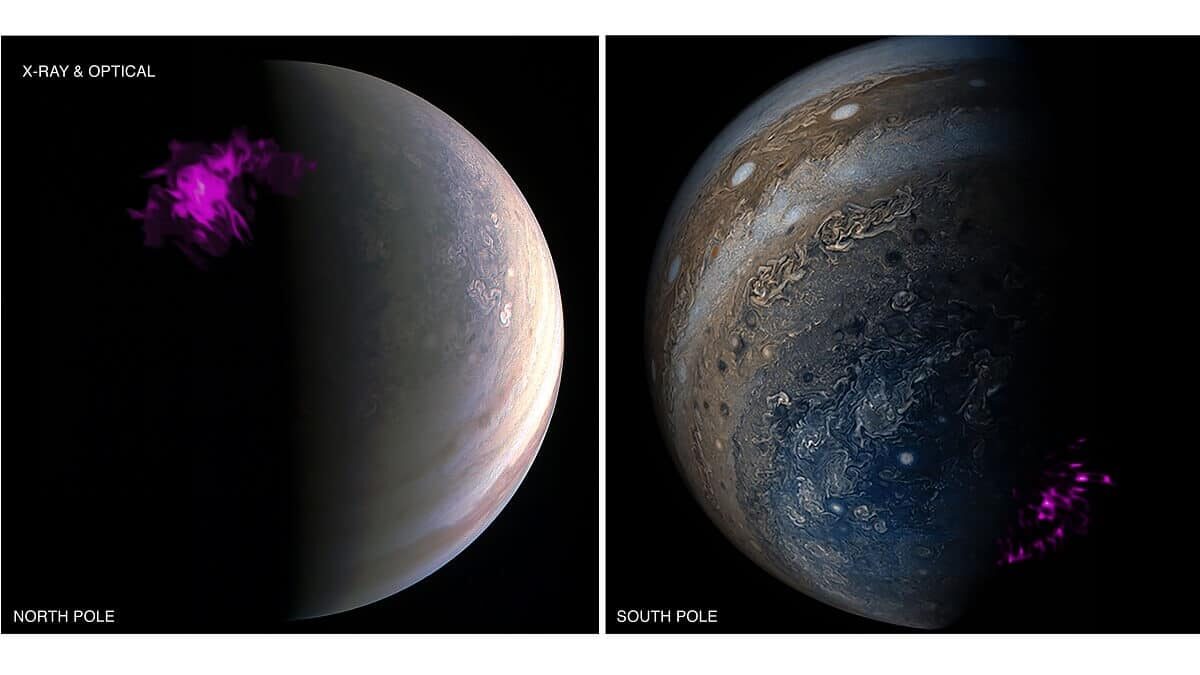
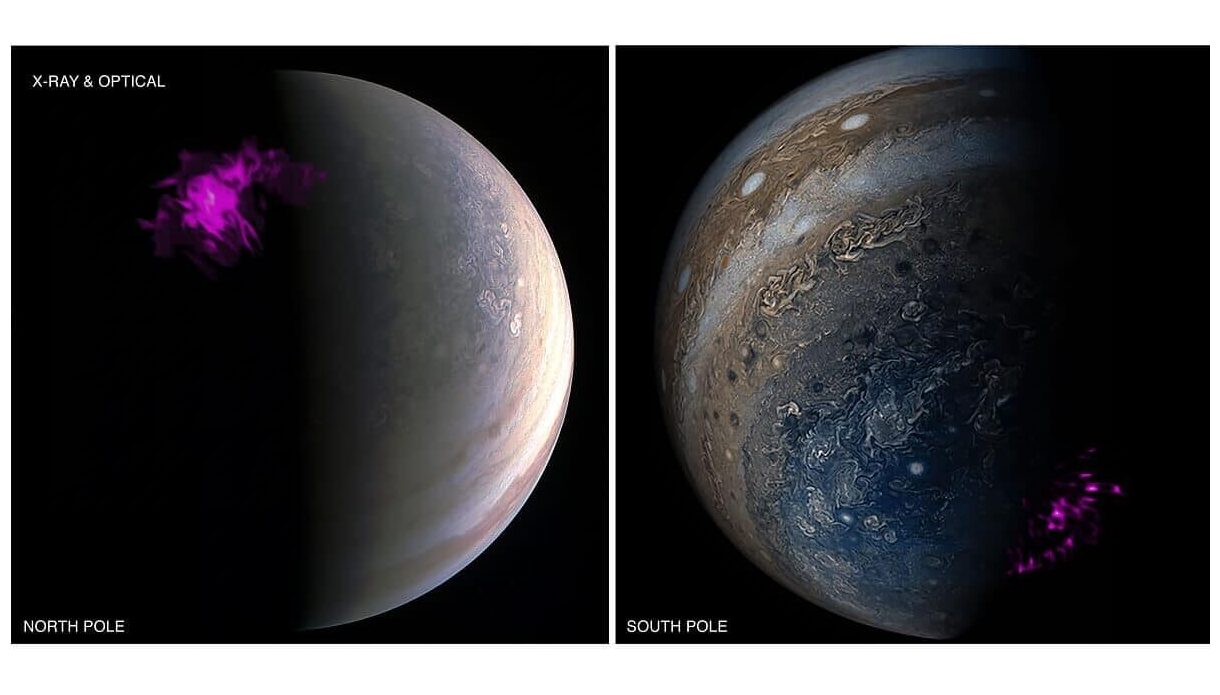
© NASA Chandra/Juno Wolk/DunnOverlaid images of Jupiter's pole from NASA's satellite Juno and NASA's Chandra X-ray telescope. Left shows a projection of Jupiter's Northern X-ray aurora (purple) overlaid on a visible Junocam image of the North Pole. Right shows the Southern counterpart.
Chinese and UK researchers have solved a 40-year-old puzzle: how does Jupiter produce regular and spectacular bursts of X-rays?
Turns out, it's all to do with the gas giant's magnetic field.Like Earth, Jupiter displays
spectacular light shows at its poles, where charged particles from the Sun (as well as from giant volcanoes on the moon Io) are channelled by the planet's magnetic field into the atmosphere. Here, these ions collide with gas atoms and produce bursts of light.
Jupiter's aurorae are much more powerful than our own, generating X-rays as well as visible light. These are produced like
clockwork - but how does the planet accelerate these charged particles to high enough speeds to produce X-rays?
"We have seen Jupiter producing X-ray aurora for four decades, but we didn't know how this happened," says William Dunn from the University College London. "We only knew they were produced when ions crashed into the planet's atmosphere."
Now, Dunn and colleagues from the Chinese Academy of Sciences have discovered that these X-ray flares are triggered by
periodic vibrations in Jupiter's magnetic field lines, which create waves of plasma that allow ions to "surf" down into the atmosphere, where they collide at high speed and generate X-rays.

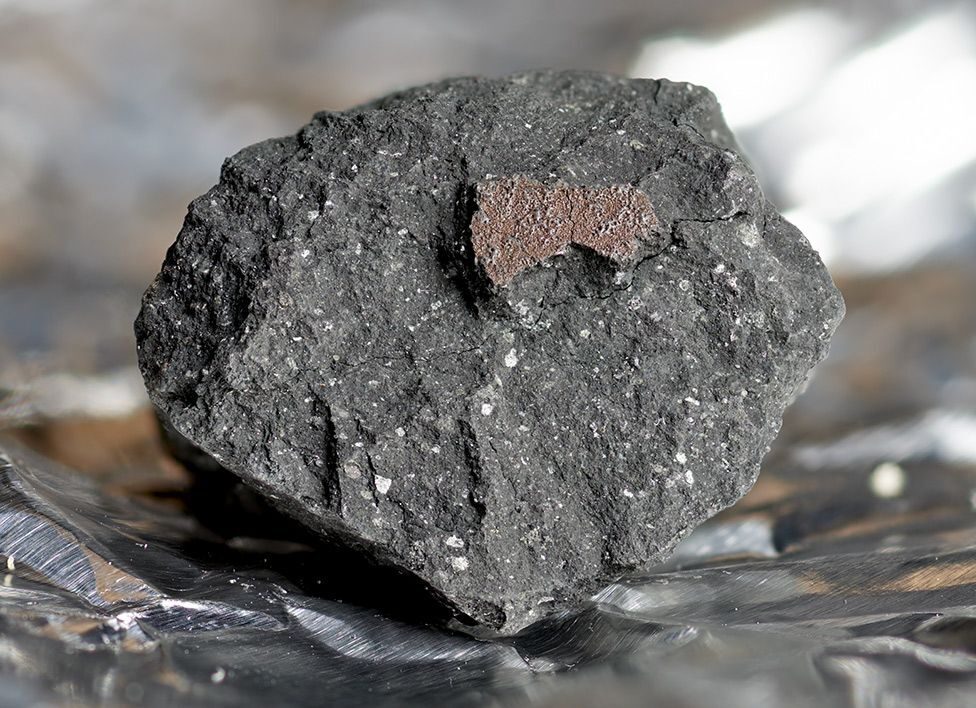













Comment: It's perhaps a sign of the documented uptick in fireball activity that meteorite recoveries are in the news more often in recent years:
- 30-pound meteorite that recently crashed in Sweden recovered in local village
- Two meteorites found in Madura, US, in just two weeks
- Suspected meteorite crashes into rice field in India
See also:- Loud blast recorded on dashcam as meteorite explodes over Sarawak, Indonesia - Locals felt earth shake
- HUGE meteor fireball lights up western China's dark morning skies
- Video shows meteor fireball blazing over Derbyshire, UK
- Chelyabinsk meteorite fragments reveal potential space collision
- Another new moon discovered around Jupiter
And check out SOTTs monthly documentary SOTT Earth Changes Summary - June 2021: Extreme Weather, Planetary Upheaval, Meteor Fireballs