Science & TechnologyS


Info

'Icelandia': Is Iceland the tip of a vast, sunken continent?

Submerged Continent
© Pixabay/CC0 Public Domain
Durham, UK: Academics believe they have identified a remarkable geological secret; a sunken continent hidden under Iceland and the surrounding ocean, which they have dubbed 'Icelandia'.

An international team of geologists, led by Gillian Foulger, Emeritus Professor of Geophysics in the Department of Earth Sciences at Durham University (UK), believe the sunken continent could stretch from Greenland all the way to Europe.

It is believed to cover an area of ~ 600,000 km2 but when adjoining areas west of Britain are included in a "Greater Icelandia" the entire area could be ~1,000,000 km2 in size.

If proven, it means that the giant supercontinent of Pangaea, which is thought to have broken up over 50 million years ago, has in fact not fully broken up.

This new theory challenges long-held scientific ideas around the extent of oceanic and continental crust in the North Atlantic region, and how volcanic islands, like Iceland, formed.

The presence of continental, rather than oceanic, crust could also spark discussions about a new source of minerals and hydrocarbons, both of which are contained in continental crust.

The revolutionary new theory was born from an innovative series of expert meetings held in Durham (UK) and is included in a dedicated chapter of In the Footsteps of Warren B. Hamilton: New Ideas in Earth Science published today (29 June 2021), by the Geological Society of America, which Professor Foulger has co-written with Dr Laurent Gernigon of the Geological Survey of Norway and Professor Laurent Geoffroy of the Ocean Geosciences Laboratory, University of Brest (France).

Info

New AI technique reveals clearer universe

shape of the Universe
© The Institute of Statistical MathematicsArtist’s visualization of this research. Using AI driven data analysis to peel back the noise and find the actual shape of the Universe.
Japanese astronomers have developed a new artificial intelligence (AI) technique to remove noise in astronomical data due to random variations in galaxy shapes. After extensive training and testing on large mock data created by supercomputer simulations, they then applied this new tool to actual data from Japan's Subaru Telescope and found that the mass distribution derived from using this method is consistent with the currently accepted models of the Universe. This is a powerful new tool for analyzing big data from current and planned astronomy surveys.

Wide area survey data can be used to study the large-scale structure of the Universe through measurements of gravitational lensing patterns. In gravitational lensing, the gravity of a foreground object, like a cluster of galaxies, can distort the image of a background object, such as a more distant galaxy. Some examples of gravitational lensing are obvious, such as the "Eye of Horus". The large-scale structure, consisting mostly of mysterious "dark" matter, can distort the shapes of distant galaxies as well, but the expected lensing effect is subtle. Averaging over many galaxies in an area is required to create a map of foreground dark matter distributions.

But this technique of looking at many galaxy images runs into a problem; some galaxies are just innately a little funny looking. It is difficult to distinguish between a galaxy image distorted by gravitational lensing and a galaxy that is actually distorted. This is referred to as shape noise and is one of the limiting factors in research studying the large-scale structure of the Universe.

Control Panel

Researchers observe thermal waves in semiconductor materials - unlocks new possibilities in electronics design

lasers test thermal semi conductors
© ICMAB, CSICTwo different lasers are focused onto the surface of the samples using a microscope objective. A rather large combination of optical elements allows to control and modify the spot size and shape, as well as the power and harmonic modulation of the lasers. Cold nitrogen gas is used for better visualization of the lasers optical path.
A study published in Science Advances reports on the unexpected observation of thermal waves in germanium, a semiconductor material, for the first time. This phenomenon may allow a significant improvement in the performance of our electronic devices in a near future. The study is led by researchers from the Institute of Materials Science of Barcelona (ICMAB, CSIC) in collaboration with researchers from the Universitat Autònoma de Barcelona, and the University of Cagliari.

Heat, as we know it, originates from the vibration of atoms, and transfers by diffusion at ambient temperatures. Unfortunately, it is rather difficult to control, and leads to simple and inefficient strategies for manipulation. This is why, for example, large amounts of residual heat can accumulate in our computers, mobile phones and, in general, most electronic devices.

However, if heat was transported through waves, such as light, it would offer new alternatives to control it, especially through the unique and intrinsic properties of waves.

Mars

UAE's Hope Mars orbiter spots elusive aurora on Red Planet

mars aurora 1
© Emirates Mars MissionAn artist's depiction of the discrete aurora on Mars.
The United Arab Emirates' (UAE) Hope Mars mission made its first major finding just a couple months after arriving at the Red Planet when it snagged unprecedented observations of a tricky aurora.

Also known as the Emirates Mars Mission (EMM), Hope is designed to study Mars' atmosphere across all its layers and at a global scale throughout the course of the year. But the new finding is outside that main science purview and occurred even before the probe's formal science mission had begun, when scientists were testing the instruments on the spacecraft. In images from one of those instruments, scientists easily spotted the highly localized, nightside aurora that scientists have struggled to study at Mars for decades.

"They're not easy to catch, and so that's why seeing them basically right away with EMM was kind of exciting and unexpected," Justin Deighan, a planetary scientist at the University of Colorado'' Laboratory for Atmospheric and Space Physics and deputy science lead for the Hope mission, told Space.com. "It's definitely something that was on our radar, so to speak, but just looking at our first set of nighttime data and saying, 'Hey, wait a second — is that? — it can't be — it is!' — that was a lot of fun."

Scientists know that Earth's auroras are tied to the planet's global magnetic field and are triggered by charged particles from the sun. But the situation is a little different at Mars, where scientists have observed three types of auroras.

Cassiopaea

First X-flare in 4 years, CME from B-class flare may hit Earth this weekend

x flare july 2021
Today's explosion registered X1.5 on the Richter Scale of Solar Flares

CME IMPACT POSSIBLE THIS WEEKEND


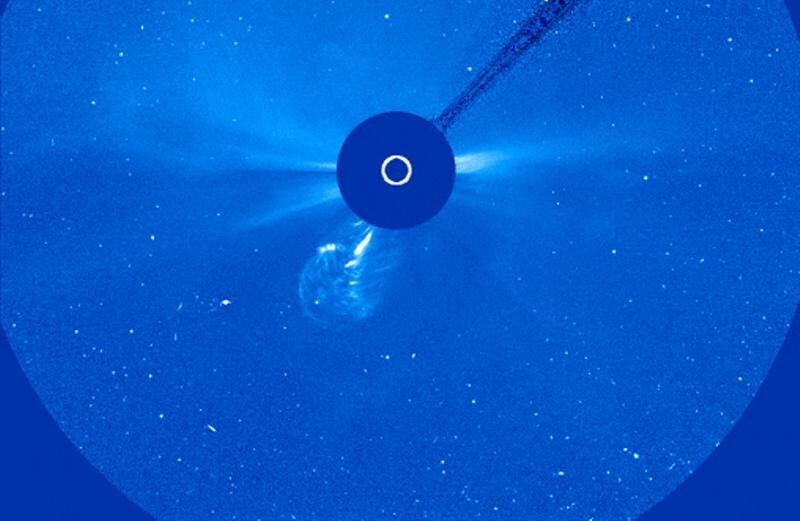
A minor coronal mass ejection (CME) is expected to hit Earth this weekend. It left the sun on June 29th, propelled toward us by a B7-class solar flare. The impact will probably be too weak to cause a geomagnetic storm, but high-latitude auroras are possible on July 3rd or 4th.

Aurora alerts: SMS Text.

FIRST X-FLARE IN 4 YEARS


A new sunspot emerged during the early hours of July 3rd and promptly exploded, producing the first X-class solar flare since Sept. 2017. NASA's Solar Dynamics Observatory recorded the extreme ultraviolet flash:

Today's explosion registered X1.5 on the Richter Scale of Solar Flares

Comment: See also: A warning from history: The Carrington event was not unique


Telescope

Astronomers may have discovered the smallest and heaviest white dwarf star ever seen

white dwarf ZTF J1901+1458
© Giuseppe ParisiThe white dwarf ZTF J1901+1458 is depicted above the moon in this artistic representation; in reality, the white dwarf lies 130 light-years from Earth in the constellation Aquila, the eagle.
Astronomers may have discovered the smallest and heaviest white dwarf star ever seen, a smoldering ember about the size of our moon but 450,000 times more massive than Earth, a new study finds.

White dwarfs are usually about the size of Earth and are the cool, dim cores of dead stars that are left behind after average-size stars have exhausted their fuel and shed their outer layers. Our sun will one day become a white dwarf, as will about 97% of all stars.

Although the sun is alone in space without a stellar partner, many stars orbit around each other in pairs. If these binary stars are both less than eight times the mass of the sun, they will both evolve into white dwarfs over time.

The newfound white dwarf, designated ZTF J1901+1458, is located about 130 light-years from Earth and may be an example of what can happen when white dwarf pairs merge. If the white dwarfs were more massive, they would explode in a powerful thermonuclear explosion known as a Type Ia supernova. However, if their combined masses fell below a certain threshold, they could form a new white dwarf heavier than either of its parents, which is what scientists think happened in the case of ZTF J1901+1458.

Better Earth

Climate change drove decline of mastodonts and elephants, new study suggests

prehistoric megafauna megaflora
© Julius CsotonyiDusk falls on East Africa's Turkana Basin 4 million years ago, where our early upright-walking ape ancestors, Australopithecus anamensis (foreground), shared their habitat with several coexisting proboscidean species, as part of a spectacular herbivore community containing some progenitors of today's charismatic East African animals. Background (left to right): Anancus ultimus, last of the African mastodonts; Deinotherium bozasi, colossal herbivore as tall as a giraffe; Loxodonta adaurora, gigantic extinct cousin of modern African elephants, alongside the closely-related, smaller L. exoptata. Middle ground (left to right): Eurygnathohippus turkanense, zebra-sized three-hoofed horse; Tragelaphus kyaloae, a forerunner of the nyala and kudu antelopes; Diceros praecox - ancestor of the modern black rhino.
Elephants and their forebears were pushed into wipeout by waves of extreme global environmental change, rather than overhunting by early humans, according to new research.

The study, published today in Nature Ecology & Evolution, challenges claims that early human hunters slaughtered prehistoric elephants, mammoths and mastodonts to extinction over millennia. Instead, its findings indicate the extinction of the last mammoths and mastodonts at the end of the last Ice Age marked the end of progressive climate-driven global decline among elephants over millions of years.

Comment: See also:


Satellite

China's Zhurong rover sends back video and audio from Mars

Zhurong
Illustration of China's Zhurong rover
2021 has been a great year so far for space science and astronomy. This year, we have crossed one more milestone as China's Zhurong Mars rover has become the second rover to sent back video and audio from the planet's Utopia Planitia region.

On Sunday, Zhurong descended into the planet's surface and has sent back to us the video of this amazing feat. The footage includes the deployment of its parachute and a uber-cool drive off from the Tianwen-1 landing platform. The drive off video also features sounds captured by the rover's climate station.

Here is the video of Zhurong's parachute deployment and descent.

Comment: See also:


Cloud Lightning

Electric Universe: Invisible bursts of electricity from volcanoes signal explosive eruptions

Lightning flashes and ash and lava spew as Sakurajima volcano erupts in Japan
© Mike Lyvers/Moment/Getty ImagesLightning flashes and ash and lava spew as Sakurajima volcano erupts in Japan. A new study distinguishes between lightning and smaller, more mysterious surges of electrical activity produced by the volcano.
As one of Japan's most active volcanoes, Sakurajima often dazzles with spectacular displays of volcanic lightning set against an ash-filled sky. But the volcano can also produce much smaller, invisible bursts of electrical activity that mystify and intrigue scientists.

Now, an analysis of 97 explosions at Sakurajima from June 2015 is helping to show when eruptions produce visible lightning strokes versus when they produce the mysterious, unseen surges of electrical activity, researchers report in the June 16 Geophysical Research Letters.

These invisible bursts, called vent discharges, happen early in eruptions, which could allow scientists to figure out ways to use them to warn of impending explosions.

Researchers know that volcanic lightning can form by silicate charging, which happens both when rocks break apart during an eruption and when rocks and other material flung from the volcano jostle each other in the turbulent plume (SN: 3/3/15). Tiny ash particles rub together, gaining and losing electrons, which creates positive and negative charges that tend to clump together in pockets of like charge. To neutralize this unstable electrical field, lightning zigzags between the charged clusters, says Cassandra Smith, a volcanologist at the Alaska Volcano Observatory in Anchorage.

Mars

Mysterious methane detections on Mars baffle NASA scientists

mars
Martian landscape
Reports of methane detections at Mars have captivated scientists and non-scientists alike. On Earth, a significant amount of methane is produced by microbes that help most livestock digest plants. This digestion process ends with livestock exhaling or burping the gas into the air.

While there are no cattle, sheep, or goats on Mars, finding methane there is exciting because it may imply that microbes were, or are, living on the Red Planet. Methane could have nothing to do with microbes or any other biology, however; geological processes that involve the interaction of rocks, water, and heat can also produce it.

Before identifying the sources of methane on Mars, scientists must settle a question that's been gnawing at them: Why do some instruments detect the gas while others don't? NASA's Curiosity rover, for instance, has repeatedly detected methane right above the surface of Gale Crater. But ESA's (the European Space Agency) ExoMars Trace Gas Orbiter hasn't detected any methane higher in the Martian atmosphere.

Comment: See also: