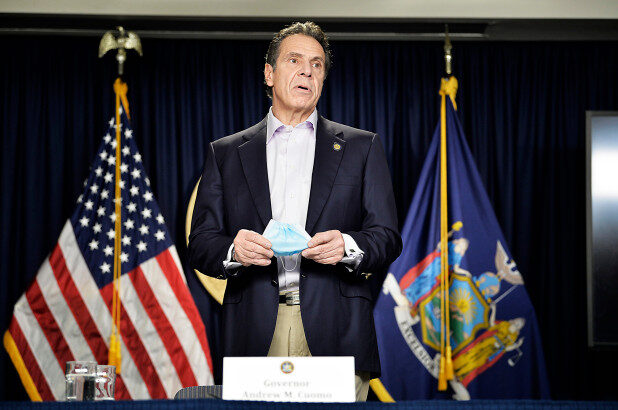
© Matthew McDermottNY Governor Andrew Cuomo holds a press conference at his NYC office.
It was a freewheeling conversation in a Manhattan restaurant about how to change Albany. Andrew Cuomo, then New York's attorney general, was a lock to be elected governor in 2010 and was gaming the hurdles and opportunities.
His conclusion would prove prophetic in ways he couldn't imagine. "The answer is to do it in two terms," he told a companion. "Third terms are always a mistake."
The irony is beyond rich, now that Cuomo is hitting major turbulence midway through his third term.
Months after he was hailed as a model governor and touted as presidential timber, the sudden question is whether he will survive a federal investigation into the nursing-home disaster and accusations by two former aides that Cuomo sexually harassed them.Power corrupts, third terms corrupt absolutely.
Calls for impeachment are growing louder over the horrific 15,000 nursing-home deaths and Cuomo's effort to hide them from the public and the FBI. Even louder are the calls from both Democrats and Republicans for him either to resign or face an independent probe into the harassment claims.
The calls took on a new urgency after the second woman's claim became public Saturday night.
The crises share common roots:
Cuomo centralized power like no governor in modern times and came to see himself as untouchable. When the Legislature granted him emergency power early in the pandemic, he used it to fight critics as well as the virus.The clamor against him has been slow to build largely because New York is run exclusively by Dems, most of whom would have instantly called for Cuomo's head if he were a Republican. Their hesitancy is also owing to the governor's reputation for taking retribution on even the mildest critics.
















Comment: Cuomo has offered up a half-hearted apology for his insensitive jokes towards females that he has worked with. Not that he really is sorry for anything, other than for getting caught being a creepy politician which seems to be a requirement for the job. Unsurprisingly, his apology backfired on him. Instead of just saying, "I shouldn't have done that," Cuomo said that "some of the things" he said "have been misinterpreted as unwanted flirtation." We can always rely on politicians to blame others for their "incorrect interpretation" than to take any real ownership for their behavior. It remains to be seen if anything substantial will come from the investigation, which has just been greenlit by the NY AG.