Science & TechnologyS


Rose

Horizontal gene transfer enabled plants to move to land

horizontal gene transfer
Natural genetic engineering allowed plants to move from water to land, according to a new study by an international group of scientists from Canada, China, France, Germany, and Russia.

"This is one of the most important events in the evolution of life on this planet -- without which we as a species would not exist," said Gane Ka-Shu Wong, co-investigator and professor in the Faculty of Science and Faculty of Medicine & Dentistry at the University of Alberta. "The movement of life from water to land -- called terrestrialization -- began with plants and was followed by animals and then, of course, humans. This study establishes how that first step took place."

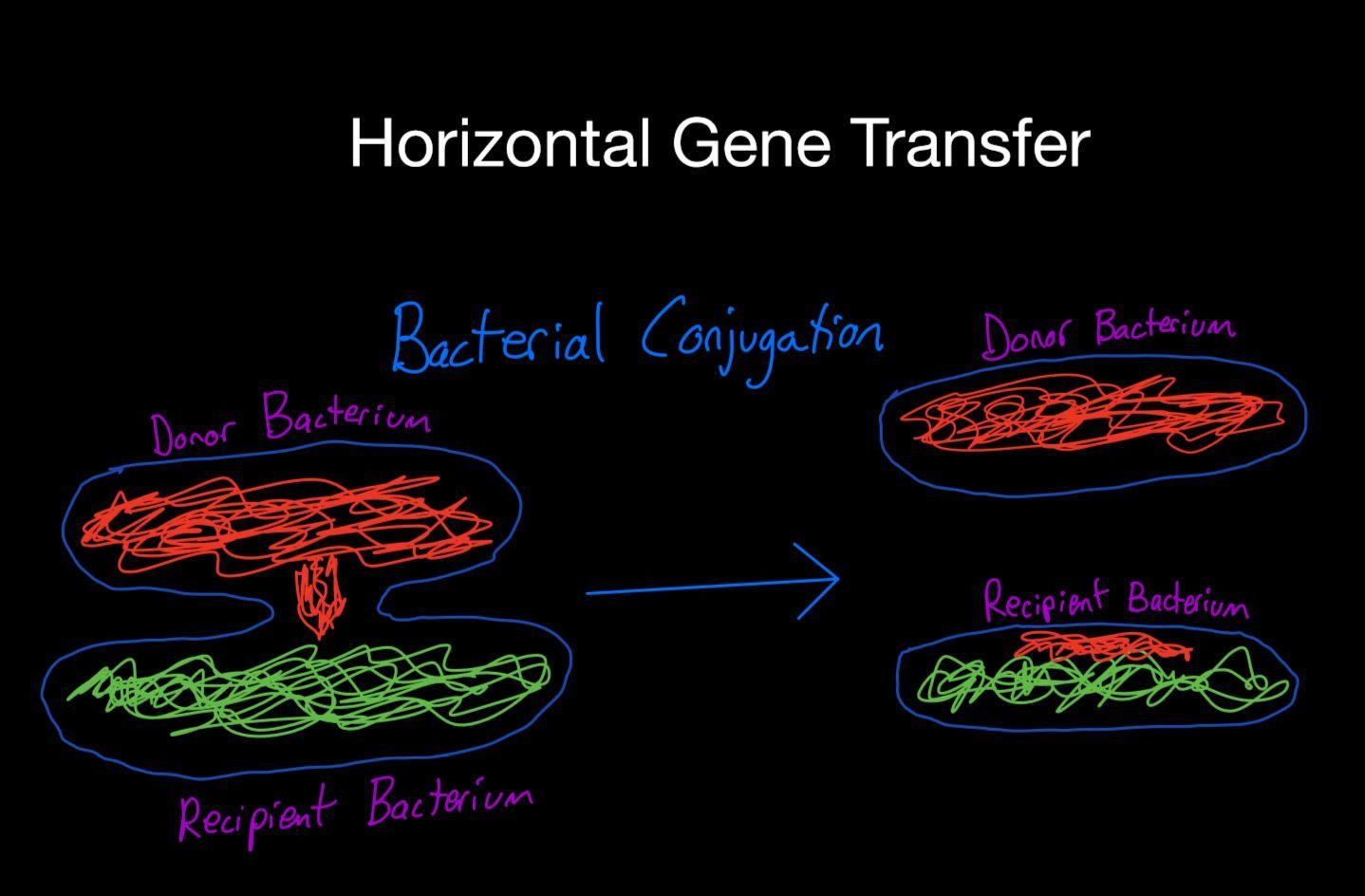
The movement of plants from water to land was made possible when genes from soil bacteria were transferred to algae through a process called horizontal gene transfer. Unlike vertical gene transfer, such as the transfer of DNA from parent to child, horizontal gene transfer occurs between different species.

Comment: See also: And check out SOTT radio's:


Better Earth

Water vapor above Jupiter's moon Europa confirmed by NASA study, fuels hopes of possible life

jupiter water
© NASA . JPL
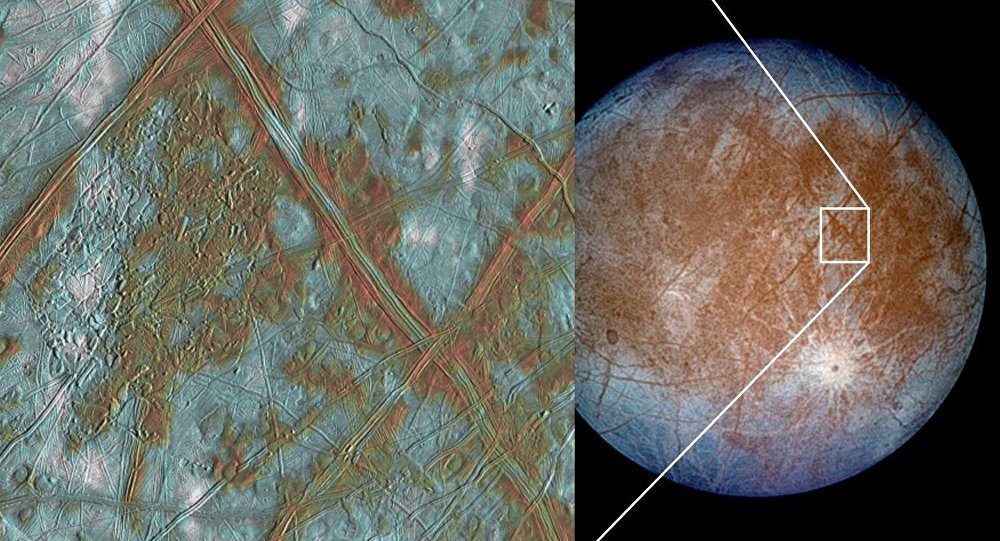
40 years ago, a Voyager spacecraft snapped the first close-up images of Europa, one of Jupiter's moons, with subsequent missions to the outer solar system amassing enough fascinating information to make it a high-priority target in NASA's search for life.

A team led by researchers at NASA's Goddard Space Flight Center in Greenbelt, Maryland, has confirmed traces of water vapour above the surface of Jupiter's icy moon Europa.

"While scientists have not yet detected liquid water directly, we've found the next best thing: water in vapour form," lead researcher and NASA planetary scientist Lucas Paganini said in a statement.

Comment: It's becoming ever more evident that water (in one form or another) is prevalent throughout the solar system, and beyond:


Road Cone

Rare gas find suggests Southern Africa lies above plume of abnormally hot mantle

KwaZulu-Natal
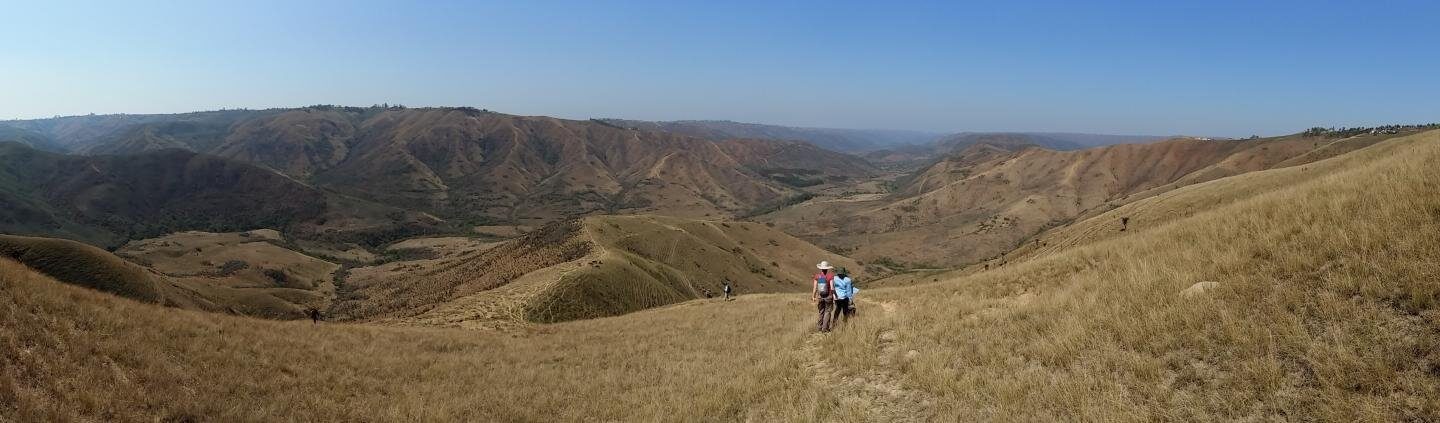
© Stuart GilfillanResearchers doing fieldwork in KwaZulu-Natal, South Africa.
The discovery of gases released from deep beneath the Earth's crust could help to explain Southern Africa's unusual landscape, a study suggests.

Scientists have long puzzled over why areas such as South Africa's Highveld region are so elevated and flat, with unexpectedly hot rocks below the surface.

Geologists have revealed that carbon dioxide-rich gases bubbling up through natural springs in South Africa originate from a column of hot, treacle-like material — called a hotspot — located deep inside the Earth.

Hotspots are known to generate volcanic activity in Hawaii, Iceland and Yellowstone National Park. In South Africa, the hotspot pushes the crust upwards, generating the distinctive landscape, which consists mostly of tablelands more than one kilometre above sea level, the researchers say.

Comment: See also:


Fireball 2

First detection of sugars in meteorites may give clues to origin of life

Bennu asteroid
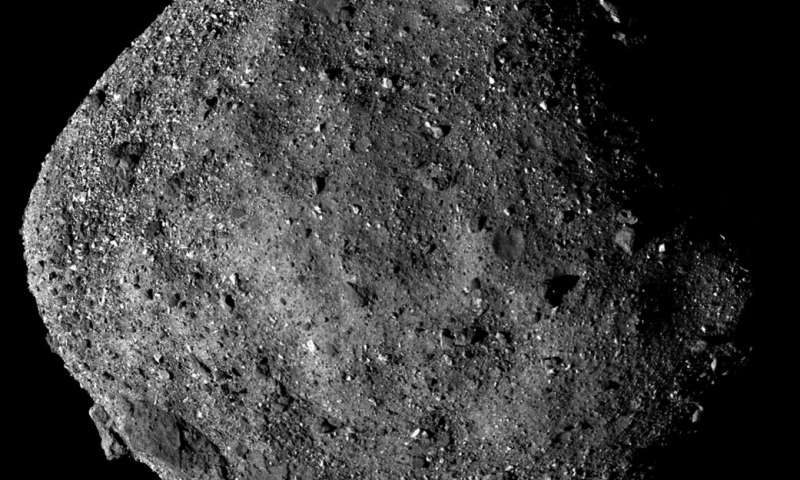
© NASA/Goddard/University of ArizonaThis is a mosaic image of asteroid Bennu, from NASA's OSIRIS-REx spacecraft. The discovery of sugars in meteorites supports the hypothesis that chemical reactions in asteroids - the parent bodies of many meteorites - can make some of life's ingredients.
An international team has found sugars essential to life in meteorites. The new discovery adds to the growing list of biologically important compounds that have been found in meteorites, supporting the hypothesis that chemical reactions in asteroids — the parent bodies of many meteorites — can make some of life's ingredients. If correct, meteorite bombardment on ancient Earth may have assisted the origin of life with a supply of life's building blocks.

The team discovered ribose and other bio-essential sugars including arabinose and xylose in two different meteorites that are rich in carbon, NWA 801 (type CR2) and Murchison (type CM2). Ribose is a crucial component of RNA (ribonucleic acid). In much of modern life, RNA serves as a messenger molecule, copying genetic instructions from the DNA molecule (deoxyribonucleic acid) and delivering them to molecular factories within the cell called ribosomes that read the RNA to build specific proteins needed to carry out life processes.

Bulb

BioEssays editor: "'Junk' DNA... full of information!" Including genome-sized "genomic code"

Junk DNA
© Kim Kyung-Hoon / Reuters
How many times have we heard it claimed that the vast majority of the human genome is "junk" and therefore could not have been designed? Even in the face of overwhelming evidence from the ENCODE project and numerous other studies showing that most of our genome has biochemical function, most evolutionists still maintain that our genomes are largely junk. But a few brave scientists, including some rare evolutionists, have been willing to buck that trend.

In a new article at Advanced Science News — "That 'Junk' DNA... Is Full of Information!" — Andrew Moore, the Editor-in-Chief of the respected biology journal BioEssays, comments on a new BioEssays paper. The paper finds that our DNA contains overlapping layered "'dual-function' pieces of information," including a "genomic code" that spans virtually the entire genome in order to "defin[e] the shape and compaction of DNA into the highly-condensed form known as 'chromatin.'" More about that paper in just a moment. It was written by leading Italian biologist Giorgio Bernardi who played a major role in the discovery of isochores. Isochores are important in this story. But for now, let's look at Moore's essay. It has something worth mentioning in almost every paragraph.

Moore starts by saying that it should not be surprising that there is more function in the genome than we initially expected:
It should not surprise us that even in parts of the genome where we don't obviously see a 'functional' code (i.e., one that's been evolutionarily fixed as a result of some selective advantage), there is a type of code, but not like anything we've previously considered as such.

Comment: See also:


Blackbox

New quantum experiment may prove that objective reality does not exist

quantum computer processor
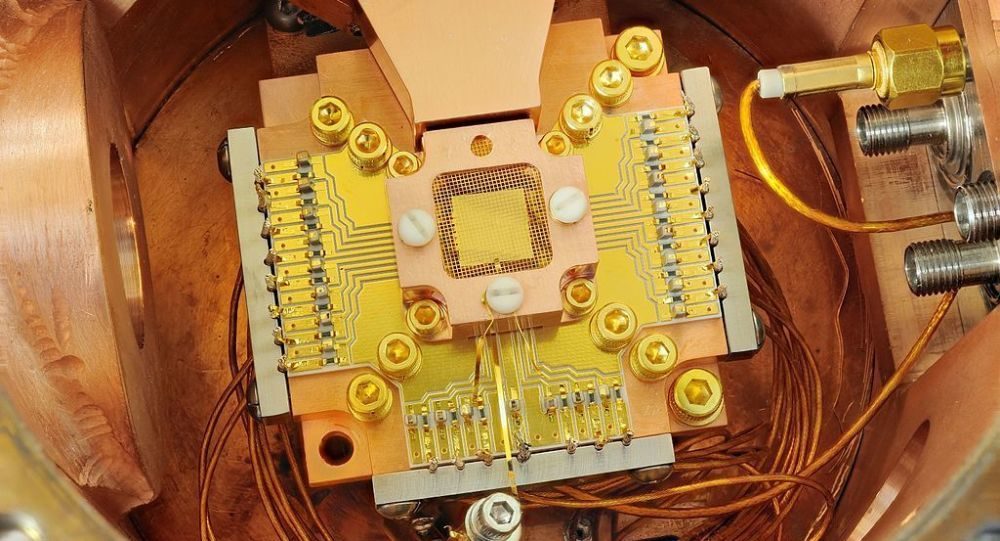
Scientists in Edinburgh have been using quantum computers to measure the behaviour of photons while being observed in order to determine if reality changes its behaviour depending on if it is being observed or not.

A new paper published in Science Advances in September claims that reality may in fact be subjective.

According to the theory in the study, particles can simultaneously exist at several places or states, known as superposition. This is only the case, however, when they are not observed.

Comment: See also:


Attention

Sixth mass extinction well under way

Rare Tiger
© Keith Roper/Flickr, CC BY-SAHumans are probably causing what ice ages and asteroids caused before them.
For more than 3.5 billion years, living organisms have thrived, multiplied and diversified to occupy every ecosystem on Earth. The flip side to this explosion of new species is that species extinctions have also always been part of the evolutionary life cycle.

But these two processes are not always in step. When the loss of species rapidly outpaces the formation of new species, this balance can be tipped enough to elicit what are known as "mass extinction" events.

A mass extinction is usually defined as a loss of about three quarters of all species in existence across the entire Earth over a "short" geological period of time. Given the vast amount of time since life first evolved on the planet, "short" is defined as anything less than 2.8 million years.

Since at least the Cambrian period that began around 540 million years ago when the diversity of life first exploded into a vast array of forms, only five extinction events have definitively met these mass-extinction criteria.

These so-called "Big Five" have become part of the scientific benchmark to determine whether human beings have today created the conditions for a sixth mass extinction.

SOTT Logo Radio

SOTT Focus: Objective:Health #37 - Big Tech Censors Natural Health Sites - With Scott Ogrin of Scottie's Tech Info

O:H header
Any regular readers of Sott.net, Mercola.com, GreenMedInfo and a number of other alternative health news websites are no-doubt familiar with the fact that alternative health information is being censored, deranked or flatly banned by a number of Big Tech platforms. Google, Facebook, Wikipedia, Pinterest, even MailChimp have all been exposed recently for taking a firm stand against their user's freedom to have access to the health information they may wish to see.

Today we're joined again by Scott Ogrin of Scottie's Tech.Info to give us the techie take on the nefarious agenda of Big Tech to control the information flow and steer public perception towards official consensus reality. We cover the latest whistleblower releases of Zach Vorhies, Dr. Robert Epstein and more.

It's a scary world, and one that is becoming increasingly difficult to navigate! Join us on this edition of Objective:Health where we cover the latest machinations of the technocracy!


And check us out on Brighteon!


For other health-related news and more, you can find us on:

♥Twitter: https://twitter.com/objecthealth
♥Facebook: https://www.facebook.com/objecthealth/

And you can check out all of our previous shows (pre YouTube) here.

Running Time: 01:17:30

Download: MP3 — 70.3 MB


Fireball

Asteroid warning: Scientists launch campaign to save Earth from deep space impact

asteroid
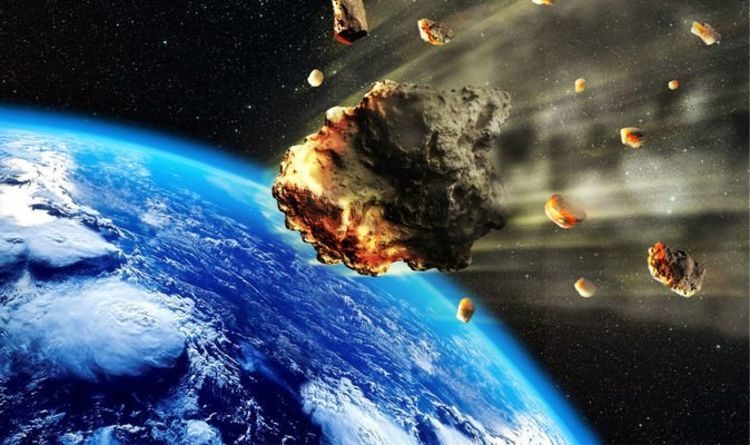
Asteroid experts all over the globe fear our planet sits in a shooting gallery of so-called Near-Earth Objects or NEOs. Approximately 66 million years ago, one of these asteroids wiped out two-thirds of all life on the planet and ended the reign of the dinosaurs. Today, four new NEOs are discovered every single day but many potential threats remain undetected.

The campaign dubbed Support Hera and initiated by the co-founders of Asteroid Day hopes to influence more research into safeguarding Earth from future impacts.

Hera is the European Space Agency's (ESA's) planetary defence and asteroid deflection mission ran in partnership with the US space agency NASA.

Comment: See also: Video from the event's YouTube page:


Seismograph

France's earthquake caused unusual crack in Earth's crust, puzzling scientists

Rouviere
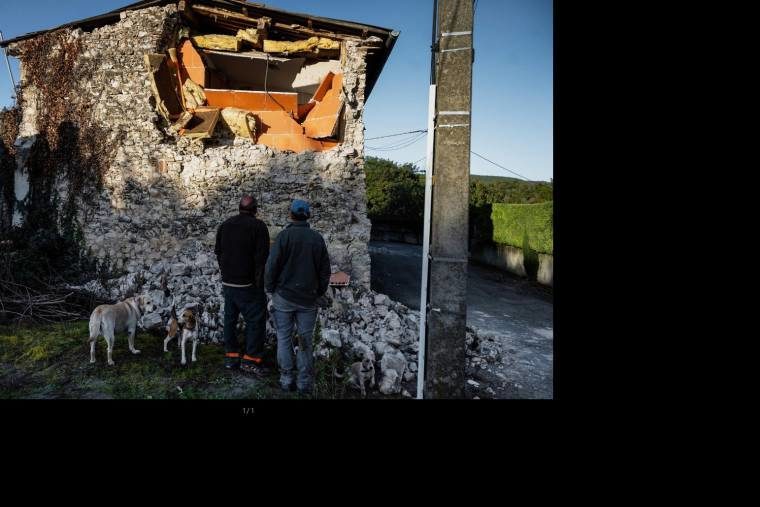
© Jeff Pachoud, AFP via Getty ImagesA 4.8 magnitude earthquake struck southeast France on November 11, damaging buildings and injuring four people. The small town of Le Teil suffered some of the worse damage, with hundreds of structures cracked and crumbling, such as the one pictured here in the town's Rouviere quarter.
A smidgen before noon, Clément Bastie and his family were preparing dinner in the small French town of Le Teil when the walls began to tremble. Glasses and plates crashed to the ground. Then a booming sound reverberated through the town.

Fears of explosions at the nearby nuclear energy plant flooded into his mind. Bastie, a high school biology and geology teacher, rushed outside expecting to see the bloom of a mushroom cloud. But as he soon discovered, the shaking came from something less devastating but still surprising for the region: an earthquake that cracked through the ground.

Clocking in at 4.8 magnitude, the temblor damaged numerous buildings and injured four people. It also left scientists buzzing over a number of curious features. For one, while France is no stranger to temblors, they are often quite small, explains seismologist Jean-Paul Ampuero of the Université Côte d'Azur in France. Monday's event was only of moderate intensity by global measures, but it was a "very large one for French standards," he says.

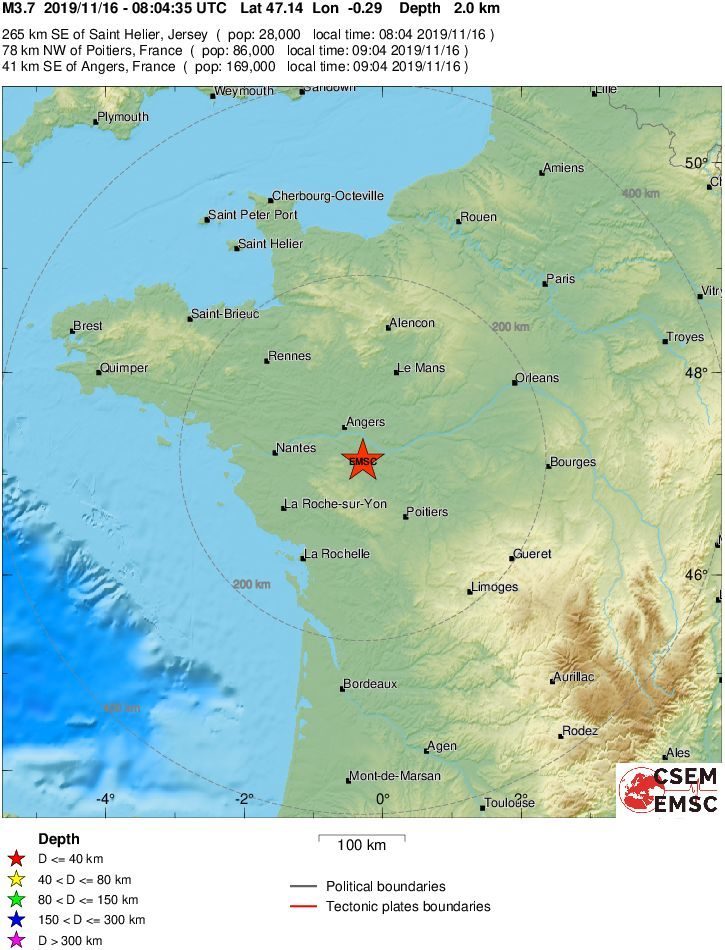
Comment: Just today another quake was recorded, although not in the same region, at M3.7 4 km W of Le Puy-Notre-Dame at 09:04 local time:

earthquake france m3.7
Everything is changing: the composition of the atmosphere; the electric charge differential between atmosphere, ground and sub-surface layers; the core itself is heating up if one theory for 'El Nino' is correct; even the Sun is behaving differently... there's gonna be a whole lotta strange in the next few years!

See also: And check out SOTT radio's: As well as SOTT's monthly documentary tracking these events: SOTT Earth Changes Summary - October 2019: Extreme Weather, Planetary Upheaval, Meteor Fireballs