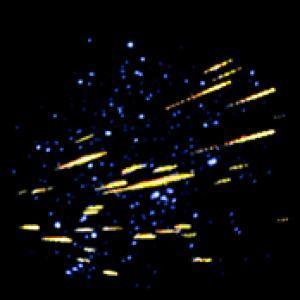
© NASAThe Alpha-Monocerotid meteor outburst in 1995. Meteors are actually pieces of rock that have broken off a comet and continue to orbit the Sun.
What's rarer than seeing a unicorn? How about a unicorn spitting meteors at the rate of 400 per hour? You'll have an opportunity to see it for yourself on Thursday night, November 21-22, when the obscure Alpha Monocerotid shower could produce upwards of 400 meteors per hour from a radiant near the star Procyon, a star near the constellation
Monoceros, the unicorn. Even more amazing, the outburst is expected to last only a half-hour.
Peter Jenniskens, a senior research scientist with the SETI Institute and NASA's Ames Research Center, along with
Esko Lyytinen of the Finnish Fireball Network, have been keeping tabs on the shower for years. During outbursts, such as those that occurred in 1925 and 1935, activity reached meteor-storm levels with a
zenithal hourly rate (ZHR) of more than 1,000. Activity rose to near-storm levels again in 1985 and 1995 with ZHRs around 700 and 400. ZHR is an idealized number based on how many meteors a single observer would see if the radiant were overhead in a dark sky during shower maximum.
The source of the Alpha Monocerotids is unknown, but the stream's orbital characteristics point to a long-period comet with a period of about 500 years. This nameless visitor deposited a dense, narrow ribbon of debris in the distant past with a half-width of only around 55,000 kilometers, equal to the distance from the center of Earth to the geostationary satellite belt.

















Comment: Sounds like a recipe for the worst social media platform ever. Considering he's launching this platform at our peak 'cancel culture' moment in history, giving people the ability to edit or delete each other's posts will likely lead to the removal of all content (except for, perhaps, the banal content Wales rails against). Everything offends someone, especially if it's something worth saying. This sounds like the opposite of the free-speech platforms people have been asking for.
See also: