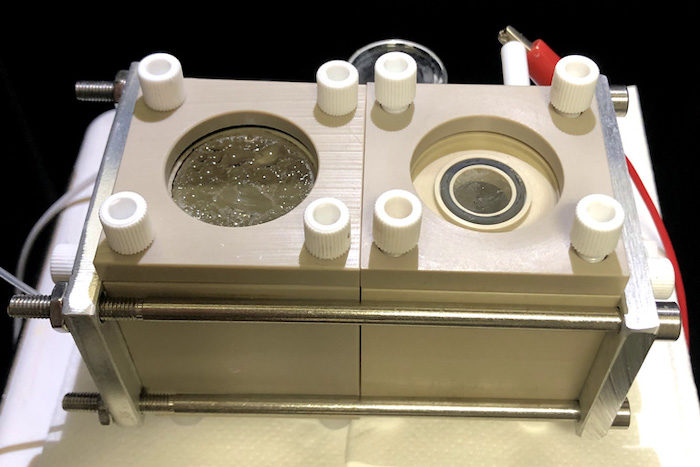
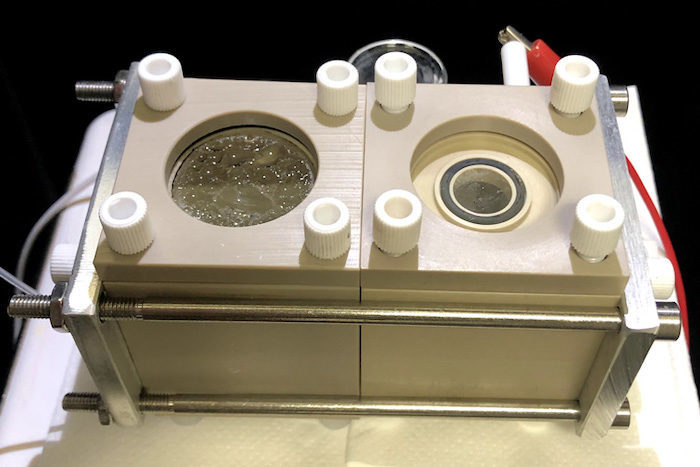
© UC Berkeley photo by Peidong YangA device to capture carbon dioxide from the air and convert it to useful organic products. On left is the chamber containing the nanowire/bacteria hybrid that reduces CO2 to form acetate. On the right is the chamber where oxygen is produced.
If humans ever hope to colonize Mars, the settlers will need to manufacture on-planet a huge range of organic compounds, from fuels to drugs, that are too expensive to ship from Earth. University of California, Berkeley, and Lawrence Berkeley National Laboratory (Berkeley Lab) chemists have a plan for that.
For the past eight years, the researchers have been working on
a hybrid system combining bacteria and nanowires that can capture the energy of sunlight to convert carbon dioxide and water into building blocks for organic molecules. Nanowires are thin silicon wires about one-hundredth the width of a human hair, used as electronic components, and also as sensors and solar cells.
Project leader Peidong Yang, professor of chemistry and the S. K. and Angela Chan Distinguished Chair in Energy at UC Berkeley and director of the Kavli energy Nanoscience Institute said:
"On Mars, about 96% of the atmosphere is CO2. Basically, all you need is these silicon semiconductor nanowires to take in the solar energy and pass it on to these bugs to do the chemistry for you. For a deep space mission, you care about the payload weight, and biological systems have the advantage that they self-reproduce: You don't need to send a lot. That's why our biohybrid version is highly attractive."
The only other requirement, besides sunlight, is water, which on Mars is relatively abundant in the polar ice caps and likely lies frozen underground over most of the planet.

















Comment: See also: Intelligent Design: Body cells are wired like computer chips and function like microprocessors