Science & TechnologyS


Fish

Radioactive signature help reveal the whale shark's age

Whale Shark
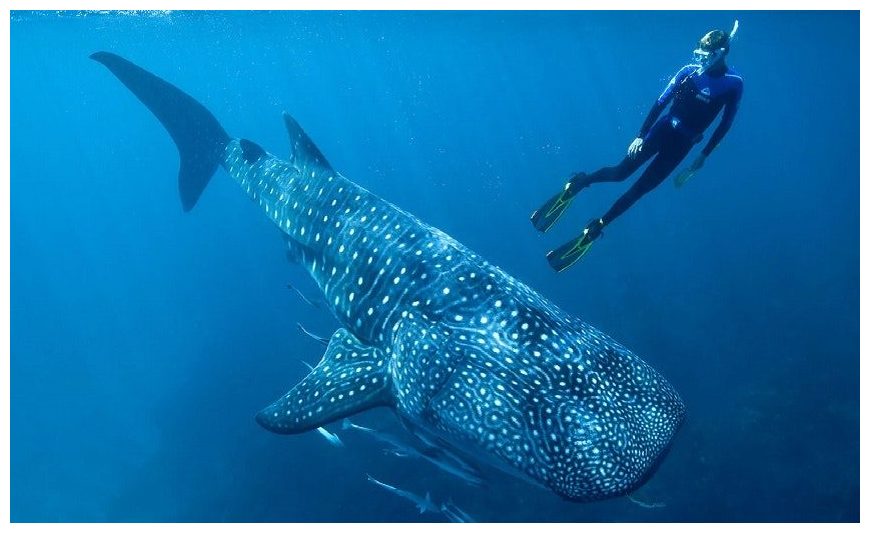
© WAYNE OSBORNAustralian researcher Mark Meekan swimming with a whale shark.
Scientists say they now know how old whale sharks (Rhincodon typus) can get, thanks in no small part to the radioactive legacy of the arms race.

Fallout from nuclear tests in the 1950s and 60s left clearly recognisable timelines in the vertebrae of the world's largest fish, they report in a paper in the journal Frontiers in Marine Science.

This allowed them to establish that one of the specimens they studied was 50 years old at death - the first time, they say, that such an age has been unambiguously verified.

The project brought together researchers from the US, Iceland and Australia, with support from others in Saudi Arabia and Pakistan.

The key was determining how much time the timelines represent.

Like all sharks and rays, Rhincodon typus lacks an otolith - the bony structure used to assess the age of other fish.

Its vertebrae do feature distinct bands that increase in number with age, in much the same way as rings of a tree trunk, but this has been of minimal value because it wasn't clear until now how often a new band formed.

Moon

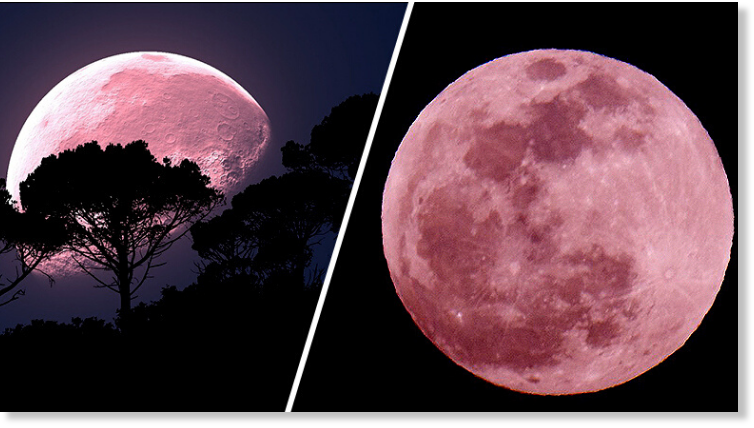
The upcoming 'super pink moon' will be the biggest and best of 2020

super pink moon
Peaking on April 7 and 8, the pink moon is expected to be the brightest supermoon of 2020.

The full pink supermoon will be peaking on April 7 and 8, depending on where in the world you find yourself.

Expected to be the brightest supermoon of 2020, this special moon comes at a time when millions across the globe won't have the freedom to travel to find the perfect viewing spot away from city lights. We hope city dwellers are able to enjoy the light of this moon from the safety of their homes and take comfort in the fact that many cities are enjoying clearer skies as a result of millions of vehicles not being on the roads.

The first full moon of spring, also known as the Paschal Moon in the Christian calendar and used to calculate the date for Easter, will be visible after sunset and reach its peak illumination at 10:35pm, EDT.

But don't expect the moon to actually be pink. Instead it will be its usual color, just brighter and bigger, especially when it's close to the horizon at moon rise or moon set.

Comment:


Health

Iran develops its own AI software to speed up coronavirus testing

hospital room Iran
© Reuters/Ali KharaCoronavirus treatment in Tehran, Iran, March 30, 2020
Tehran has unveiled new artificial intelligence software to speed up detection of the Covid-19 virus. With US sanctions restricting access to testing kits, necessity forced one of the region's hardest-hit countries to innovate.

The software was revealed by government officials in Tehran on Saturday. Developed by a consortium of Iranian universities in only one month, it uses artificial intelligence to analyze computed tomography (CT) scans of potentially infected lungs, allowing doctors to upload images and instantly receive results.

Wearing a face mask at the press conference, Iranian Vice President for Science and Technology Sorena Sattari told reporters that the breakthrough will ease the workload on analysts - who previously had to manually pore over hundreds of pictures per day - and bring a "new perspective" to the diagnosis and treatment of the virus.

CT imaging allows physicians to spot abnormalities on patients' lungs, indicating a Covid-19 infection. However, the method has been sidelined around the world in favor of polymerase chain reaction (PCR) testing, which looks for the virus' genetic material instead of its symptoms.

Bulb

Irish scientists develop UV light emitting robot to clean healthcare facilities

akara robotics, UV robot
A robot emitting ultraviolet light (UVC) with the ability to disinfect hospitals and get rid of the Covid-19 virus has been developed by a start-up attached to Trinity College Dublin.

Being able to clean healthcare facilities thoroughly and quickly is hugely demanding as coronavirus cases escalate.

Created by Akara Robotics, it is clinically proven to kill viruses, bacteria and harmful germs, and does so in a much shorter time compared to usual cleaning methods, according to its inventor Dr Conor McGinn.

Robot Violet was tested in an acute hospital in the Dublin area last week after Dr McGinn contacted the HSE indicating it would be effective in tackling the Covid-19 pandemic in healthcare settings. They are awaiting microbiological test results to confirm its effectiveness.

Comet 2

NASA spots rare interstellar comet Borisov 'falling apart'

Comet Borisov breaking up
© NASA/ESA/D. Jewitt
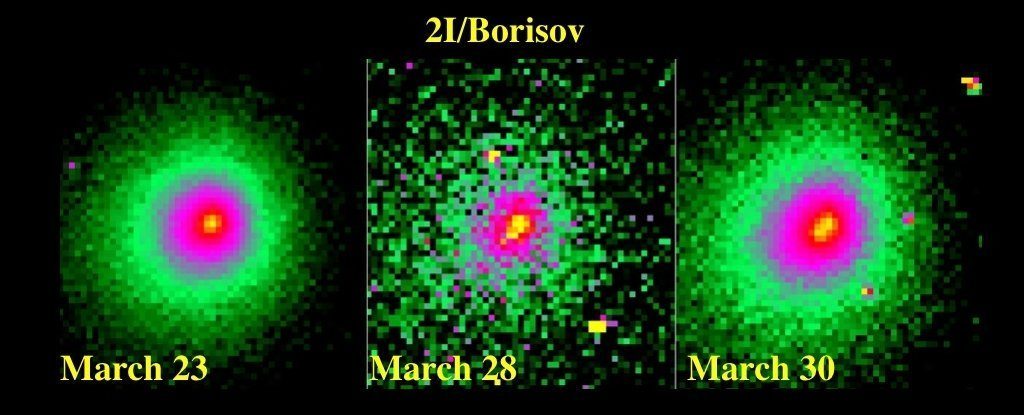
For the first time, we may be watching a comet from another solar system breaking apart after making a trip around our sun.

Comet 2I/Borisov is just the second ever interstellar object identified by astronomers as it passed through our cosmic neighborhood. The first was the bizarre object 'Oumuamua a few years earlier that was spotted when it was already on its way out of the solar system, leaving scientists little time to study it.


Borisov, on the other hand, was first observed last year as it approached the sun, giving astronomers months of opportunity to take a close look and determine that the object is, in fact, a comet from beyond our solar system. It also turns out to be a lot like comets native to our own solar system.

And now, it seems, Borisov's days could be numbered.

A note posted to The Astronomer's Telegram Thursday evening by a team of astronomers using the Hubble Space Telescope announced the "possible fragmentation" of the comet.

Comment: The 'falling apart' / 'fragmentation' and 'observed outbursts' of comet Borisov is likely due to its changing electric discharge. An important note on comets as detailed by Pierre Lescaudron in Earth Changes and The Human cosmic Connection:
Comets or Asteroids

The fundamental difference between asteroids and comets is not their chemical composition, i.e. dirty, fluffy icy comets vs. rocky asteroids. Rather, as has long been put forward by plasma theorists, what differentiates 'comets' from 'asteroids' is their electric activity.

When the electric potential difference between an asteroid and the surrounding plasma is not too high, the asteroid exhibits a dark discharge mode or no discharge at all. But when the potential difference is high enough, the asteroid switches to a glowing discharge mode. At this point the asteroid is a comet. From this perspective, a comet is simply a glowing asteroid and an asteroid is a non-glowing comet. Thus the very same body can, successively, be a comet, then an asteroid, then a comet, etc., depending on variations in the ambient electric field it is subjected to.
See also: Comet 67P surprises scientists with 'bright outbursts', collapsing cliffs and rolling boulders during Rosetta mission


Microscope 1

Scientists discover deep-sea bacteria that doesn't need oxygen to function

Acetobacterium woodii metabolism
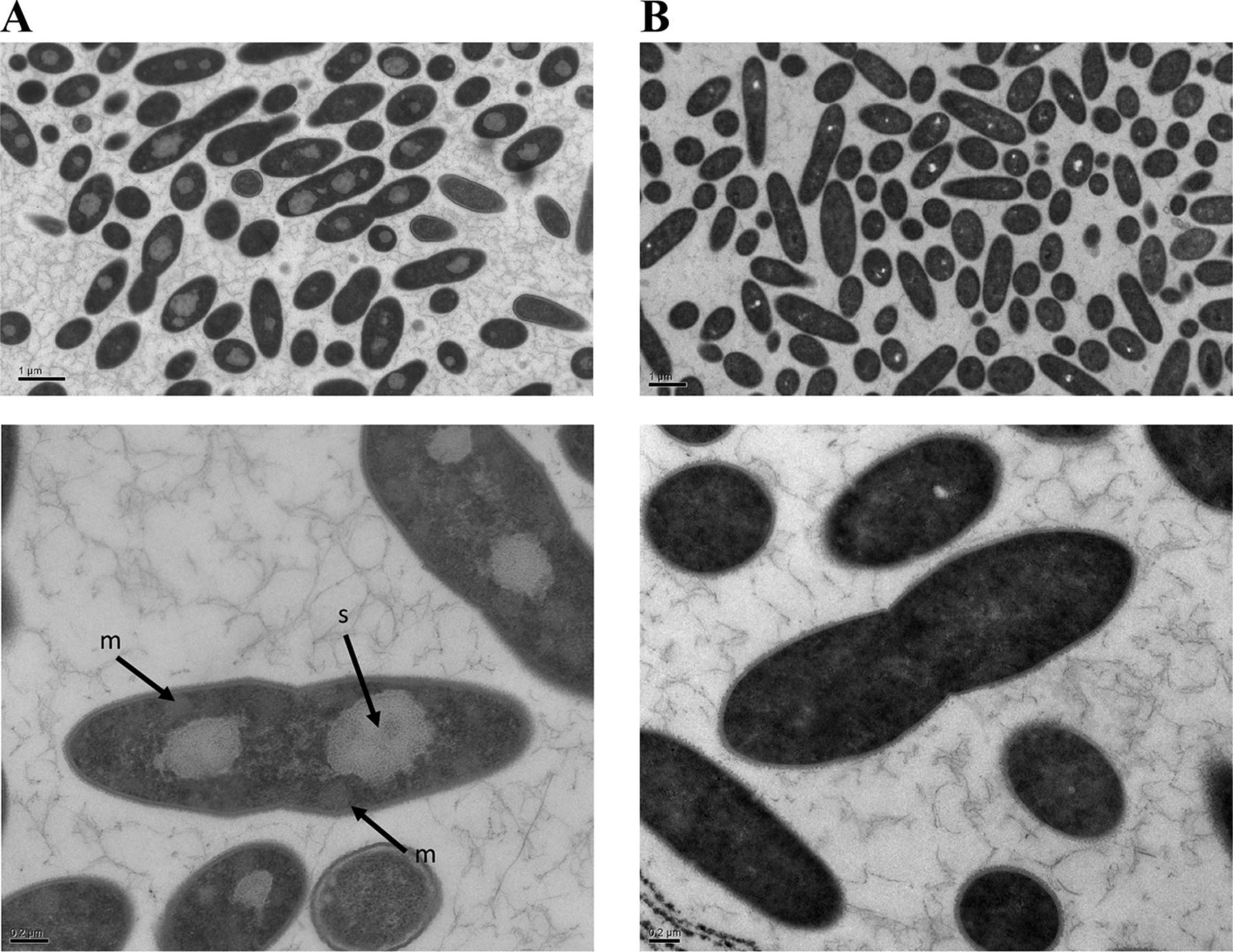
© Kai Schuchmann, Silke Schmidt, et al/Journal of BacteriologyElectron microscopic images of A. woodii grown on 1,2-PD (A) or lactate (B). Cells were grown on the respective substrate to the late exponential growth phase. Cells grown on 1,2-PD showed structures with sizes around 100 to 200 nm, resembling microcompartments (m), and much larger structures that could be storage compartments (s).
A curious kind of bacteria found on the floor of the deep ocean might have a metabolism unlike anything we've seen before.

Known as Acetobacterium woodii, scientists in Germany claim that this species, which also lives in the intestines of termites, can both create and use hydrogen and carbon dioxide to produce energy all on its own, even without the need for oxygen.

The ability to survive on organic and inorganic substances alike without oxygen makes this bacterium quite unique among microorganisms, and while scientists have long suspected something like this existed, it's never been clearly described among acetogenic bacteria, which produce methane free from oxygen.

Red Flag

A new study claiming SARS-CoV-2 coronavirus originated naturalistically is riddled with assumptions and weak reasoning

COVID-19
A Peer Review Failure

A recent study done by an international collaboration of five scientists, and published in the scientific journal Nature Medicine, has concluded that the SARS-CoV-2 coronavirus (also known as HCoV-19), responsible for the current global pandemic, originated naturalistically rather than via laboratory manipulation. Here I review their methods and compare their research with the claims made.

To investigate the origins of the SARS-CoV-2 coronavirus, the team used a Bayesian approach. Bayes' Theorem, named after the eighteenth century Reverend Thomas Bayes, computes the probability of an event given some new evidence. While students will recall using Bayes' Theorem to solve problems involving urns and colored balls, in fact it has a wide range of practical, real-world, applications.

Rocket

SpaceX loses third Starship prototype in cryogenic ground test

SpaceX's Starship space vehicle collapsed
© NASA
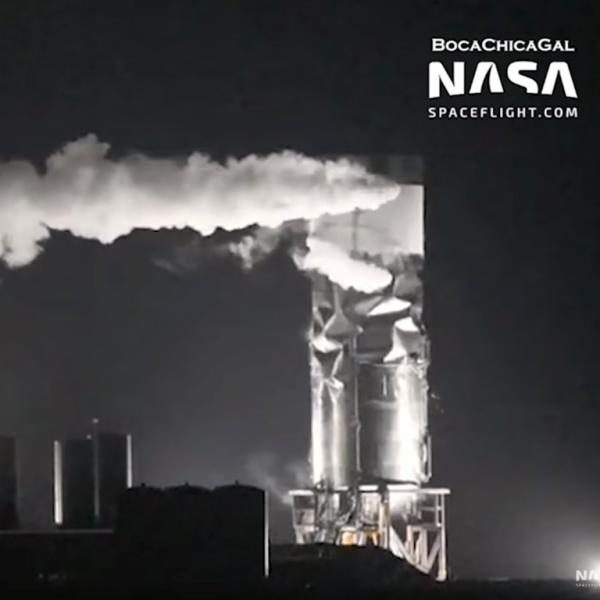
A prototype for SpaceX's Starship space vehicle collapsed during pressure testing early Friday at the company's facility in South Texas — the program's third failure during such testing since November — but assembly of a new version is already underway.

The stainless steel cylinder appeared to rupture near its top after filling with super-cold liquid nitrogen overnight at SpaceX's launch site at Boca Chica, Texas. Elon Musk, SpaceX's founder and CEO, tweeted early Friday that the accident may have been the result of a "test configuration mistake."

The Starship the upper stage of of SpaceX's next-generation launch and space transportation system. Coupled with a massive booster named the Super Heavy, the Starship could haul more than 100 metric tons, or 220,000 pounds, of cargo to low Earth orbit, according to SpaceX.

The fully reusable Super Heavy and Starship vehicles, which will also be able to carry people, will eventually replace the partially reusable Falcon rocket family, SpaceX says.

But testing of Starship prototypes in South Texas has not gone as quickly as Musk hoped. Last September, Musk said he wanted the Starship to reach orbit within six months. That timeframe passed last week, and no full-size Starship test craft has flown yet.


Comet 2

NASA: 5 asteroids including 2 city-killer NEOs approaching Earth this weekend

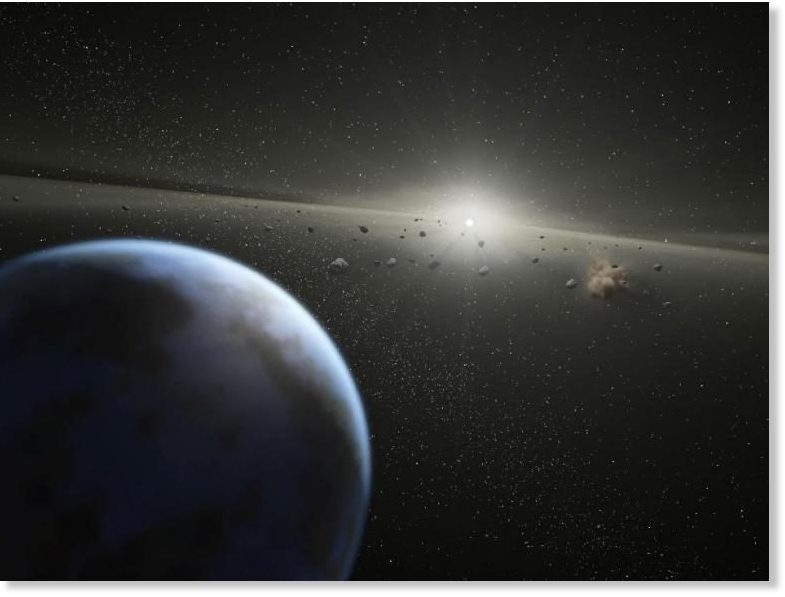
This artist's animation illustrates a massive asteroid belt in orbit around a star the same age and size as our Sun.
© NASA/JPL-CaltechThis artist's animation illustrates a massive asteroid belt in orbit around a star the same age and size as our Sun.
NASA's Center for Near-Earth Object Studies (CNEOS) has detected a total of five asteroids that are expected to approach Earth this weekend. According to the data collected by CNEOS, two of the approaching asteroids are big enough to destroy entire cities during an impact event on Earth.

The first asteroid that's expected to fly past Earth this weekend is known as 2015 FC35. As indicated in CNEOS' database, this asteroid measures about 820 feet wide. This means it is significantly bigger than the towers of the Golden Gate Bridge in California.

2015 FC35 is expected to approach Earth on April 4 at 5:04 am EDT with an average speed of almost 31,000 miles per hour. During this time, the asteroid will fly past Earth from 0.02679 astronomical units or about 2.5 million miles away.

2015 FC35's visit will then be followed by the arrival of the asteroid 2020 FL6. According to CNEOS, this space rock has an estimated diameter of about 177 feet. It is currently traveling across the Solar System at a speed of almost 27,000 miles per hour.

CNEOS noted that 2020 FL6 would fly past Earth on April 4 at 9:20 am EDT from a distance of 0.01294 astronomical units or roughly 1.2 million miles away.

Comment: Celestial Intentions: Comets and the Horns of Moses


Archaeology

The story of human evolution changes dramatically—again!

human evolution
© AMNH/R. Mickens
It's one thing to be expected to believe an orthodoxy, another to be expected to believe that the current revolution of a whirligig represents some ultimate reality:
Until recently, the story of our origins was thought to be settled: Homo sapiens evolved in eastern Africa about 150,000 years ago, became capable of modern behaviour some 60,000 years ago and then swept out of Africa to colonise the world, completely replacing any archaic humans they encountered. But new fossils, tools and analyses of ancient and modern genomes are tearing apart that neat tale. The Jebel Irhoud skull has turned out to be a key to a new, slowly emerging paradigm. With the dust yet fully to settle, the question now is how many, if any, of our old assumptions still hold.

Graham Lawton, "Human evolution: The astounding new story of the origin of our species" at New Scientist

Comment: