Science & TechnologyS


Robot

Daleks, drones, and high-tech cops: Robots come out on top amid coronavirus pandemic

coronavirus drones daleks
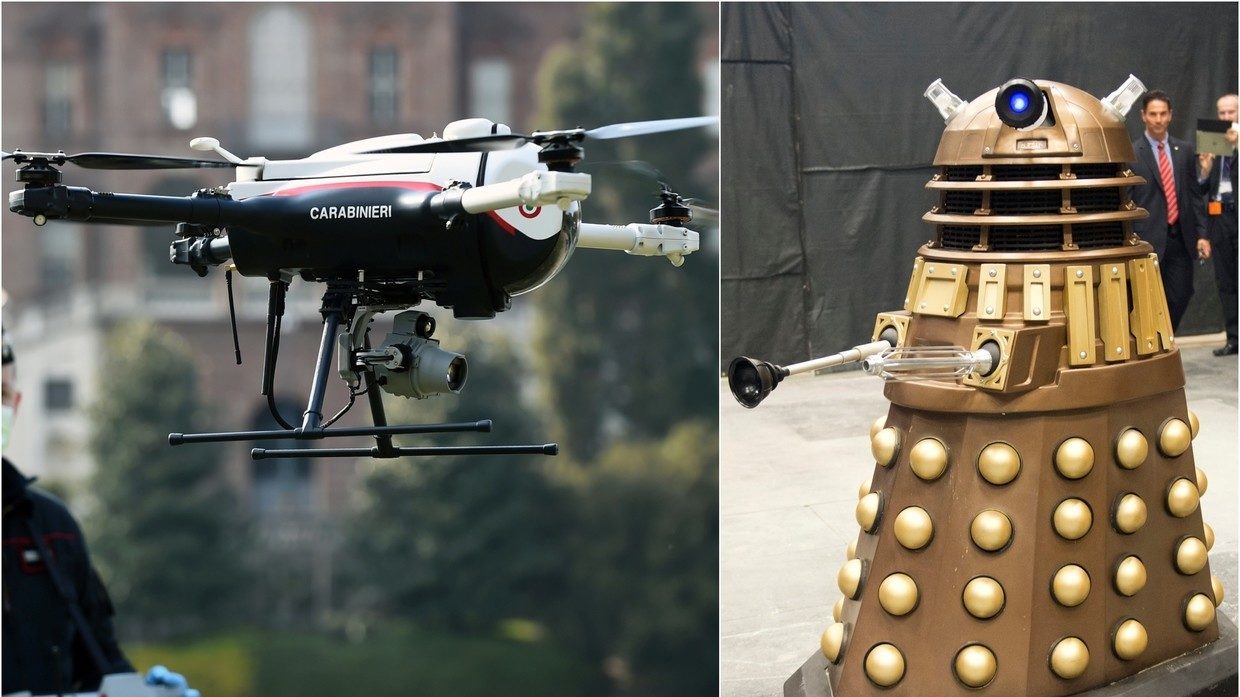
© Reuters / Pool / Massimo PincaItalian police drone vs. Dalek: which would you rather have around during a pandemic?
As coronavirus lockdowns keep people indoors and physically distant from one another, robots are picking up the slack, doing the jobs humans can't or won't do — and keeping their erstwhile masters in line.

You're not alone when you're with a drone


The sight of drones flying through cities shouting at residents to wear masks and maintain social distancing — already common during the early weeks of the epidemic in China — has become ubiquitous all over the world, with the airborne babysitters spotted everywhere from West Australia to Manhattan.


Magic Hat

Bacterial enzyme found in compost, mutated by scientists, can recycle plastic in hours

pepsi
© Mario Anzuoni/ReutersThe company behind the breakthough, Carbios, has partnered with major companies including Pepsi and L’Oréal.
A mutant bacterial enzyme that breaks down plastic bottles for recycling in hours has been created by scientists.

The enzyme, originally discovered in a compost heap of leaves, reduced the bottles to chemical building blocks that were then used to make high-quality new bottles. Existing recycling technologies usually produce plastic only good enough for clothing and carpets.

The company behind the breakthrough, Carbios, said it was aiming for industrial-scale recycling within five years. It has partnered with major companies including Pepsi and L'Oréal to accelerate development. Independent experts called the new enzyme a major advance.

Comment: See also: Russian scientists isolate bacteria which neutralizes nuclear waste


Galaxy

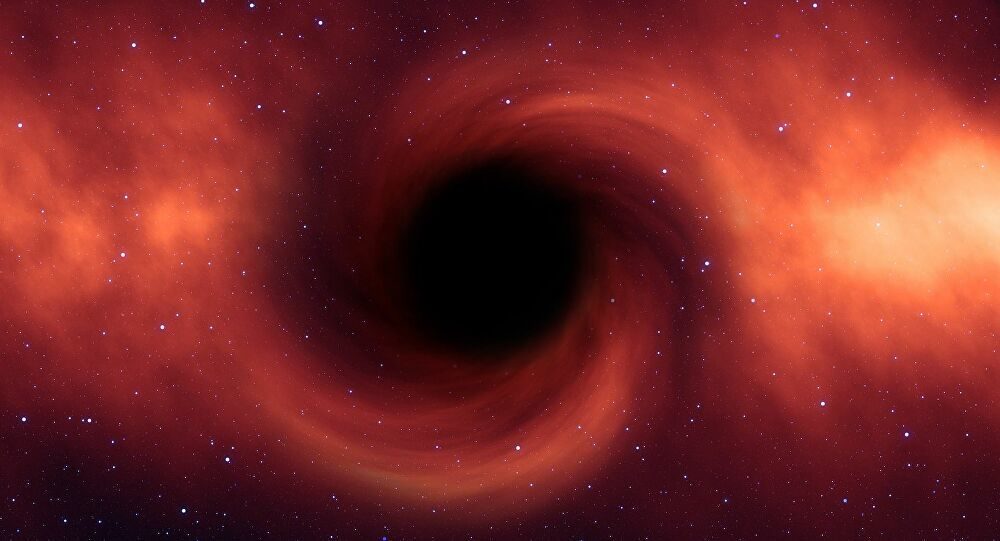
Supermassive black hole emitting high-energy jets captured in 'unprecedented detail'

black hole
The images were taken by the Event Horizon Telescope aimed at capturing and exploring the environment around black holes by using innovative technology to link radio dishes across the Earth to create a planet-sized interferometer.

Researchers from Boston University captured a detailed image of a jet of plasma powered by a supermassive black hole. The image was taken by the Event Horizon Telescope from a distance of over 5bn lightyears, from the M87 radio galaxy.


Comment: See also:


Archaeology

Scientists uncover a 60,000-year-old forest underwater and think its preserved trees may help pioneer new medicines

underwater forest
© Francis ChoiWood from a 60,000-year-old bald cypress forest buried off the coast of Alabama was uncovered by storms
A forest of cypress trees that once grew on the banks of a river off Alabama's coast in Mobile Bay has been buried under sediment for nearly 60,000 years. Scientists studying the wood from the forest believe it may hold secrets to creating new medicines to save lives.

According to an article published April 1 by the National Oceanic and Atmospheric Administration (NOAA), the ancient forest remained undisturbed until recent intensifying storms (including Hurricanes Ivan and Katrina) along the coast have been sweeping up the seabed and sediment that kept the forest entombed.

The site now lies 60 feet underwater, and in the last four to five years, has been visited by a few scientists and filmmakers. But in December, a team of scientists from Northeastern University and the University of Utah set out on an expedition, funded by NOAA, to dive into the waters and bring back pieces of wood to study.

Comment: This submerged forest is a testimony of the higher sea level. 12,000 years ago, sea level was 100 meter (330 feet) lower than today. Knowing that human activity is mostly coastal, how many remnants of previous civilizations are now under water?


Arrow Down

Global infection of COVID-19 may be in the tens of millions, drastically reducing actual mortality rate - study


Comment: As we've been saying since January...


Covid-19
© Akesin | Dreamstime.com
The number of confirmed cases for the novel coronavirus disease COVID-19 officially issued by countries and widely reported by national and international media outlets dramatically understates the true number of infections, according to a recent report from the University of Göttingen. Dr. Christian Bommer and Professor Sebastian Vollmer from Göttingen University have used estimates of COVID-19 mortality and time until death from a recent study published in The Lancet Infectious Diseases to test the quality of official case records. Their data shows that countries have only discovered on average about 6% of coronavirus infections and the true number of infected people worldwide may already have reached several tens of millions. Their study is available online.

Comment: One of the main reasons we haven't seen widespread testing is because if people knew the coronavirus was much less deadly than the flu, then the authorities wouldn't be able to introduce the draconian lockdown and 'reset' they've been seeking for a very long time.


Comet 2

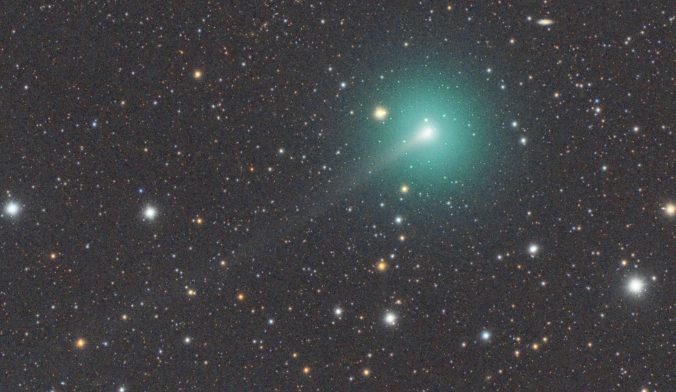
New Comet C/2020 F5 (MASTER)

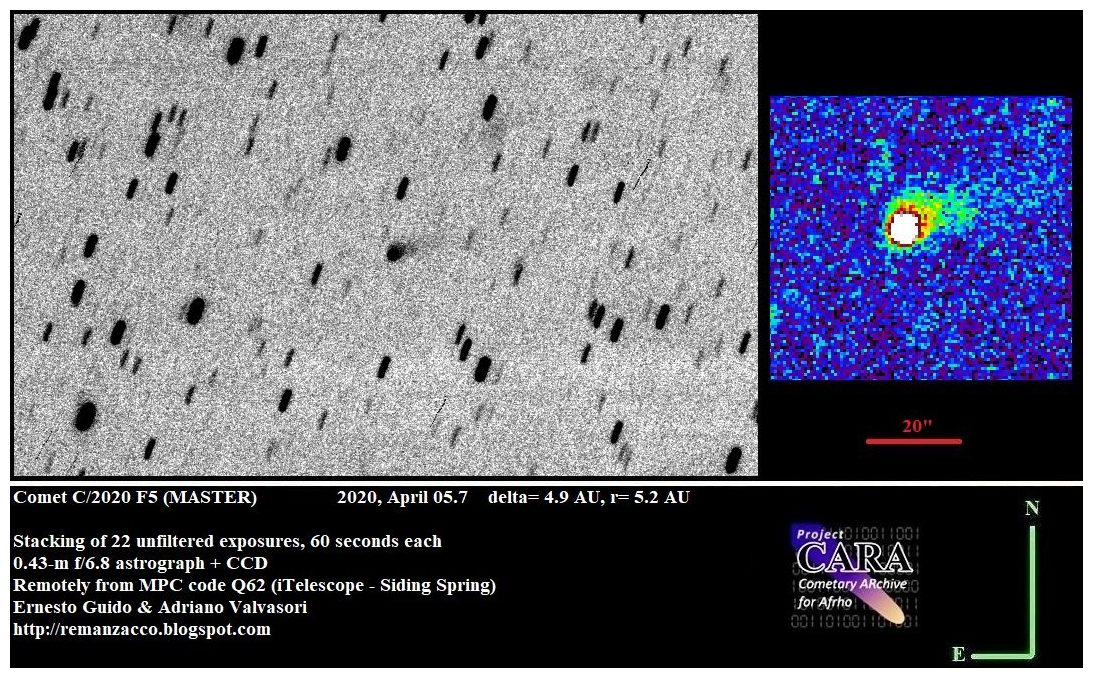
CBET 4746 & MPEC 2020-G73, issued on 2020, April 08, announce the discovery of a comet (magnitude ~15.8) in images taken with the "Mobile Astronomical System of the Telescope-Robots" (MASTER) auto-detection system (0.40-m f/2.5 reflector) near San Juan, Argentina. Additional pre-discovery observations from Mar. 17.0 UT (mag 15.8-15.9), Mar. 22.0 (mag 15.8), and Mar. 23.0 (mag 15.7-15.8) were found on images taken with the MASTER 0.40-m reflector at the South African Astronomical Observatory (Sutherland). The new comet has been designated C/2020 F5 (MASTER).

We performed follow-up measurements of this object while it was still on the PCCP webpage.

Stacking of 22 unfiltered exposures, 60 seconds each, obtained remotely on 2020, April 05.7 from Q62 (iTelescope network) through a 0.43-m f/6.8 astrograph + CCD, shows that this object is a comet with a compact coma about 10" in diameter and a tail 30" long in PA 290.

Our confirmation image (click on it for a bigger version)
Comet C/2020 F5 MASTER
© Remnanzacco Blogspot

Galaxy

Electric currents driven by solar wind create Saturn's auroras, heat planet's atmosphere - NASA

Saturn
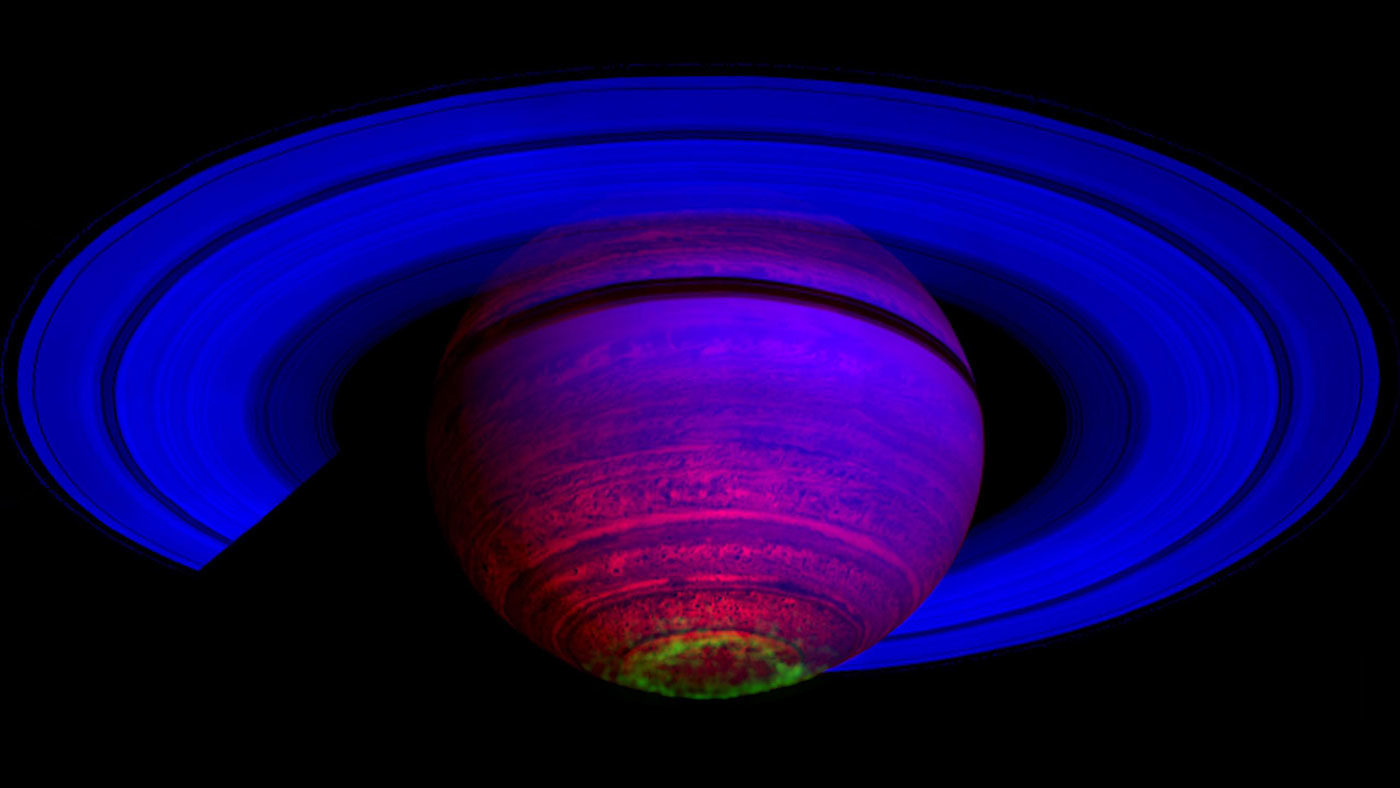
© NASA/JPL/ASI/University of Arizona/University of LeicesterThis false-color composite image shows auroras (depicted in green) above the cloud tops of Saturn's south pole. The 65 observations used here were captured by Cassini's visual and infrared mapping spectrometer on Nov. 1, 2008.


New mapping of the giant planet's upper atmosphere reveals likely reason why it's so hot.


The upper layers in the atmospheres of gas giants - Saturn, Jupiter, Uranus and Neptune - are hot, just like Earth's. But unlike Earth, the Sun is too far from these outer planets to account for the high temperatures. Their heat source has been one of the great mysteries of planetary science.

New analysis of data from NASA's Cassini spacecraft finds a viable explanation for what's keeping the upper layers of Saturn, and possibly the other gas giants, so hot: auroras at the planet's north and south poles. Electric currents, triggered by interactions between solar winds and charged particles from Saturn's moons, spark the auroras and heat the upper atmosphere. (As with Earth's northern lights, studying auroras tells scientists what's going on in the planet's atmosphere.)

Comment: Although there is much more to the story, this discovery isn't such a surprise for those familiar with electric universe theory, nor for those who have read Pierre Lescaudron's & Laura Knight-Jadczyk's book Earth Changes and the Human-Cosmic Connection

And, now that NASA has come to realize the above, one wonders when they and their mainstream colleagues will apply these same understandings and their effects to life on our own planet? It's notable that in recent years action in our own skies has been on the rise.

See also: And check out SOTT radio's:


Comet 2

Comet ATLAS Y4 is breaking up

Comet ATLAS (C/2019 Y4)
Comet ATLAS on March 28th. Credit: Tim Connolly of Plattsburgh, NY.
Comet ATLAS (C/2019 Y4), what are you doing? New data from astronomers around the world show that the once-promising comet is beginning to fade. For Karl Battams of the Naval Research Lab in Washington DC, it could be a classic case of "I told you so."

"Quoting myself from March 15th," says Battams, "'I wouldn't be surprised to see Comet ATLAS start to fade rapidly and possibly even disintegrate before reaching the sun.' I very much hope I'm wrong, but Comet Elenin did something similar several years ago, holding lots of promise and then just... fizzling."


Comment: Comet Elenin nucleus was fragmented by a Coronal Mass Ejection. Source


In recent months, Comet ATLAS galvanized astronomers as it fell toward the sun, skyrocketing in brightness like few comets before it. By late May 2020 it promised to rival Venus in the sunset sky. But recent developments belie that possibility.

Comment: This comes less than a week after Comet C2I Borisov also began 'falling apart', and, as noted in the comment under that article:
The 'falling apart' / 'fragmentation' and 'observed outbursts' of comet Borisov is likely due to its changing electric discharge. An important note on comets as detailed by Pierre Lescaudron in Earth Changes and The Human cosmic Connection:
Comets or Asteroids

The fundamental difference between asteroids and comets is not their chemical composition, i.e. dirty, fluffy icy comets vs. rocky asteroids. Rather, as has long been put forward by plasma theorists, what differentiates 'comets' from 'asteroids' is their electric activity.

When the electric potential difference between an asteroid and the surrounding plasma is not too high, the asteroid exhibits a dark discharge mode or no discharge at all. But when the potential difference is high enough, the asteroid switches to a glowing discharge mode. At this point the asteroid is a comet. From this perspective, a comet is simply a glowing asteroid and an asteroid is a non-glowing comet. Thus the very same body can, successively, be a comet, then an asteroid, then a comet, etc., depending on variations in the ambient electric field it is subjected to.
See also: And check out SOTT radio's: Behind the Headlines: Earth changes in an electric universe: Is climate change really man-made?


Info

'Smart Toilet' will identify you by 'analprint'

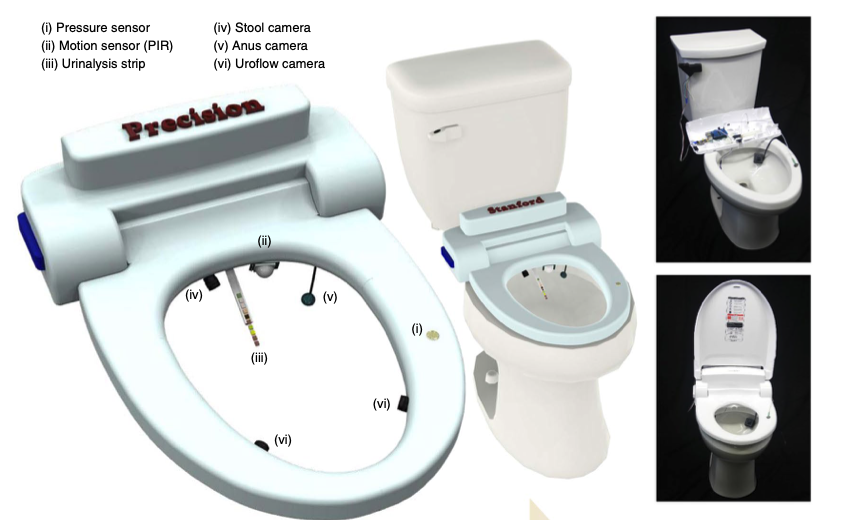
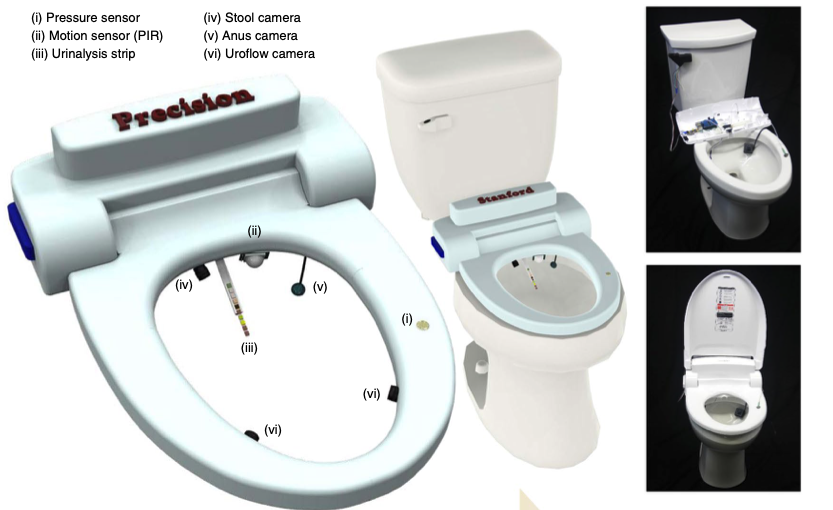
Smart Toilet
© Seung-min Park et. al / Nature Biomedical Engineering
A team of researchers primarily based out of Stanford University has engineered a proof-of-concept smart toilet module designed to monitor a user's health based on their urine and stools.

The system mounts on a conventional sit-down toilet and utilizes cameras to measure the user's feces based on the Bristol stool scale. At the same time, a pressure sensor built in to the toilet seat monitors the bowel movement's duration. Both of these measures can reveal conditions like chronic constipation, irritable bowel system, and even colon cancer.

Users who stand to urinate can also have their velocity, flow, and duration measured by camera, while test strips automatically extend into the stream for urinalysis, which can ascertain a variety of chemical levels and test for numerous substances.

Upon completion of defecation or urination, the system uploads all of the user's results to a protected cloud. Individual users are identified via a fingerprint scanner embedded in the flush lever as well as by "analprint" (yes, the researchers called it an analprint). A camera on the toilet module images the user's anus, allowing an algorithm to link the anus image to a specific person on subsequent use.

Saturn

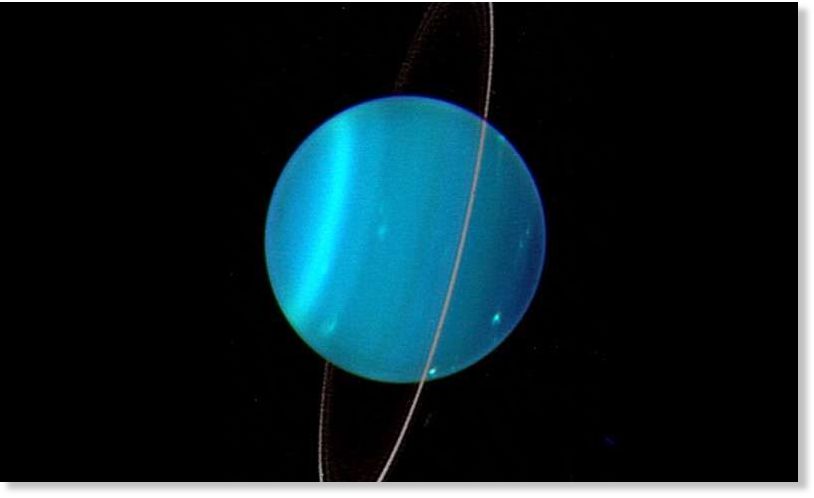
Origins of Uranus' oddities explained by Japanese astronomers

uranus
The ice giant Uranus' unusual attributes have long puzzled scientists. All of the planets in the solar system revolve around the sun in the same direction and in the same plane, which astronomers believe is a vestige of how our solar system formed from a spinning disc of gas and dust. Most of the planets also rotate in the same direction, with their poles orientated perpendicular to the plane in which the planets revolve. However, uniquely among all the planets, Uranus is tilted at about 98 degrees.

Instead of thinking about the reality of stars spread in all directions and at various distances from the Earth, it is easier to understand by envisioning the celestial sphere. To picture what the celestial sphere is, look up at the night sky and imagine that all of the stars you see are painted on the inside of a sphere surrounding the solar system. Stars then seem to rise and set as the Earth moves relative to this "sphere."