

© WAYNE OSBORNAustralian researcher Mark Meekan swimming with a whale shark.
Fallout from nuclear tests in the 1950s and 60s left clearly recognisable timelines in the vertebrae of the world's largest fish, they report in a paper in the journal Frontiers in Marine Science.
This allowed them to establish that one of the specimens they studied was 50 years old at death - the first time, they say, that such an age has been unambiguously verified.
The project brought together researchers from the US, Iceland and Australia, with support from others in Saudi Arabia and Pakistan.
The key was determining how much time the timelines represent.
Like all sharks and rays, Rhincodon typus lacks an otolith - the bony structure used to assess the age of other fish.
Its vertebrae do feature distinct bands that increase in number with age, in much the same way as rings of a tree trunk, but this has been of minimal value because it wasn't clear until now how often a new band formed.
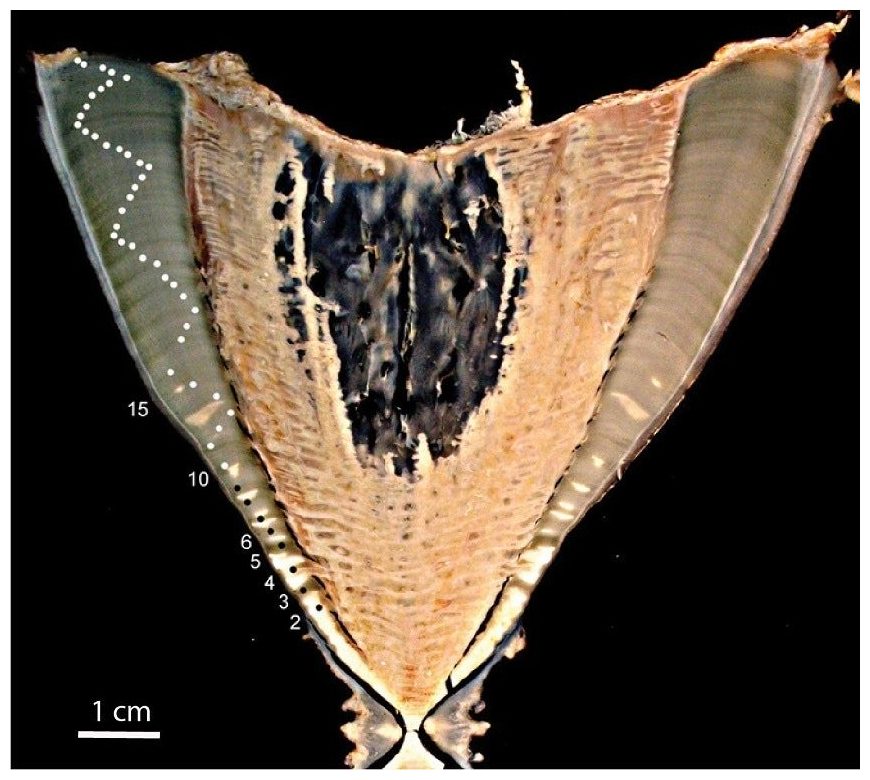
© PAUL FANNING, PAKISTAN NODE OF THE UN FOOD AND AGRICULTURAL ORGANISATIONA whale shark vertebra in cross-section, showing 50 growth bands.
This naturally occurring radioactive element can be used by archaeologists and historians to date ancient bones and artefacts, because its rate of decay is constant and easily measured.
Fallout from the tests saturated first air and the oceans, and the isotope gradually moved through food webs across the planet, producing an elevated carbon-14 label, which still persists.
This additional radioisotope also decays at a steady rate, meaning that the amount contained in bone formed at one point in time will be slightly greater than that contained in otherwise identical bone formed more recently.
Using bomb radiocarbon data prepared by Steven Campana from the University of Iceland, researchers led by Joyce Ong from Rutgers University, US, and Mark Meekan from the Australian Institute of Marine Science tested the carbon-14 levels in the growth rings of two dead whale sharks stored in Pakistan and Taiwan.
"We found that one growth ring was definitely deposited every year," Meekan says.
This allowed them to determine the age of the sharks they were studying, and to confirm that long lifespans are probably a feature of this endangered but now protected species.



I don't know, let's cut it in half and count the rings.
C14 is the isotope used in 'carbon dating' because people originally thought that the amount of C14 in the world and its rate of decomposition were fixed. We now know that Solar, Cosmic and Nuclear radiation can seriously affect the rate of C14 formation and decay, which means we should also know that 'carbon dating' is not very accurate.