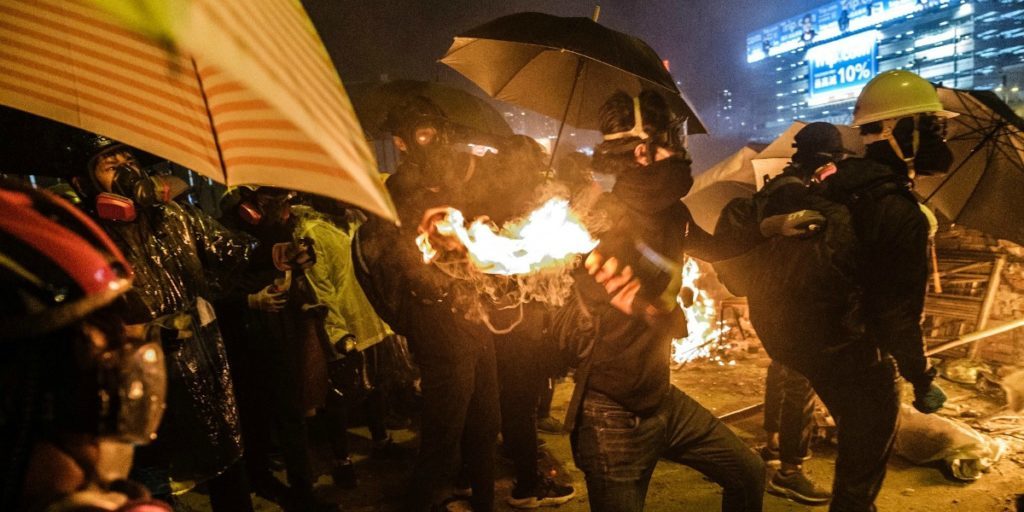
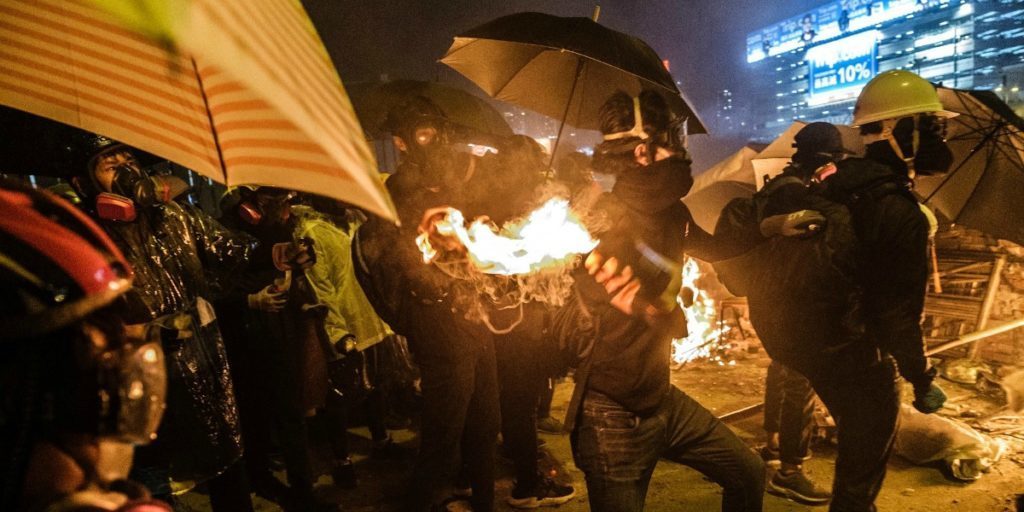
New York Times photo (11/17/19) of Hong Kong protesters with Molotov cocktail.
2019 may be remembered as the year of the protest, as demonstrations are engulfing the world. From the Yellow Vests in France to demonstrations in Lebanon, Gaza, Chile, Ecuador and Haiti, sustained movements all over the planet have taken to the street demanding change. Yet US corporate media have been disproportionately interested in only one: the Hong Kong protests.
As FAIR argued previously (FAIR.org,
10/26/19), this disparity in coverage can largely be explained by understanding who is protesting and what they are protesting against. The unrest in Hong Kong flared up in March in response to a
proposed extradition treaty between the island city, the Chinese central government and Taiwan, which many residents feared would be used by Beijing authorities to arrest and persecute opponents of the Chinese state.
Thus, the target of Hong Kong's protesting is an official enemy of the US, hence the extent and favorability of the coverage.FAIR conducted a study of
New York Times and CNN coverage of four important protest movements around the world: Hong Kong, Ecuador, Haiti and Chile. Those outlets were chosen for their influence and their reputation as the most important, agenda-setting outlets in the print and television media. Full documentation, including links to all articles in the sample, can be found
here. All relevant results to "country+protests" on those outlets' websites were counted, except purely rehosted content, since each protest began. This was March 15 for Hong Kong, October 3 for Ecuador, October 14 for Chile and July 7, 2018, for Haiti. The end date for the study was November 22, 2019.

















Comment: See also: US government drops case against Max Blumenthal after jailing journalist on false charges