Science & TechnologyS


Telescope

Mysterious radio burst from space is unusually close - and especially baffling

M81 galaxy
© ASA, ESA and the Hubble Heritage Team (STXCI/AURA)
Bright, fleeting blasts of radio waves coming from the vicinity of a nearby galaxy are deepening one of astronomy's biggest mysteries. The repeating bursts of energy seem to be coming from an ancient group of stars called a globular cluster, which is among the last places astronomers expected to find them.

Often originating billions of light-years away, the extremely bright, extremely brief bursts of radio waves known as fast radio bursts, or FRBs, have defied explanation since they were first spotted in 2007. Based on observations to date, scientists surmised that the bursts are powered by young, short-lived cosmic objects called magnetars.

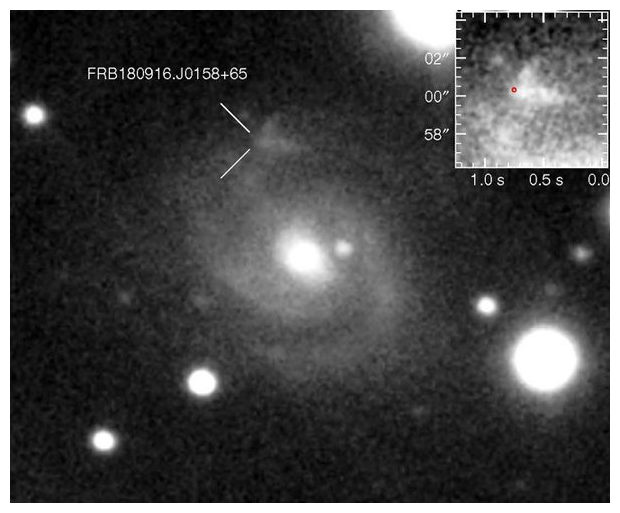
But a fast radio burst discovered last year has now been traced to a globular cluster about 11.7 million light-years away, near the neighbouring spiral galaxy M81, according to a paper describing the discovery posted on the scientific preprint server arXiv. Finding this burst among a cluster of ageing stars is kind of like finding a smartphone embedded in Stonehenge — the observation doesn't make sense.

"This is definitely not a place fast radio bursts are expected to live," Bryan Gaensler, an astronomer at the University of Toronto and a co-author of the new paper, posted on Twitter. "Just what is going on?"

Scientists are struggling to explain the cosmic anachronism. They're also moving toward the conclusion that maybe, as with many other celestial phenomena, there are multiple ways to cook up a fast radio burst.

Sun

Chinese 'artificial sun' experimental fusion reactor sets new world record

artificial sun experiment
© XinhuaChina, India, Japan, South Korea, Russia and the US are jointly working on the ITER project.
The Chinese experiment is part of the International Thermonuclear Experimental Reactor project.

China's Experimental Advanced Superconducting Tokamak (EAST) has set a new record in the latest experiment, where it achieved a plasma temperature of 216 million Fahrenheit (120 million C) for 101 seconds. Not just that, the scientists working on the "artificial sun", also achieved 288 million Fahrenheit (160 million C) for 20 seconds, according to state media reports.

Situated at the Institute of Plasma Physics of the Chinese Academy of Sciences (ASIPP) in Hefei, the Tokamak device has been designed to reproduce the nuclear fusion process, something natural to the Sun and stars. The experiment is being carried out to provide infinite clean energy through controlled nuclear fusion. The previous record maintained a plasma temperature of 180 million F (100 million C) for 100 seconds, which has now been broken, a big step towards getting nuclear fusion to work.

Comment: See also:


Satellite

Lucky Strike? Tiny piece of space junk hits the International Space Station, leaves hole in robotic arm

Robotic arm hole
© NASA/Canadian Space AgencyCircle shows the impact site on the ISS robotic arm boom
A robotic arm attached to the outside of the International Space Station has been hit with space junk and visibly damaged, according to the Canadian Space Agency.

In a blog post, the CSA notes that 'a small section of the arm boom and thermal blanket' of Canadarm2 was hit. The space agency first noticed the incident 'during a routine inspection' on May 12. 'Despite the impact, results of the ongoing analysis indicate that the arm's performance remains unaffected,' CSA wrote in the post, adding that the robotic arm is 'continuing to conduct its planned operations.'

The amount of space junk has increased since the dawn of the space age and now and then, they have caused damage. NASA explained that 'a number' of space shuttle windows were replaced due to damage from material that was later found out to be paint flecks.

According to the US space agency, more than 27,000 pieces of space junk are tracked.

Comment: More details were offered from another report:
Officials called the hole a "lucky strike" given the relatively small size of the arm, which is 57.7 feet (17.6 meters) long and has a diameter of just 14 inches (35 cm).

The size of the hole is not apparent in the pictures, nor if the debris went all the way through. However, it does appear Canadarm2's role in keeping the space station properly maintained can continue without interruption, following careful work from both CSA and NASA.
"Results of the ongoing analysis indicate that the arm's performance remains unaffected. The damage is limited to a small section of the arm boom and thermal blanket."
Canadarm2 was scheduled soon to move a Canadian robotic hand, Dextre, into a spot to replace a faulty power switchbox called the Remote Power Control module, but CSA added that operation should not be affected whatsoever. Both Canadarm2 and Dextre are usually operated from CSA headquarters near Montreal, Quebec.


Cassiopaea

Cosmic voids revealed in most detailed map of the universe defy our understanding of physics

dark matter galaxy
© (Dark Energy Survey/DOE/FNAL/DECam/CTIO/NOIRLab/NSF/AURA)
Astronomers have created the most comprehensive map yet of all the dark matter in the universe.

That's no easy feat, considering dark matter is invisible. Scientists know this shadowy cousin of regular matter exists, though, because its strong gravitational forces can pull entire galaxies together.

Based on observations of its influence, astronomers estimate that dark matter makes up one-quarter of the universe.

The new map is the product of years of work by a group of 400 scientists from seven countries, known as the Dark Energy Survey (DES).

Comment: This comes on the heels of two other recent, surprising discoveries which seem to upturn our theories on space:


Bizarro Earth

Water causes the deep Earth's most mysterious earthquakes says research

Deep Earthquakes
© Illustration by Steven Shirey, Peter van Keken, Lara Wagner, and Michael Walter/Carnegie Institution for Science.Some of Earth's largest earthquakes occur at tremendous depths (500-700 km) beneath the surface, always within or near oceanic plates that have sunk back into the Earth's interior. The cause of these events has been an enduring question in geology and geophysics for more than 40 years. In a new paper, a team of Carnegie and University of Alberta geoscientists provide several lines of evidence that fluids contribute to the genesis of deep earthquakes. New thermal modeling shows that carbonated crust and hydrated mantle in cold slabs can transport these fluids down to where deep earthquakes occur. Evidence from diamonds provides mineralogical proof of these mobile fluids in the mantle transition zone (440 - 670 km depth). This figure shows a sample thermal model of a subduction zone, with the relatively cold (blue) oceanic plate sinking into the comparatively hot (red) mantle. Three regions of earthquakes (grey spheres) visible in the oceanic plate: "intermediate-depth" dehydration-related earthquakes occurring between ~70 and ~250 km, a region of reduced seismicity between ~250 and ~350 km, and the region of "deep" seismicity below 350 km that extends to ~700 km. Superdeep diamonds (blue octahedra) are known to crystallize from fluids released in this deep region as the oceanic plate warms by the heat from the surrounding mantle.
Washington, DC — The cause of Earth's deepest earthquakes has been a mystery to science for more than a century, but a team of Carnegie scientists may have cracked the case.

New research published in AGU Advances provides evidence that fluids play a key role in deep-focus earthquakes — which occur between 300 and 700 kilometers below the planet's surface. The research team includes Carnegie scientists Steven Shirey, Lara Wagner, Peter van Keken, and Michael Walter, as well as the University of Alberta's Graham Pearson.

Most earthquakes occur close to the Earth's surface, down to about 70 kilometers. They happen when stress builds up at a fracture between two blocks of rock — known as a fault — causing them to suddenly slide past each other.

However, deeper into the Earth, the intense pressures create too much friction to allow this kind of sliding to occur and the high temperatures enhance the ability of rocks to deform to accommodate changing stresses. Though theoretically unexpected, scientists have been able to identify earthquakes that originate more than 300 kilometers below the surface since the 1920s.

"The big problem that seismologists have faced is how it's possible that we have these deep-focus earthquakes at all," said Wagner. "Once you get a few tens of kilometers down, it becomes incredibly difficult to explain how we are getting slip on a fault when the friction is so incredibly high."

2 + 2 = 4

Virologists say genetic "fingerprints" prove COVID-19 man-made, 'No credible natural ancestor'

Sorensen/Dalgleish
© Aksel Fridstrøm/Daily MailNorwegian scientist Dr. Birger Sorensen and British Professor Angus Dalgleish
Two notable virologists claim to have found "unique fingerprints" on COVID-19 samples that only could have arisen from laboratory manipulation, according to an explosive 22-page paper obtained by the Daily Mail.

British professor Angus Dalgleish - best known for creating the world's first 'HIV vaccine', and Norwegian virologist Dr. Birger Sørensen - chair of pharmaceutical company, Immunor, who has published 31 peer-reviewed papers and holds several patents, wrote that while analyzing virus samples last year, the pair discovered "unique fingerprints" in the form of "six inserts" created through gain-of-function research at the Wuhan Institute of Virology in China.

They also conclude that "SARS-Coronavirus-2 has "no credible natural ancestor" and that it is "beyond reasonable doubt" that the virus was created via "laboratory manipulation."

Nebula

Gamma rays 10 times more energetic than thought possible detected

milky way
Astronomers have detected the highest-energy light ever seen, streaming in from near the center of the Milky Way. Hundreds of gamma ray signals were detected with ultra-high energies, with the most powerful signals crossing the Peta-electronvolt (PeV) threshold - much higher than thought possible in our galaxy.

Gamma rays are the most energetic type of electromagnetic radiation, released during extreme events like supernovae, matter-antimatter annihilation, and the activity of objects like pulsars. They're often detected with energies in the Giga-electrovolt (GeV) range, but they've been known to occasionally top the Tera-electronvolt (TeV) mark, which is 1,000 GeV.

Comment: See also: And check out SOTT radio's:


Galaxy

Milky Way not unusual, surprising astronomers

Galaxy UGC 10738
© Jesse van de Sande/European Southern ObservatoryGalaxy UGC 10738, seen edge-on through the European Southern Observatory’s Very Large Telescope in Chile, revealing distinct thick and thin discs.
The first detailed cross-section of a galaxy broadly similar to the Milky Way, published today, reveals that our galaxy evolved gradually, instead of being the result of a violent mash-up. The finding throws the origin story of our home into doubt.

The galaxy, dubbed UGC 10738, turns out to have distinct 'thick' and 'thin' discs similar to those of the Milky Way. This suggests, contrary to previous theories, that such structures are not the result of a rare long-ago collision with a smaller galaxy. They appear to be the product of more peaceful change.

Comment: It's possible that the reason galaxies are found to form in similar ways is because the forces acting on them are also very similar; and for more clues on that we need look to Electric Universe theory: Also check out SOTT radio's:


Robot

IDF brags of waging 'first AI war,' lending credence to view that Gaza serves as testing ground for Israel's fighting techniques

Israeli soldier AI
© Getty Images/Andrew Burton/PhonlamaiPhotoIsraeli soldier near Gaza border • Artificial Intelligence at work
The 11-day flare-up between Israel and Hamas was dubbed the "first AI war" by Israel's military, which bragged about using advanced computing technologies to sift through the staggering amount of intelligence it collects on Gaza.

"For the first time, artificial intelligence (AI) was a key component and power multiplier in fighting the enemy," a senior officer in the Israel Defense Forces' (IDF) Intelligence Corps said, as cited by Israeli media.

The elite intelligence Unit 8200 used programs called "Alchemist," "Gospel" and "Depth of Wisdom," to further boost an already overwhelming superiority that IDF has over militants in the blockaded Gaza enclave. AI-powered analysis was applied to vast amounts of data collected through satellite imaging, surveillance cameras, interception of communications and human intelligence, according to the Israeli military.


Comment: A different take on Israel's AI breakthrough:


Comet 2

New Comet C/2021 K1 (ATLAS)

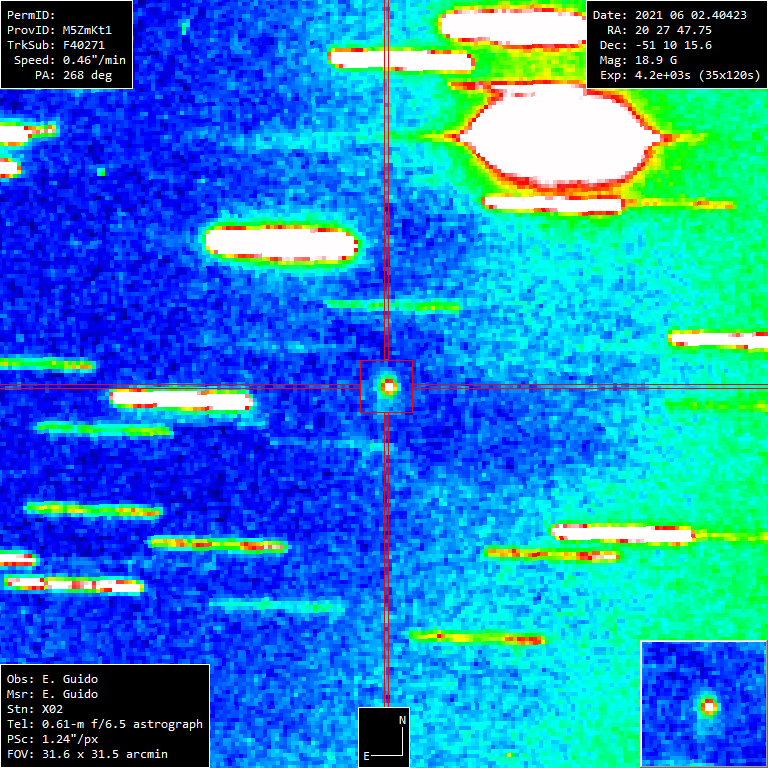
CBET 4968 & MPEC 2021-K89, issued on 2021, May 27, announce the discovery of a new comet (magnitude ~17.0) on CCD images taken on May 14.5 UT with the 0.5-m reflector + CCD in the course of the ATLAS-HKO (T05) survey. The object was originally found by Peter Veres of Minor Planet Center (MPC) as unusually bright among the MPC's isolated tracklet file (ITF) and linked to the detections from May 22 (F51) and May 14 (T08). A review of the ATLAS images revealed the cometary nature of this object.

As with the ATLAS observations, this object was reported without comments by Pan-STARRS1 1.8-m Ritchey-Chretien reflector at Haleakala on May 22.6 UT (mag 17.6-18.0), submitted as two separate objects on the same night. This object has been found to show cometary appearance also by CCD astrometrists elsewhere after it was posted on the MPC's PCCP webpage. The new comet has been designated C/2021 K1 (ATLAS).

Stacking of 44 unfiltered exposures, 60 seconds each, obtained remotely on 2021, May 27.3 from X02 (Telescope Live, Chile) through a 0.61-m f/6.5 astrograph + CCD, shows that this object is a comet with a compact coma about 20" arcsecond in diameter and a tail 30" long in PA 245 (Observers E. Guido, M. Rocchetto, E. Bryssinck, M. Fulle, G. Milani, C. Nassef, G. Savini, A. Valvasori).

Our confirmation images (click on the images for a bigger version; made with TYCHO software by D. Parrott)
Comet C/2021 K1
© Remanzacco Blogspot