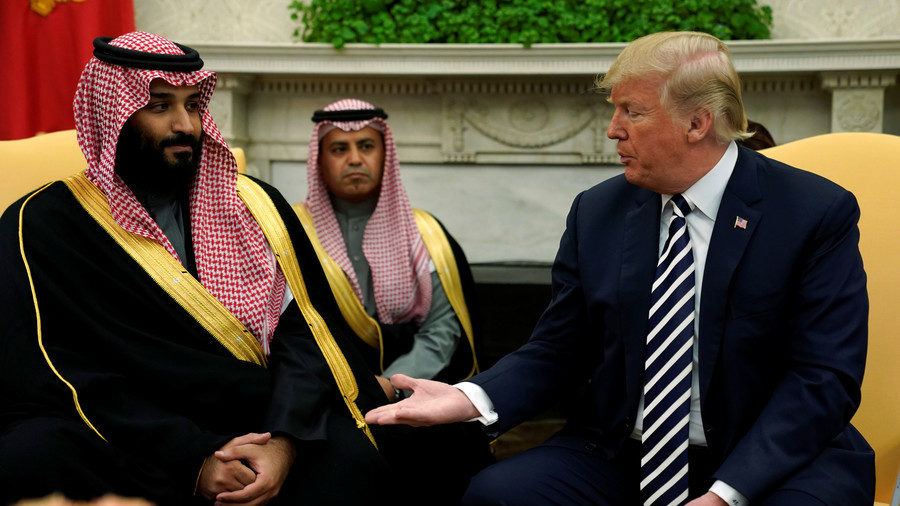
© Reuters / Jonathan Ernst
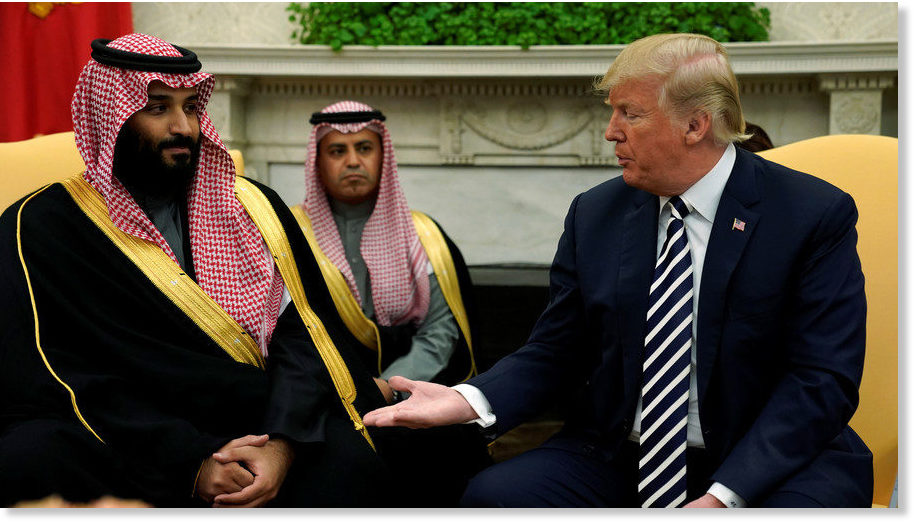
The 633-word statement of President Donald Trump on the Saudi royals' role in the grisly murder of
Washington Post contributor Jamal Khashoggi is a remarkable document, not only for its ice-cold candor.
The president re-raises a question that has roiled the nation since Jimmy Carter:
To what degree should we allow idealistic values trump vital interests in determining foreign policy?On the matter of who ordered the killing of Khashoggi, Trump does not rule out the crown prince as prime suspect:
"King Salman and Crown Prince Mohammad bin Salman vigorously deny any knowledge of the planning or execution of the murder... (but) it could very well be that the Crown Prince had knowledge."
Yet, whether MBS did or didn't do it, the Saudis have "agreed to spend and invest $450 billion in the United States." And a full fourth of that is for "military equipment from Boeing, Lockheed Martin, Raytheon and other great U.S. defense contractors."
"Foolishly" cancel these contracts, warns Trump, and Russia or China will snap them up. Moreover, the Saudis have agreed to pump oil to keep prices down.
Trump is unabashedly putting U.S. economic and strategic interests first. He is not going to damage our relationship with Riyadh and its royal family, even if the future king ordered a cold-blooded killing of a U.S.-based Saudi journalist he regarded as an enemy.
Comment: Buchanan is right on both fronts: Trump is basically opting for a pragmatic foreign policy along the lines of that practiced by Russia. But at the same time, his justifications for this specific relationship are completely delusional. He accuses Iran of the very types of crimes which he excuses Saudi Arabia for, and then uses those crimes (which don't affect the Saudi relationship) as a reason for allying with Saudi Arabia (which actually commits those crimes). It is incoherent, because American foreign policy is incoherent - at least on the level of its public rationalization. Trump is honest about the Saudi relationship. He should be just as honest about Iran: the U.S. doesn't like Iran because Israel doesn't like them.
Like Buchanan, Glenn Greenwald is also
clearsighted when it comes to Trump's statement:
This statement instantly and predictably produced pompous denunciations pretending that Trump's posture was a deviation from, a grievous violation of, long-standing U.S. values and foreign policy rather than what it actually and obviously is: a perfect example - perhaps stated a little more bluntly and candidly than usual - of how the U.S. has conducted itself in the world since at least the end of World War II.
The reaction was so intense because the fairy tale about the U.S. standing up for freedom and human rights in the world is one of the most pervasive and powerful prongs of western propaganda, the one relied upon by U.S. political and media elites to convince not just the U.S. population but also themselves of their own righteousness, even as they spend decades lavishing the world's worst tyrants and despots with weapons, money, intelligence and diplomatic protection to carry out atrocities of historic proportions.
After all, if you have worked in high-level foreign policy positions in Washington, or at the think thanks and academic institutions that support those policies, or in the corporate media outlets that venerate those who rise to the top of those precincts (and which increasingly hire those security state officials as news analysts), how do you justify to yourself that you're still a good person even though you arm, prop up, empower and enable the world's worst monsters, genocides, and tyrannies?
Simple: by pretending that you don't do any of that, that such acts are contrary to your system of values, that you actually work to oppose rather than protect such atrocities, that you're a warrior and crusader for democracy, freedom and human rights around the world.
That's the lie that you have to tell yourself: so that you can look in the mirror without instantly feeling revulsion, so that you can show your face in decent society without suffering the scorn and ostracization that your actions merit, so that you can convince the population over which you have ruled that the bombs you drop and the weapons with which you flood the world are actually designed to help and protect people rather than slaughter and oppress them.
That's why it was so necessary - to the point of being more like a physical reflex than a conscious choice - to react to Trump's Saudi statement with contrived anger and shock rather than admitting the truth that he was just candidly acknowledging the core tenets of U.S. foreign policy for decades. The people who lied to the public and to themselves by pretending that Trump did something aberrational rather than completely normal were engaged in an act of self-preservation as much as propagandistic deceit, though both motives were heavily at play.
...
If you want to denounce Trump's indifference to Saudi atrocities on moral, ethical or geo-political grounds - and I find them objectionable on all of those grounds - by all means do so. But pretending that he's done something that is at odds with U.S. values or the actions of prior leaders or prevailing foreign policy orthodoxies is not just deceitful but destructive.
It ensures that these very same policies will endure: by dishonestly pretending that they are unique to Trump, rather than the hallmarks of the same people now being applauded because they are denouncing Trump's actions in such a blatantly false voice, all to mask the fact that they did the same, and worse, when they commanded the levers of American power.











Comment: