
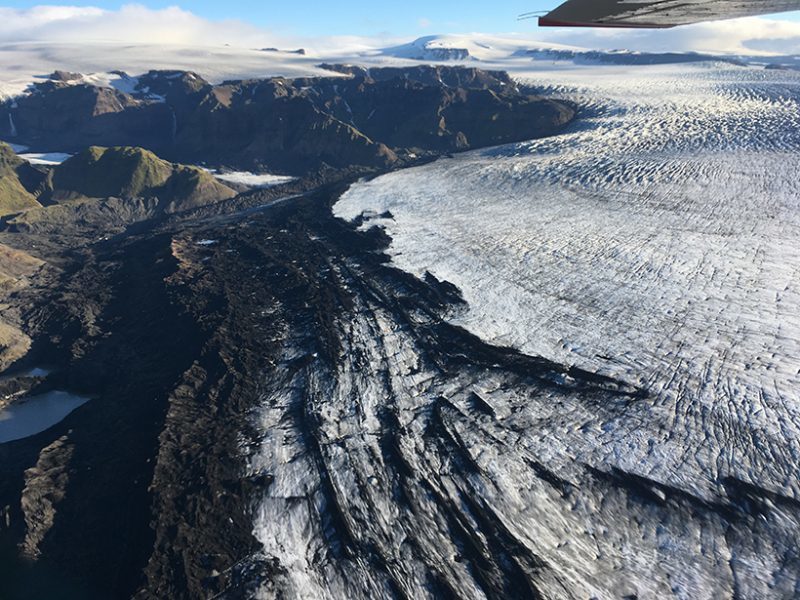
© Evgenia IlyinskayaAn airborne view of the massive glacier (600 square kilometers and up to 700 meters thick) that covers Katla, one of Iceland's most active and hazardous volcanoes. New research of Katla's emissions suggests that ice-covered volcanoes may emit greater quantities of carbon dioxide than previously estimated.
The emission rate of carbon dioxide (CO2) is one of the less obvious-but nevertheless significant-measures of volcanic activity. Volcanic CO2 emissions are also important for understanding the preindustrial climate balance. To date, estimates of global volcanic CO2 emissions have been extrapolated primarily from measurements collected at a small number of active sources. Ice-covered volcanic centers are prevalent, but they are often difficult to access, and their vents are difficult to discern, so they are rarely included in these calculations.














Comment: While it's clear that much greater forces are driving our planet's climate, it's notable what global warmists fail to include in their obviously erroneous models.
See:
- Volcanic eruptions, rising CO2, boiling oceans, and why man-made global warming is not even wrong
- Professor Valentina Zharkova explains and confirms why a "Super" Grand Solar Minimum is upon us
- Greenland getting colder says 15 years of data but global warmists 'fill in the gaps' to convince themselves otherwise
And check out SOTT radio's: Behind the Headlines: Earth changes in an electric universe: Is climate change really man-made?