
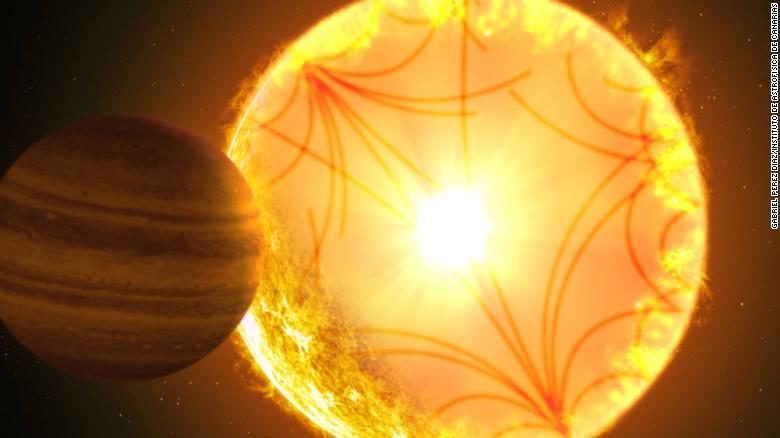
This is an artist's illustration of the Kepler-1658 system, where Kepler-1658 b orbits an evolved subgiant star every 3.8 days.
It's taken so long because the initial estimate of Kepler-1658, the planet's host star, was wrong. This also made the size estimate for the planet incorrect as well, and both of them were underestimated.
The incorrect numbers contributed to confusion that made the planet candidate seem like a false positive, and it was set aside. Then, University of Hawai'i graduate student Ashley Chontos focused her first year graduate research project on re-analyzing host stars of Kepler planet candidates.
Together, Chontos and an international team of astronomers have a paper on the planet that has been accepted for publication in the Astronomical Journal.
"Our new analysis, which uses stellar sound waves observed in the Kepler data to characterize the star, demonstrated that the star is in fact three times larger than previously thought. This in turn means that the planet is three times larger, revealing that Kepler-1658 b is actually a hot Jupiter," Chontos said in a statement.















Comment: See also: