Science & TechnologyS


Satellite

Japan successfully lands a probe on an asteroid, photos taken and rock samples forthcoming

asteroid picture
© JAXA
The life of an asteroid is lonely. The rocks spend eons drifting through the cold vacuum of space.

But on Wednesday, the asteroid Ryugu welcomed a special visitor: Japan's Hayabusa-2 probe successfully landed on the asteroid's surface at 21:06 ET (01:06 UTC on Thursday).

The Japan Aerospace Exploration Agency (JAXA) launched Hayabusa-2 into space in December 2014. Its mission: explore and collect samples from Ryugu, a primitive asteroid half-a-mile in diameter that orbits the sun at a distance up to 131 million miles (211 million kilometers).

The probe reached its destination in June 2018, then got to work making observations, measuring the asteroid's gravity, and rehearsing to touch down.

It blasted the asteroid with a copper plate and a box of explosives in April in order to loosen rocks and expose material under the surface, then successfully landed on Ryugu last night to gather up the rock and soil debris.

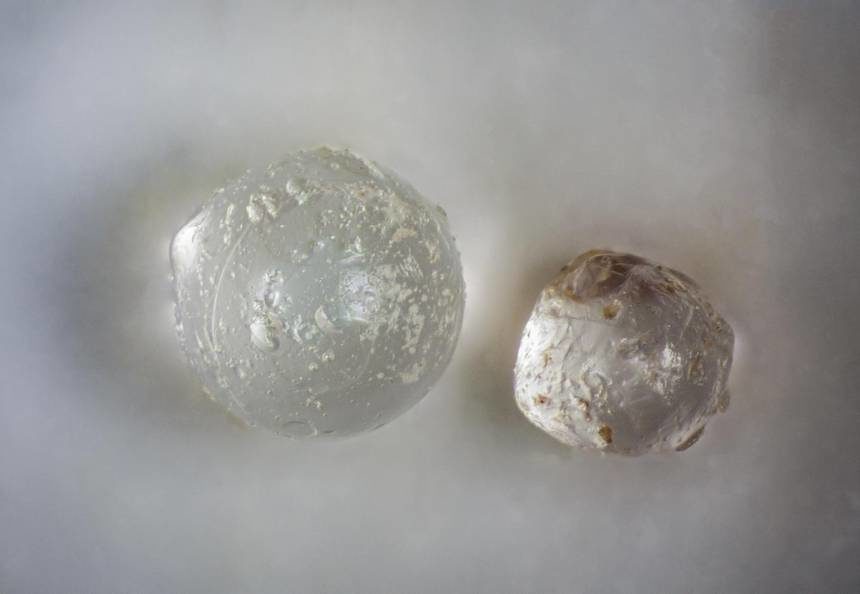
The spacecraft captured the images below as it left the asteroid's surface.

Chalkboard

Researchers publish first-ever photo of quantum entanglement

quantum entanglement
© University of GlasgowQuantum entanglement caught on camera. The photo shows a strong form of quantum entanglement
In an incredible first, scientists have captured the world's first actual photo of quantum entanglement - a phenomenon so strange Einstein famously described it as 'spooky action at a distance'.

The image was captured by physicists at the University of Glasgow in Scotland, and it's so breathtaking we can't stop staring.

It might not look like much, but just stop and think about it for a second: this fuzzy grey image is the first time we've seen the particle interaction that underpins the strange science of quantum mechanics and forms the basis of quantum computing.

Bullseye

Turns out goldfish are more like broken carp

goldfish
© Goldfish, by ぱたごん [CC BY-SA 3.0], via Wikimedia Commons.
Michael Behe opens his new book Darwin Devolves with the story of the polar bear. It's big and distinctive like a Darwin champion new species, but it's really a variety of brown bear that "evolved" to survive in arctic cold (in fact, it can hybridize with Alaskan brown bears). How did it do that? Behe shows that genes for regulating fat and for metabolizing cholesterol became broken or blunted, and this had a side effect of keeping the bears warm in cold climates, changing their coat color, while permitting them to survive on fatty diets of seals. Darwin's mechanism did not create anything new; it broke things, but in the case of the polar bear, it worked out.

A Similar Story

A similar story can be told about goldfish, it turns out. Goldfish underwent whole-genome duplication (WGD) events after they diverged from carp and zebrafish. According to evolutionary theory, this provided goldfish with extraordinary opportunities for advancement, because now there were two copies of each gene to evolve. One copy, called an "ohnolog" (as a hat tip to Susumi Ohno's 1970 idea of evolution through gene duplication), could maintain the old functions of a gene. The other copy would be free to undergo evolutionary change. Phys.org explains:
[T]he goldfish (and its cousin the common carp) went through a "whole genome duplication" after evolutionarily "splitting off" from zebrafish. Now, having four copies of every gene instead of two allows for one copy to change and evolve without harming the fish. This can result in lost genes or new functions for genes. This is a natural complement to "knockout" laboratory studies.

Add in the common carp genome with its own ornamental varieties (known as koi), and there are plenty of avenues of comparison to provide researchers with a window into how genes change during evolution. [Emphasis added.]

Comment: See also:


Microscope 2

Cells use flow fields from contractile movement to synchronize toxin release in unison

Spirostomum ambiguum
© Y. TsukiiSpirostomum ambiguum
Observations of cellular life in a local marsh lead researchers to the discovery of a new type of intercellular communication.

Crouching in the boot-sucking mud of the Baylands Nature Preserve in Palo Alto, Manu Prakash, associate professor of bioengineering at Stanford University, peered through his Foldscope -- a $1.75 origami microscope of his own invention -- scrutinizing the inhabitants of the marsh's brackish waters. With his eye trained on a large single-cell organism, called Spirostomum, he watched it do something that immediately made it his next research subject.

"I still remember for the very first time, seeing this organism swim by under the Foldscope," said Prakash. "This is a massive cell but it contracts in less than a blink of an eye, accelerating faster than almost any other single cell. When you aren't expecting it, it's like it disappears. I remember being so excited, I had to bring the cells back to the lab and take a careful look."

Galaxy

NASA's Hubble telescope uncovers a black hole that astronomers say shouldn't exist

spiral galaxy NGC 3147 black hole
A Hubble Space Telescope image of the spiral galaxy NGC 3147 appears next to an artist's illustration of the supermassive black hole residing at the galaxy’s core. The Hubble image shows off the galaxy's sweeping spiral arms, full of young blue stars, pinkish nebulas, and dust in silhouette. However, at the brilliant core of NGC 3147 lurks a monster black hole, weighing about 250 million times the mass of our Sun.
"We've never seen the effects of both general and special relativity in visible light with this much clarity," said Marco Chiaberge of the European Space Agency, and the Space Telescope Science Institute and Johns Hopkins University, both in Baltimore, Maryland, a member of the team that conducted the Hubble study.

"This is an intriguing peek at a disk very close to a black hole, so close that the velocities and the intensity of the gravitational pull are affecting how the photons of light look," added the study's first author, Stefano Bianchi of Università degli Studi Roma Tre, in Rome, Italy. "We cannot understand the data unless we include the theories of relativity."

Black holes in certain types of galaxies like NGC 3147 are malnourished because there is not enough gravitationally captured material to feed them regularly. So, the thin haze of infalling material puffs up like a donut rather than flattening out in a pancake-shaped disk. Therefore, it is very puzzling why there is a thin disk encircling a starving black hole in NGC 3147 that mimics much more powerful disks found in extremely active galaxies with engorged, monster black holes.

"We thought this was the best candidate to confirm that below certain luminosities, the accretion disk doesn't exist anymore," explained Ari Laor of the Technion-Israel Institute of Technology located in Haifa, Israel. "What we saw was something completely unexpected. We found gas in motion producing features we can explain only as being produced by material rotating in a thin disk very close to the black hole."

The astronomers initially selected this galaxy to validate accepted models about lower-luminosity active galaxies — those with black holes that are on a meager diet of material. Models predict that an accretion disk forms when ample amounts of gas are trapped by a black hole's strong gravitational pull. This infalling matter emits lots of light, producing a brilliant beacon called a quasar, in the case of the most well-fed black holes. Once less material is pulled into the disk, it begins to break down, becomes fainter, and changes structure.

Comment: An artist's vision of the peculiar thin disc of material circling a supermassive black hole at the heart of the spiral galaxy NGC 3147, located 130 million light-years away:


Info

Ancient DNA sheds light on domestic cattle

Domestic Cattle
© CATHERINE FALLS COMMERCIAL / GETTY IMAGESIf you only knew our story: domestic cattle had a complex history, research shows.
Cows are seemingly simple creatures. Their history is anything but.

An analysis of ancient genomes from domestic cattle and their wild relatives has uncovered the complex family tree of our milk- and steak-producing charges.

The study, published in the journal Science, reveals a history shaped by centuries-long drought and trysts with wild aurochs.

European cattle (Bos taurus) were domesticated around 10,500 years ago in a region that today spans parts of Turkey and the Middle East from wild aurochs (Bos primogenius), large beasts that were eventually snuffed out in the seventeenth century.

Genetic information from modern cattle indicate that a pool of just 80 female aurochs contributed to this initial domestication event. But analysis of modern genomes can only reveal so much about this early history.

One complicating factor is the introduction of genes from zebu (Bos indicus) - the characteristically humped cattle of South Asia that were domesticated around 8000 years ago from Indian aurochs (Bos nomadicus). This occurred further east in the Indus Valley, a region in modern-day Afghanistan, Pakistan and northern India.

To get at some of the early events in cattle history, geneticist Dan Bradley, from Trinity College Dublin, and his colleagues painstakingly extracted DNA from as many old cattle bones as they could get their hands on.

Satellite

In world first, Japan's Hayabusa2 probe collects samples from distant asteroid after 'perfect' touchdown

Hayabusa2
Hayabusa2 touched down on its targeted area measuring 7 meters in width, located 20 meters from the artificial crater’s center. The probe extended a tube to the surface and fired a small metallic projectile from it, successfully capturing the subsurface debris as it floated up.
The Hayabusa2 probe made a "perfect" touchdown Thursday on a distant asteroid and collected samples from beneath the surface in an unprecedented mission that could shed light on the origins of the solar system.

"We've collected a part of the solar system's history," Japan Aerospace Exploration Agency (JAXA) project manager Yuichi Tsuda said at a jubilant news conference in Sagamihara, Kanagawa Prefecture, hours after the successful landing was confirmed.

"We have never gathered subsurface material from a celestial body further away than the moon," he added.

"We did it and we succeeded in a world first."

The fridge-sized probe made its second landing on the asteroid around 10:30 a.m., with officials from JAXA breaking into applause and cheers at the mission control room in Sagamihara as initial data suggested the touchdown had been a success.

Confirmation of the landing came only after Hayabusa2 lifted back up from the asteroid and resumed communications with the control room.

Research Director Takashi Kubota told reporters that the touchdown operation was "more than perfect."

Rocket

Arianespace Vega rocket carrying UAE military satellite crashes into Atlantic after developing 'major anomaly'

Arianspace Vega rocket failure Jul 2019
The rocket suffered an "anomaly" two minutes after takeoff, causing its trajectory to degrade. The satellite was capable of capturing high definition images that could be used for mapping and gathering agricultural information as well as urban surveillance and monitoring of borders and coastlines.
French commercial rocket launch provider Arianespace has confirmed its VV15 mission, a Vega rocket carrying an Emirati military satellite, failed 2 minutes after launch, veering off course and crashing in the Atlantic Ocean.

"A major anomaly occurred, resulting in the loss of the mission," Luce Fabreguettes, executive VP of missions, operations and purchasing, said. "On behalf of Arianespace, I wish to express my deepest apologies to our customers for the loss of their payload and telling them how sorry I am."

The Vega launched from Guiana Space Center in Kourou, French Guiana at 1:53 GMT Thursday and left its intended course immediately before losing telemetry data two minutes into the launch, during its second-stage ignition phase.


Beaker

Gene-edited babies and family planning

gene edited babies
Technology surrounding the human embryo has moved out of the realm of science fiction and into the reality of difficult decisions. Clinical embryologists fertilize human eggs for the purpose of helping couples conceive. The genetic makeup of these embryos are tested on a routine basis. And today, we no longer ask "can we," but rather, "should we" edit human embryos with the goal of implantation and delivery of a baby?

As a reproductive endocrinologist, I frequently encounter couples grappling with complicated reproductive issues. If one or both parents are affected by single gene disorders, these couples have the opportunity to first test their embryos and then decide whether to transfer an embryo carrying a mutation rather than finding out the genetic risk of their baby while pregnant. In some cases they may decide not to transfer an embryo that carries the mutation as part of the in vitro fertilization procedure.

These issues seem simple, but carry large consequences for patients. "Should we transfer an embryo affected with our genetic disorder?" "What should we do with our affected embryos if we do not transfer them?" Some patients will opt to skip testing altogether.

Binoculars

Pentagon looking to prep soldiers for 'battlefield nuclear warfare' with virtual reality tech

Battlefield tech
© Global Look/Sebastian Gollinow
The Pentagon has put out a call for virtual reality training environments with "radiological/nuclear considerations" - another sign that the US' unhealthy obsession with nuclear warfare isn't going away anytime soon.

The Defense Threat Reduction Agency, a Department of Defense division focused on countering weapons of mass destruction, is looking for virtual reality systems it can use to train combat forces in a "battlefield nuclear warfare environment." The agency issued a "sources sought notice" last week, seeking technical specs and other market information on "virtual training and testing programs" for combat troops "performing radiological threat objects find and interdict operations" - as well as fighting on the nuclear "battlefield."

"AR/VR capabilities will not replace field training requirements," the notice states, adding that its "purpose is to test warfighter scenarios and decision-making to provide users realistic outcomes to support training and course-of-action selection when faced with radiological/nuclear threats." It may also be used for "planning training scenarios" and "equipment testing events." While the addition of a realistic VR overlay of post-nuclear devastation could make soldiers more reluctant to push the big red button, that decision has never been left to the rank-and-file, and it's unlikely their commanders will be lining up to experience even the most high-tech post-apocalyptic training module.