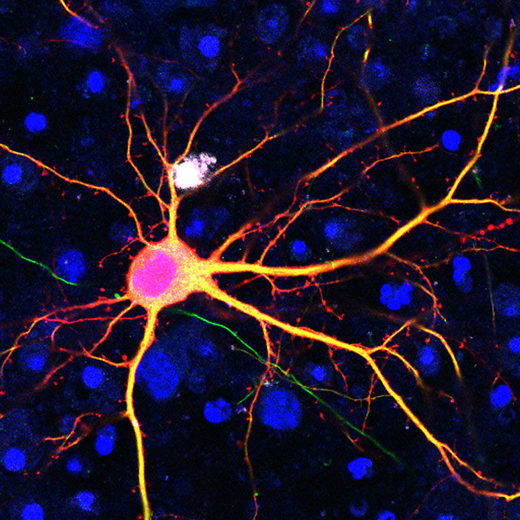
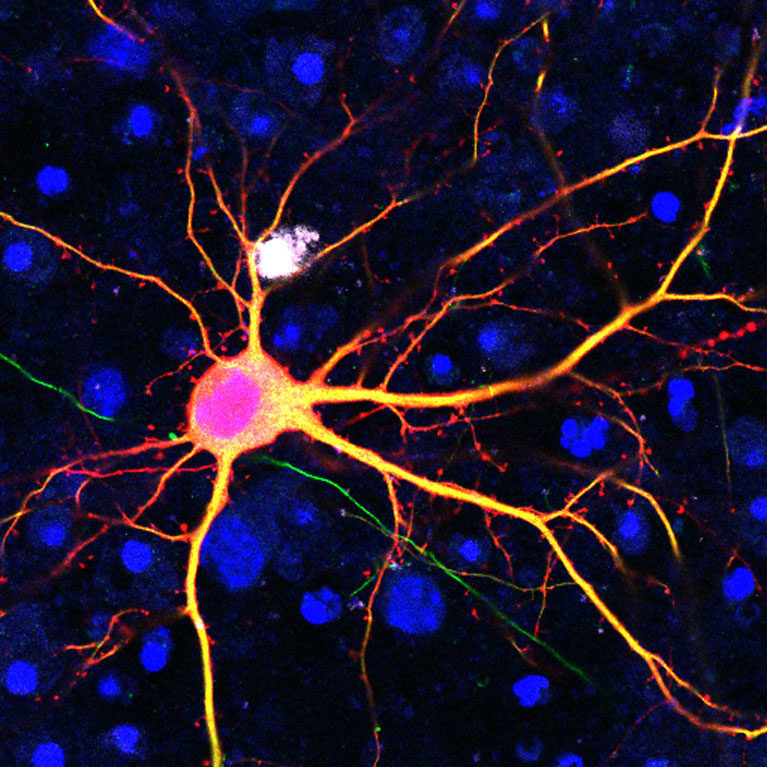
Neuron targeted using the SATI technology.
The ability to edit genes in living organisms offers the opportunity to treat a plethora of inherited diseases. However, many types of gene-editing tools are unable to target critical areas of DNA, and creating such a technology has been difficult as living tissue contains diverse types of cells.
Now, Salk Institute researchers have developed a new tool —
dubbed SATI — to edit the mouse genome, enabling the team to
target a broad range of mutations and cell types. The new genome-editing technology, described in
Cell Research on August 23, 2019, could be expanded for use in a broad range of gene mutation conditions
such as Huntington's disease and the rare premature aging syndrome, progeria."This study has shown that SATI is a powerful tool for genome editing," says
Juan Carlos Izpisua Belmonte, a professor in Salk's Gene Expression Laboratory and senior author of the paper. "It could prove instrumental in developing effective strategies for target-gene replacement of many different types of mutations, and opens the door for using genome-editing tools to possibly cure a broad range of genetic diseases."
Techniques that modify DNA — notably the CRISPR-Cas9 system — have generally been most effective in dividing cells, such as those in the skin or the gut, using the cells' normal DNA repair mechanisms. The Izpisua Belmonte lab
previously showed that their CRISPR/Cas9-based gene-editing technology, called HITI (for homology-independent targeted integration), could target both dividing and non-dividing cells. Protein-coding regions function like recipes for making proteins, while areas called non-coding regions act as chefs deciding how much food to make.
These non-coding regions make up the vast majority of DNA (~98%) and regulate many cellular functions including turning genes off and on, so could be a valuable target for future gene therapies.

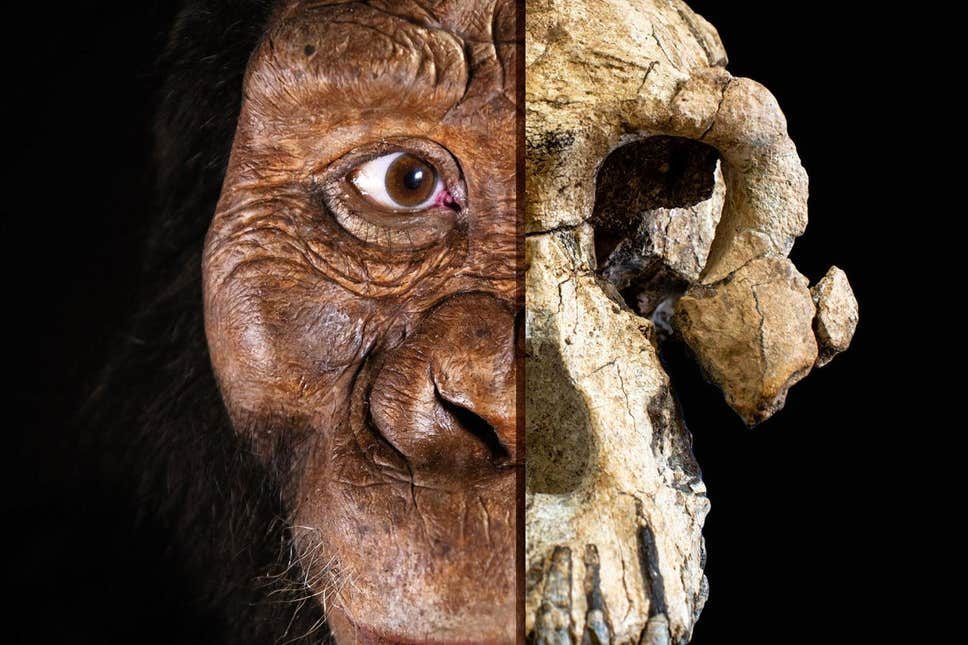
















Comment: These findings not only 'challenge' researchers understanding of evolution, but also, as noted above, similar discoveries have cast serious doubt over whether they are indeed ancestors of humans at all: Unlikely that South African fossil species is ancestral to humans
See also:
- Previously unknown "proto-hominin" species suggests ancestor of humans evolved in Europe not Africa
- Darwinism, Creationism... How About Neither?
- Why Darwinism Is Wrong, Dead Wrong - Part 1: Intelligent Design and Information
- The Probability of Evolution
And check out SOTT radio's: