Science & TechnologyS


Comet 2

Another doomed comet just fell into the Sun

soho comet sundiver august 2019
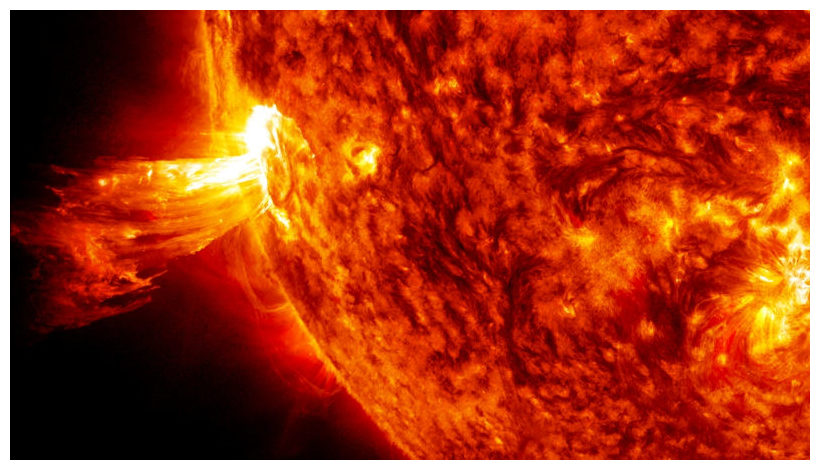
© NASA/ESO/SOHOThe Solar and Heliospheric Observatory (SOHO) observed a comet dive directly into the sun on Aug. 15, 2019.
Comet's death dive Into Sun snapped by SOHO spacecraft

Yesterday (Aug. 15), the Solar and Heliospheric Observatory (SOHO) watched a comet meet its demise as the dirty snowball dove directly into the sun, according to Space Weather astronomer Tony Phillips.

In the video captured by SOHO, you can see a number of objects zooming around the sun, which is blocked by an opaque disk to reduce glare. Seemingly right on top of the sun is Venus, which is bright and easy to spot. Left of center and not quite as bright as Venus, you can also see Mars. Just about 10 seconds into the video, the sun-bound comet suddenly becomes obvious and easy to detect.

Info

New state of matter discovered by scientist

New State of Matter
© sakkmesterke/Getty Images
Breakthrough Offers Promise for Enhanced Storage and Computation Capabilities

A team of physicists has uncovered a new state of matter — a breakthrough that offers promise for increasing storage capabilities in electronic devices and enhancing quantum computing.

"Our research has succeeded in revealing experimental evidence for a new state of matter — topological superconductivity," says Javad Shabani, an assistant professor of physics at New York University. "This new topological state can be manipulated in ways that could both speed calculation in quantum computing and boost storage."

The discovery, reported in a paper on arXiv, was conducted with Igor Zutic at the University of Buffalo and Alex Matos-Abiague at Wayne State University.

The work centers on quantum computing — a method that can make calculations at significantly faster rates than can conventional computing. This is because conventional computers process digital bits in the form of 0s and 1s while quantum computers deploy quantum bits (qubits) to tabulate any value between 0 and 1, exponentially lifting the capacity and speed of data processing.

Einstein

Erik Verlinde: A radical theory of gravity

Erik Verlinde
© phys.orgErik Verlinde
Erik Verlinde has been compared to Einstein for completely rethinking the nature of gravity.
  • The Dutch physicist Erik Verlinde's hypothesis describes gravity as an "emergent" force not fundamental.
  • The scientist thinks his ideas describe the universe better than existing models, without resorting to "dark matter".
  • While some question his previous papers, Verlinde is reworking his ideas as a full-fledged theory.
The Dutch theoretical physicist Erik Verlinde is no stranger to big ideas. His 2009 hypothesis about gravity earned him comparisons to Einstein for its complete rethinking of what gravity could be. Verlinde proposed that gravity was not a fundamental force of nature but rather emerged out of the interactions of information that fills the universe. He also didn't think there was such a thing as "dark matter" - a useful construct which is supposedly taking up 27% of the known universe (but is yet to be observed). Now, in a new interview, Verlinde reveals he is taking steps towards conceptualizing his groundbreaking ideas in a full-fledged theory.


Comment:


See also:


Galaxy

LIGO and Virgo likely spotted the first black hole swallowing up a neutron star

Black hole/neutron star
© Dana Berry/NASAGravitational waves may have revealed a black hole in the process of swallowing up a neutron star (illustrated). If confirmed, the event would be the first of its kind ever seen.
Shudders in the cosmos have revealed what's likely the sad end of a neutron star — getting swallowed by a black hole.

If confirmed, it would be the first solid detection of this source of gravitational waves, revealing a type of cataclysm never before spotted. Researchers from the LIGO and Virgo gravitational wave observatories reported the candidate event, which was detected August 14, in a public database used by astronomers.

Scientists are still analyzing the data to verify what created the gravitational waves, which are tiny vibrations in spacetime caused by massive, accelerating objects. But one thing seems fairly certain: "Something has occurred out there in the sky," says physicist Daniel Holz of the University of Chicago, a member of LIGO. "So far, it doesn't obviously look like anything we've detected with high confidence before."

Butterfly

Counterintuitive physics property found to be widespread in living organisms

negative differential response
© Khopkins2010, Wikimedia CommonsA negative differential response occurs in substrate inhibition, a process that occurs in about 20% of all known enzymes.
Ever since the late 19th century, physicists have known about a counterintuitive property of some electric circuits called negative resistance. Typically, increasing the voltage in a circuit causes the electric current to increase as well. But under some conditions, increasing the voltage can cause the current to decrease instead. This basically means that pushing harder on the electric charges actually slows them down.

Due to the relationship between current, voltage, and resistance, in these situations the resistance produces power rather than consuming it, resulting in a "negative resistance." Today, negative resistance devices have a wide variety of applications, such as in fluorescent lights and Gunn diodes, which are used in radar guns and automatic door openers, among other devices.

Most known examples of negative resistance occur in human-engineered devices rather than in nature. However, in a new study published in the New Journal of Physics, Gianmaria Falasco and coauthors from the University of Luxembourg have shown that an analogous property called negative differential response is actually a widespread phenomenon that is found in many biochemical reactions that occur in living organisms. They identify the property in several vital biochemical processes, such as enzyme activity, DNA replication, and ATP production. It seems that nature has used this property to optimize these processes and make living things operate more efficiently at the molecular scale.


Comment: The materialist assumptions goes unstated: "by accident" and "for no actual purpose".


Microscope 2

Newly discovered organ that senses pain may be lurking under your skin

nociceptive
© Reprinted with permission from Hind Abdo et al.,A colorized microscope image shows the structure of a newly described organ called the nociceptive glio-neural complex, highlighted here in green. Nerve cells in this image are depicted in red, while cells in the outer part of the skin are shown in blue.
Identified in mice, the simple organ most likely exists in humans, too, offering fresh insight into how we experience painful pressure and pricks.

Most people who've been jabbed by a needle know the drill: First the pierce, then the sharp, searing pain and an urge to pull away, or at least wince. While the exact circuitry behind this nearly universal reaction is not fully understood, scientists may have just found an important piece of the puzzle: a previously unknown sensory organ inside the skin.

Dubbed the nociceptive glio-neural complex, this structure is not quite like the typical picture of a complex organ like the heart or the spleen. Instead, it's a simple organ made up of a network of cells called glial cells, which are already known to surround and support the body's nerve cells. In this case, the glial cells form a mesh-like structure between the skin's outer and inner layers, with filament-like protrusions that extend into the skin's outer layer.

Comment: Only a decade or so ago, parts of the human body that were once considered disposable, like our appendix or tonsils, have actually been discovered to play critical roles in maintaining optimal health. The finding above is just one of a number of recent discoveries that show just how much we've yet to learn: Also check out SOTT radio's: Objective:Health #25 - Fascia - The Body's "Fiber Optic" Crystalline Matrix


Microscope 2

Scientists discover a cure for the deadliest strain of tuberculosis

doctor
© Joao Silva / The New York Times
When she joined a trial of new tuberculosis drugs, the dying young woman weighed just 57 pounds.

Stricken with a deadly strain of the disease, she was mortally terrified. Local nurses told her the Johannesburg hospital to which she must be transferred was very far away — and infested with vervet monkeys.

"I cried the whole way in the ambulance," Tsholofelo Msimango recalled recently. "They said I would live with monkeys and the sisters there were not nice and the food was bad and there was no way I would come back. They told my parents to fix the insurance because I would die."

Five years later, Msimango, 25, who became the trial's fifth enrolled patient, is now tuberculosis-free. She is healthy at 103 pounds, and has a young son.

Info

More genes in the body than there are stars in the universe

Human Microbiome
© KATERYNA KON/SCIENCE PHOTO LIBRARY, VIA GETTY IMAGESThere are likely more genes in the body than there are stars in the universe.
US scientists have begun the daunting task of trying to work out how many genes there are in the human microbiome.

Even when you consider just the gut and the mouth (in itself, a unique research double) the numbers are potentially overwhelming.

Microbiologists and bioinformaticians from Harvard Medical School and Joslin Diabetes Centre gathered all publicly available sequencing data on human oral and gut microbiomes and analyzed the DNA from around 3500 samples - 1400 from mouths and 2100 from guts.

In all, there were nearly 46 million bacterial genes - 24 million in the oral microbiome and 22 million in the gut.

That leads the team to suggest that there may be more genes in the collective human microbiome than there are stars in the observable universe (we're talking trillions) - and that at least half of them may be unique to each individual.

"Ours is a gateway study, the first step on a what will likely be a long journey toward understanding how differences in gene content drive microbial behaviour and modify disease risk," says Harvard's Braden Tierney, first author of a paper published in the journal Cell Host & Microbe, with admirable understatement.

Most research to date has focused on mapping the types of bacteria that inhabit our bodies in an effort to determine whether and how the presence of a given bacterial species might affect disease risk, the researchers say.

In contrast, their work looks at the genes that make up the various microbial species and strains.

Eye 1

Amazon says its facial recognition can now identify fear along with other emotions

  • Amazon said this week its facial recognition software, Rekognition, can detect a person's fear.
  • Rekognition is used for facial analysis or sentiment analysis.
  • The company claims it can accurately identify seven emotions: happy, sad, angry, surprised, disgusted, calm and confused.
Amazon Rekognition
Amazon said this week its facial recognition software can detect a person's fear.

Rekognition is one of many Amazon Web Services (AWS) cloud services available for developers. It can be used for facial analysis or sentiment analysis, which identifies different expressions and predicts emotions from images of people's faces. The service uses artificial intelligence to "learn" from the reams of data it processes.

Comment: See also:


Biohazard

We're unprepared for race specific bioweapons threat - Cambridge University

bioweapon
In the future, we may have to deal with biological weapons that target specific groups of people, passing over everyone else.

That's according to a new report out of Cambridge University's Centre for the Study of Existential Risk reviewed by The Telegraph. In it, the Cambridge researchers argue that world governments have failed to prepare for futuristic weapons based on advanced technology like artificial intelligence and genetic manipulation — or even a killer pathogen designed to kill only people of a particular race.

Proactive Action

The report specifically called for the creation of independent groups to assess the risks of various future technologies and sort out whatever protocols are already in place to protect people from them, per The Telegraph.

Comment: The US has been at the forefront of bio-weapon research, and stands accused of attempting to develop race specific bioweapons, it also has a history of targeting specific groups for medical experimentation. However genetic research shows that, throughout human history relentless migrations and mixing - even intra-species mixing - means that it's not possible to define race through genetics, therefore any attempts at targeting one particular group would likely threaten the population of the entire planet: Also check out SOTT radio's: The Truth Perspective: Interview with Dilyana Gaytandzhieva: Pentagon Biological Warfare And Arms Trafficking to Terrorists