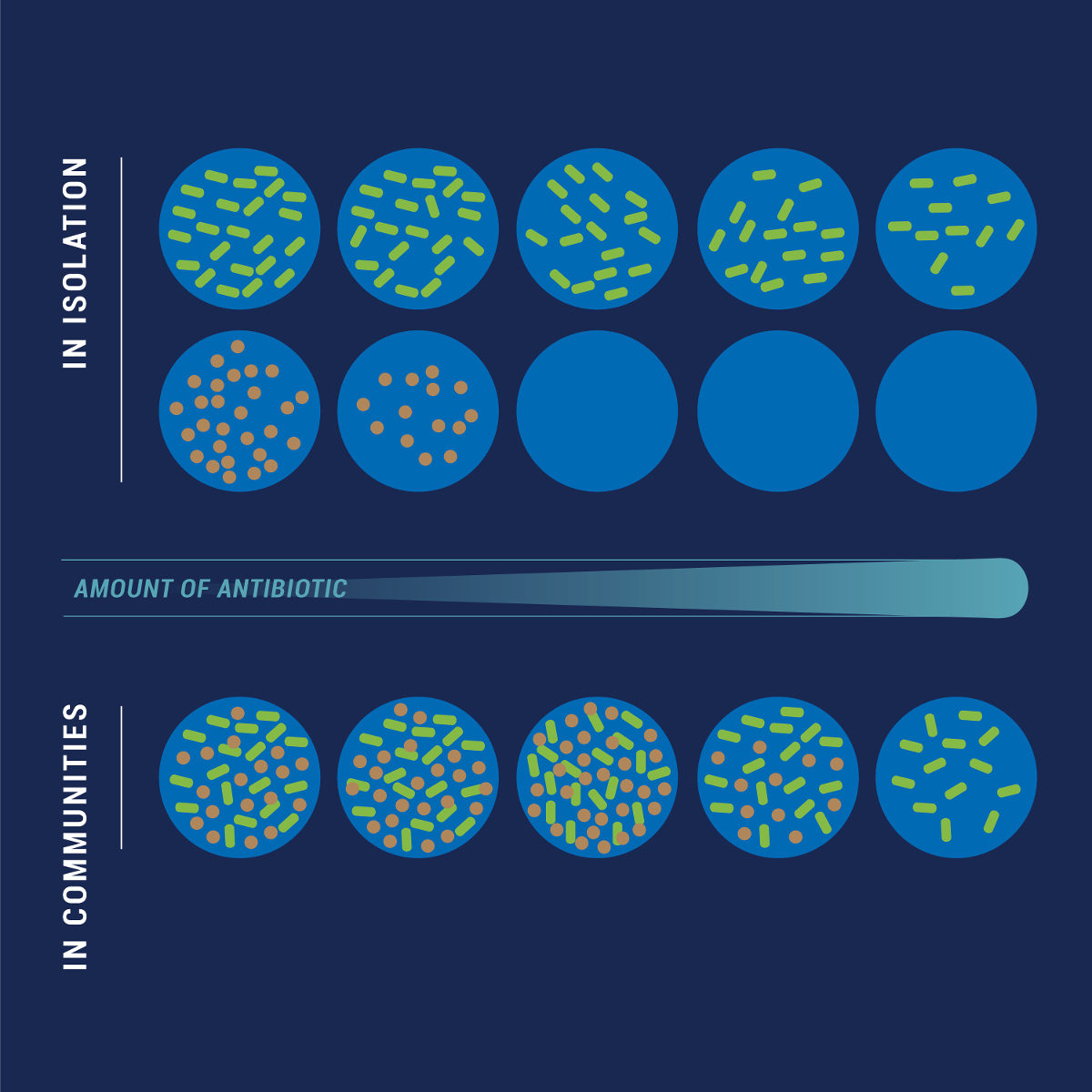
© Illustration courtesy of Navid Marvi and Andres Aranda-Diaz.
Baltimore, MD
— Antibiotics can make easy work of infections. But how do they affect the complex ecosystems of friendly bacteria that make up our microbiome?
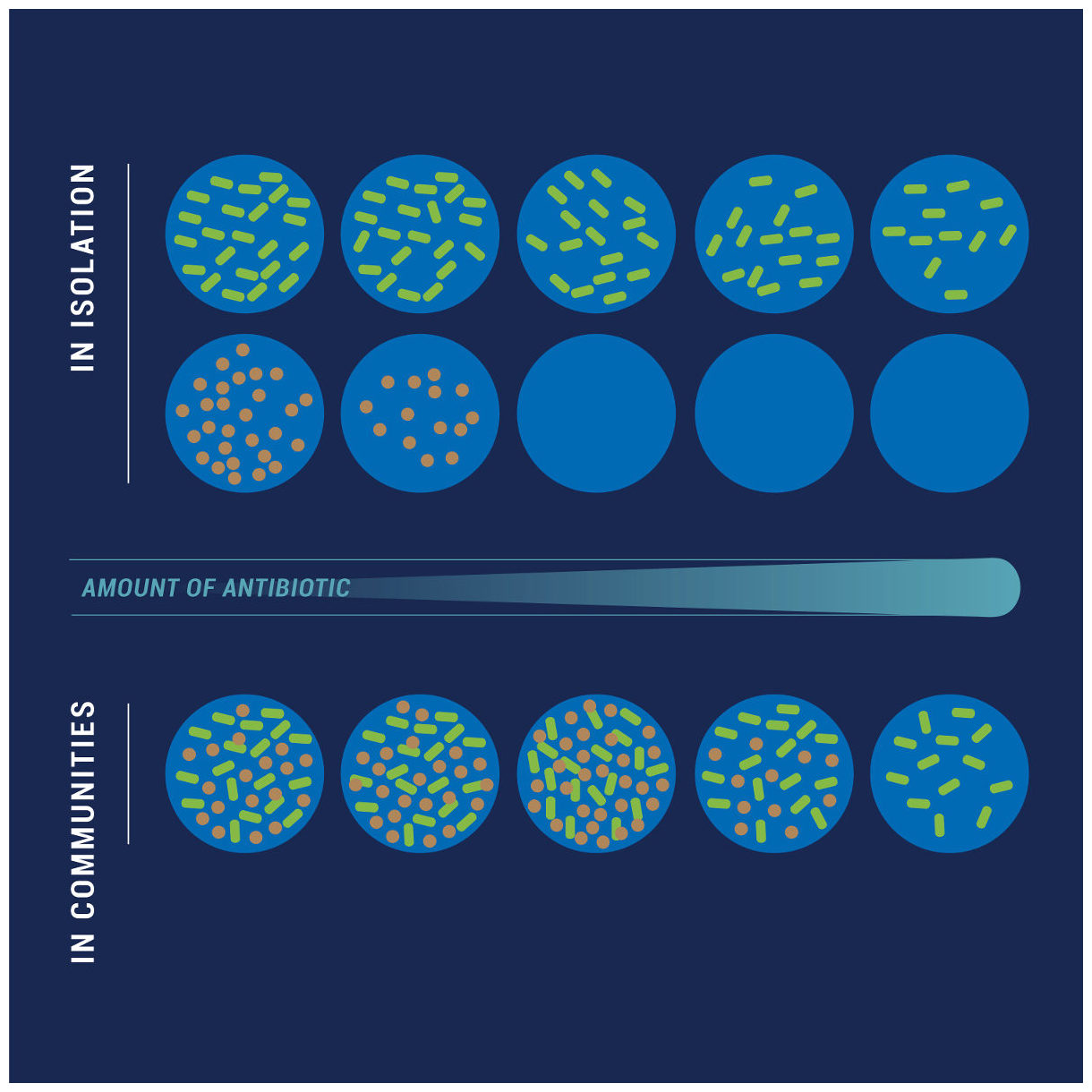
"When a doctor prescribes antibiotics, it sets up a multi-faceted experiment in your gastrointestinal system," explains Carnegie's Will Ludington "What can it teach us about the molecular principles of species interactions in nature?"
New work led by Ludington and Stanford University's K.C. Huang set out to answer this challenging question and
discovered a new form of antibiotic tolerance. Their findings, which have important health implications, are published by
eLife.
This is one of several research fronts on which Ludington uses the fruit fly microbiome to understand interactions between species in a bacterial community. It poses an ideal environment for probing both natural bacterial populations and the human microbiome.
The human microbiome is an ecosystem of hundreds to thousands of microbial species living within our guts. It affects our health and even our longevity. But it's difficult to elucidate the myriad ways that the different species that comprise our microbiome interact with and influence each other, even under normal conditions. Once antibiotics are introduced, little is understood about how these vital communities are impacted on a biochemical level.
This is why the fruit fly makes such an excellent model. Unlike the human microbiome, it consists of only a handful of bacterial species.


















Comment: See also: