
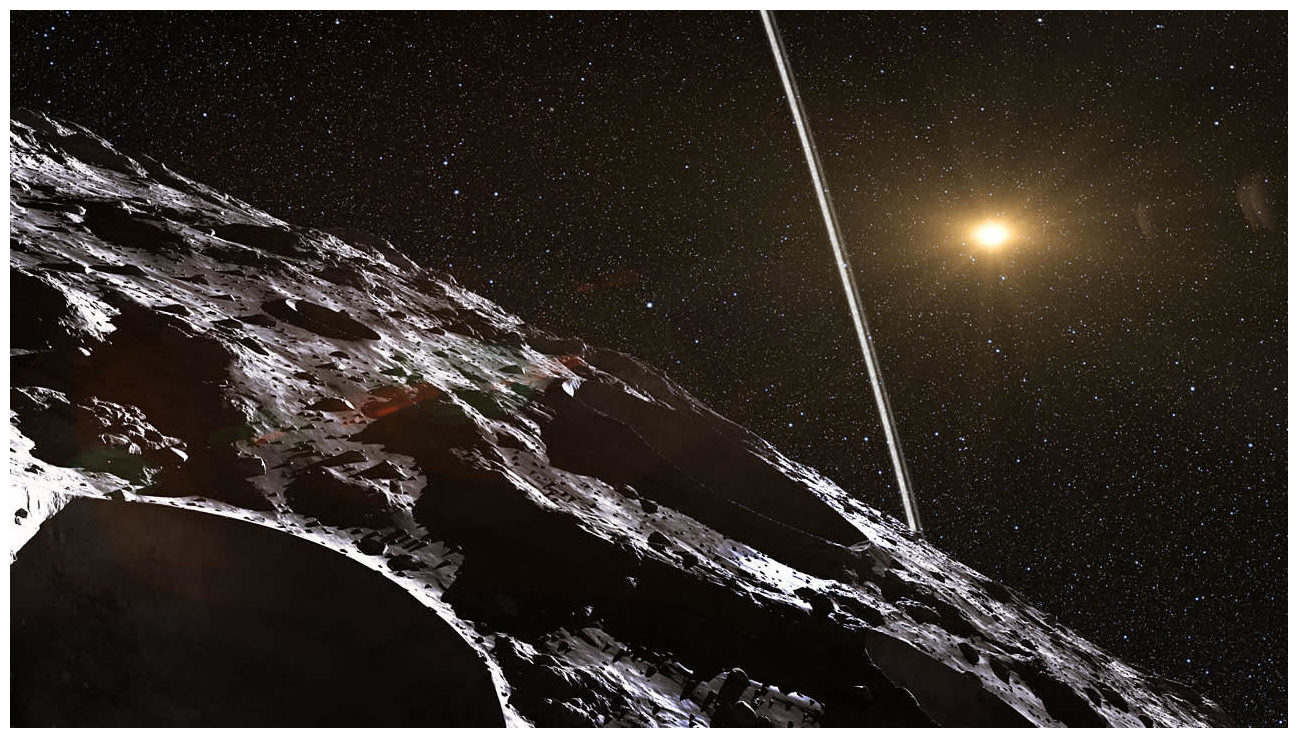
© Illustration: ESO/L. Calçada/Nick Risinger/SkySurvey OrgArtist’s impression of the Centaur Chariklo.
Astronomers think they've found an entire population of asteroids originating from outside our solar system, according to a new
paper.
The objects at the centre of this investigation aren't new discoveries. Called the Centaurs, they're mysterious asteroids that orbit in the neighbourhood of Jupiter and beyond. These objects take highly inclined orbits relative to the plane of the rest of the planets, and in at least one case, orbit the "wrong" way relative to the rest of the solar system's objects. By playing the laws of physics in reverse, scientists Fathi Namouni at the Université Côte d'Azur in France and Helena Morais at UNESP in Brazil
found that 19 of these objects likely originated around another star.Astronomers first spotted the object (514107) 2015 BZ509, now called Ka'epaoka'awela, in the Pan-STARRS survey in 2015. Analysis of this asteroid revealed something shocking: It was orbiting the
wrong way around the solar system in a stable yet eccentric orbit near Jupiter, on a tilt relative to the rest of the planets.
Morais and Namouni studied that object's orbit, built a simulation, and played in reverse the behaviour of a million imaginary objects that fit Ka'epaoka'awela's orbital parameters, each with slightly different properties within the margin of error of the original observations. Most of the simulated objects either crashed into the Sun or other planets or were ejected from the solar system, but both of these cases failed to produce sensical origin stories for the asteroids once they turned the arrow of time back forward, Namouni explained. The ones that did obey the laws of physics were stable since the founding of the solar system 4.5 billion years ago. The researchers interpreted their observations as the objects having been captured from elsewhere.
















Comment: Ah for the good old days when we worried that the pathocrats tampering with the food supply might increase illnesses in the population.
Since then we've learned that Gates & Co. are attempting to directly 'edit' PEOPLE's genes through mandatory mass vaccination with experimental 'behavior-modifying' vaccines, and that their mad science experiments to create a Master Race and eliminate/control undesirables have literally 'gone awry' and resulted in this COVID-19 lockdown.