
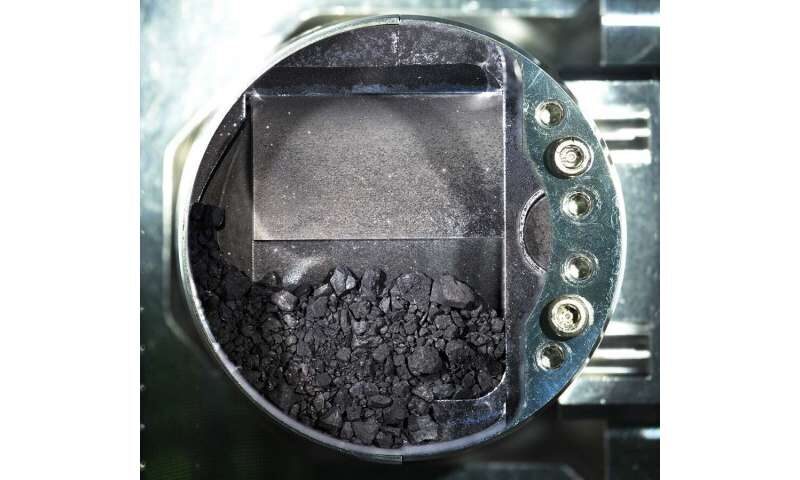
© JAXA via APThis photo provided Thursday, Dec. 24, 2020, by the Japan Aerospace Exploration Agency (JAXA), shows soil samples, seen inside the A compartment of the capsule brought back by Hayabusa2, in Sagamihara, near Tokyo. Japanese space officials said Thursday they found more asteroid soil samples collected and brought back from the Hayabusa2 spacecraft, in addition to black sandy granules they found last week, raising their hopes of finding clues to the origins of the solar system.
The samples Japanese space officials described Thursday are as big as 1 centimeter (0.4 inch) and rock hard, not breaking when picked up or poured into another container. Smaller black, sandy granules the spacecraft collected and returned separately were described last week.
The Hayabusa2 spacecraft got the two sets of samples last year from two locations on the asteroid Ryugu, more than 300 million kilometers (190 million miles) from Earth. It dropped them from space onto a target in the Australian Outback, and the samples were brought to Japan in early December.












Comment: See also: