Animals
S


Question

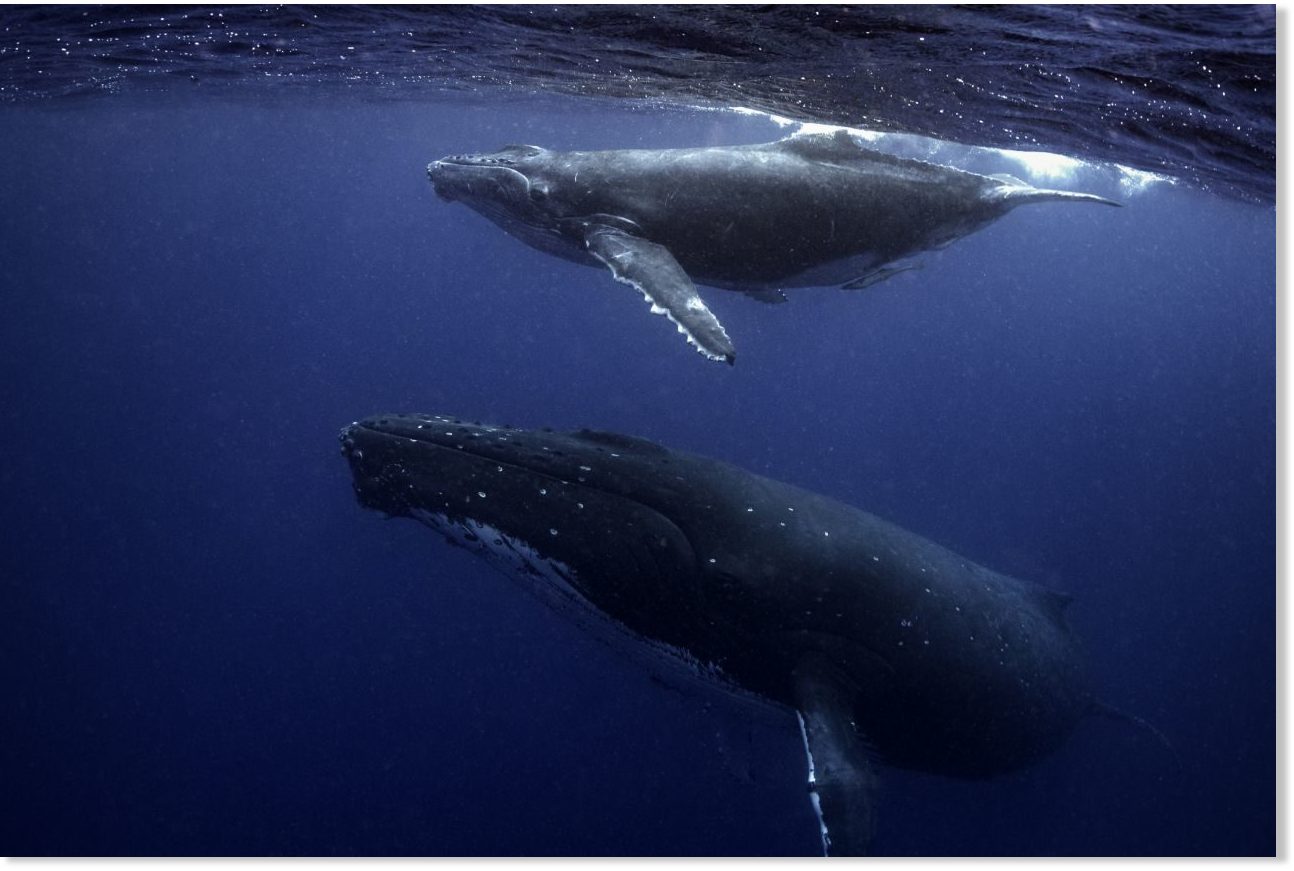
Sunspots may cause mass whale strandings, new study suggests

Does the sun cause grey whale strandings?
Solar storms and sunspots may be behind mass whale strandings, new research has suggested.

Grey whales are far more likely to strand on days when there are more sunspots, researchers from Duke University found.

The finding suggests that the migrating animals may use a magnetic sense to navigate, which is disrupted by solar activity.


Sunspots are linked to solar storms, a sudden release of high-energy particles from the sun that can disrupt magnetic orientation.

The Duke University researchers analysed 186 live strandings of grey whales and the results showed they occurred significantly more on days with high sunspot counts.

Binoculars

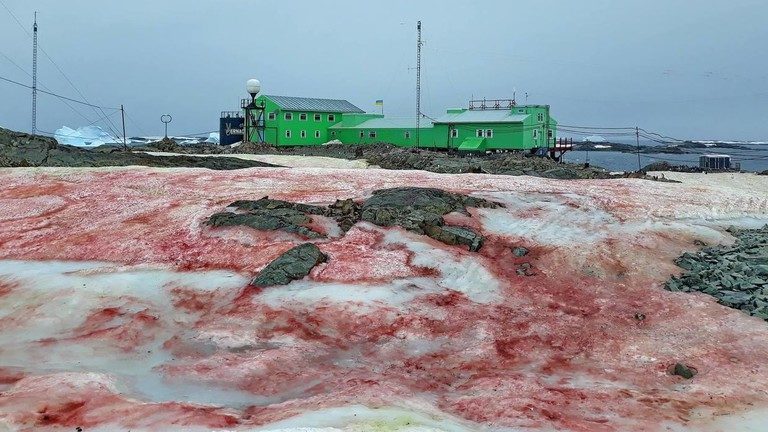
Blood-red snow appears at Ukrainian polar station in Antarctic

blood red snow antarctic
© National Antarctic Scientific Center of Ukraine / Andrey Zotov
Ukrainian polar station in the Antarctic has turned into a horror movie set after the snow around it turned a bloody red. But scientists appear unfazed, offering an explanation for the strange phenomenon.

Photos from the Vernadsky research base were posted on Facebook by the Ukrainian Ministry of Education and Science, which said that the snow had been like this for the past two weeks.

However, the ministry assured its followers that there was no reason for concern over the wellbeing of the station's inhabitants, and mentioned no bad omens either.

Comment: While this appears to be a relatively normal event for the Antarctic in summer, similar life on our planet isn't behaving so predictably:


Question

25 more dead starlings found at another location in North Wales

dead starlings
Tests are being carried out on the latest discovery to found out how they died

A group of dead starlings found on the coastal path are being tested by police.

Nine dead birds were discovered between Porthmadog and Criccieth , with rural crime officers saying their deaths are thought to be a result of a "natural phenomenon".

A tweet by North Wales Police 's rural crime team said: "More dead starlings have been recovered, this time from the Wales Coastal Path near Cricieth.

"Don't be alarmed. We think this is a natural phenomenon. No 5G, no UFOs and hopefully no criminality. They are being recovered for toxicology tests."

It comes after 300 dead starlings were found on Anglesey in December in a case which mystified experts.


Attention

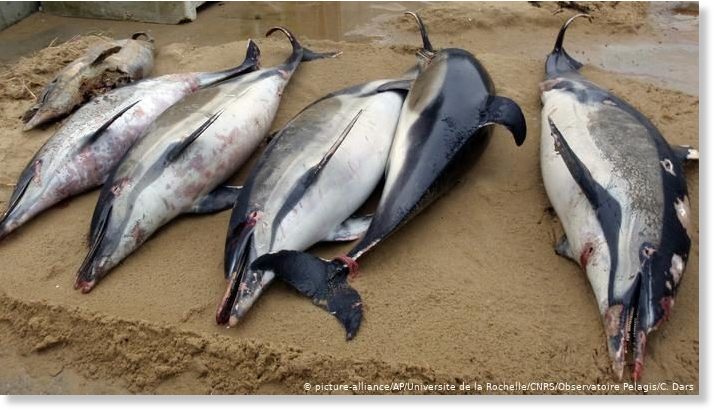
670 cetacean species dead on French coast since start of year - 11,000 dolphins found in 2019

dead dolphins
dead dolphins
Over 600 marine animals have been found dead along French beaches. Animal welfare activists say fishing nets are responsible for their deaths and predict an increase in numbers.

Hundreds of dead dolphins washed up on France's Atlantic coast with many more predicted to come, according to a French monitoring group for marine mammals.

Around 670 dead animals have been found on beaches as of mid-February, according to the conservation group Pelagis. Among the dead were hundreds of protected cetacean species including whales.


Animal welfare activists have said that tightly meshed fishing nets were responsible for their deaths.

Cow

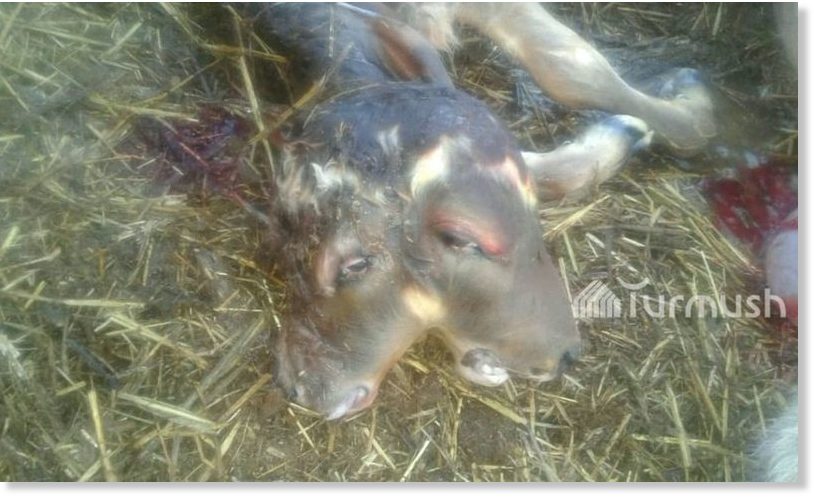
Signs and Portents: Rare two-headed calf born in Tyup, Kyrgyzstan

two headed calf
A rare two-headed calf was born in the Kurmontu village of Tyup district in the Isssyk-Kul region, Turmush reports.

The veterinarian Kudaibergen uulu Nurgazy said that the calf born with the help of caesarean section.

"The owner of the calf and I performed the operation and removed the calf. One of the calf's head did not move and we realized that he would die anyway, so we killed him. On Feb 23, we examined the cow," he said.

Info

Mythical founder Romulus tomb rediscovered beneath the Forum in Rome

Tomb Beneath Curia Julia
© Parco ColosseoA 3D laser scan image showing the location of the tomb (in yellow) buried beneath the steps to the Curia Julia, or Senate House, in the Roman Forum.
A tomb that was buried thousands of years ago and revered by ancient Romans as the resting place of their city's mythical founder Romulus has now been rediscovered beneath the Forum in Rome.

The underground tomb and the temple built around it are thought to date from the sixth century B.C., according to archaeologists.

Ancient Romans believed the tomb held the remains of their city's founder, but the stone sarcophagus that archaeologists just found inside the tomb is empty.

The underground temple — called a hypogeum in Greek — contains a votive altar that was dedicated to Romulus, said Alfonsina Russo, the director of the Parco Archeologico del Colosseo, which oversees the city's ancient ruins.

The entrance to the tomb is hidden in the northwest of the Forum, underneath the building of the Curia Julia, or Senate House, Russo told a news conference in Rome today (Feb. 21). The tomb itself would once have been beneath the Comitium — the central meeting place of the ancient city where votes by public assemblies were conducted, she said.

The tomb is also near the Lapis Niger — meaning "Black Stone" in Latin — an ancient shrine paved in black marble and thought to cause bad luck, with a stone block marking the spot where Romulus was said to have been murdered by jealous members of the Senate.

The temple was therefore "located in a highly symbolic place for the political life of Rome," Russo said.

The empty 4.5-foot-long (1.4 meters) sarcophagus in the tomb was made of a light volcanic stone, called tuff, quarried from the Capitoline Hill beside the Forum, she said.

Fish

Fossils discovered in the Sahara reveal catfish and tilapia swam in rivers 12,000 years ago

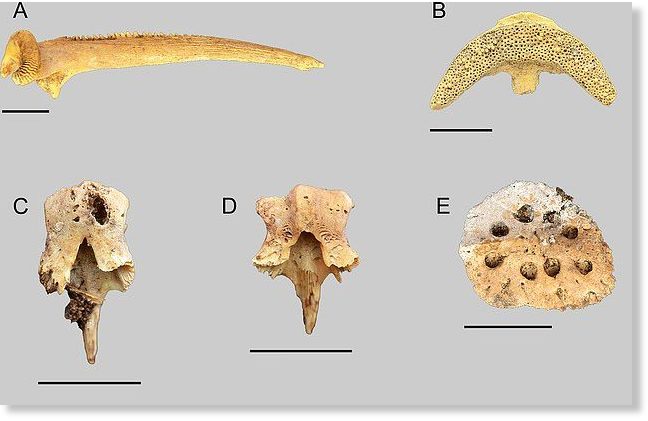
Paleontologists uncovered 17,551 identifiable
Paleontologists uncovered 17,551 identifiable remains on the Tadrart Acacus Mountains, with 80 percent belonging to fish that fed early humans during the Holocene period. (A and B are both fossilized remains of a catfish, while C and D belong to a tilapia. The fossil E is remains of a crocodile)
The Saharan environment in southwest Libya is a sandy, dry world, but fossil records show it was flowing with water and life some 12,000 years ago.

Paleontologists uncovered 17,551 identifiable remains on the Tadrart Acacus Mountains, with 80 percent belonging to fish that fed early humans during the Holocene period.

The remains show there was once an abundance of catfish and tilapia in the area, which died off from over fishing - the bones had cut marks and traces of burning.

The study also found that tilapia decreased more significantly over time, which may have been because catfish have accessory breathing organs allowing them to breathe air and survive in shallow, high-temperature waters.

Attention

Global crop failures continue: In Australia this is going to be the WORST HARVEST ever recorded

Australia on a globe
Global food production is being hit from seemingly every side. Thanks to absolutely crazy weather patterns, giant locust armies in Africa and the Middle East, and an unprecedented outbreak of African Swine Fever in China, a lot less food is being produced around the world than originally anticipated. Even during the best of years we really struggle to feed everyone on the planet, and so a lot of people are wondering what is going to happen as global food supplies become tighter and tighter. The mainstream media in the United States is so obsessed with politics right now that they haven't been paying much attention to this emerging crisis, but the truth is that this growing nightmare is only going to intensify in the months ahead.

In Australia, conditions have been extremely hot and extremely dry, and that helped to fuel the horrific wildfires that we recently witnessed.

And everyone knew that agricultural production in Australia was going to be disappointing this year, but it turns out that it is actually going to be the worst ever recorded...
Australia's hottest and driest year on record has slashed crop production, with summer output expected to fall to the lowest levels on record, according to official projections released Tuesday.

The country's agriculture department said it expects production of crops like sorghum, cotton and rice to fall 66 percent — the lowest levels since records began in 1980-81.

Comment: See also:


Better Earth

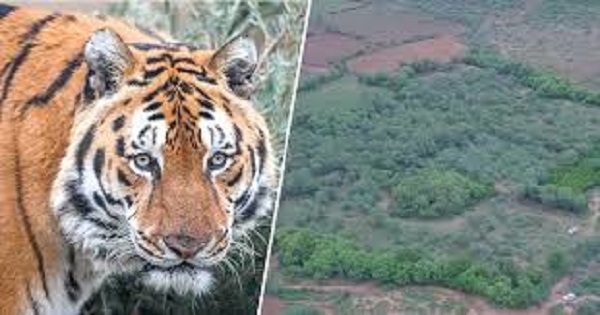
Couple has been buying land near a tiger reserve and letting forest grow back so big cats can roam

Tiger reserve
Some twenty years ago, photographer Aditya Singh resigned from his job in civil services in Delhi and moved to the city of Sawai Madhopur in Rajasthan with his wife and artist Poonam so they could be closer to nature. It was there that they started a tourist resort to earn a living.

Over the years, the couple bought about 35 acres bordering the Ranthambore Tiger Reserve on one side. Farmers were selling their land because of predators, including tigers, in the area.

The area, called Bhadlav was barren and had little vegetation but has since been transformed into a lush green forest frequented by wild animals, including tigers.

After settling in Ranthambore, Aditya first visited the Bhadlav area with a BBC filmmaker and became aware that the farmers were selling their land because of the risk of predators searching for prey.


''As a result, farmers were selling their land," Singh told Mongabay India. ''I just bought this and did nothing to it except removing the invasive species. We allowed the land to recover and now after 20 years it has become a lush green patch of forest which is frequently visited by all kind of animals, including tigers, leopards and wild boars.''

For Poonam it was love at first sight when she visited Ranthambore with her husband. "My first sighting was a tigress with three cubs on a hill. It was magical. At the end of the trip, I just asked him if we can move to Ranthambore. He wanted it too and within months we moved. As far as this land is concerned, it was a dream that we both saw an achieved together to have our own area of wilderness," she told Mongabay-India.

Poonam managed the tourist resort with Aditya for twenty years and closed it in 2019.

An aerial photograph of their land shows the stark contrast between their lush green forest and the barren land surrounding them, including the Ranthambore Tiger Reserve, with whom they share a boundary.

Attention

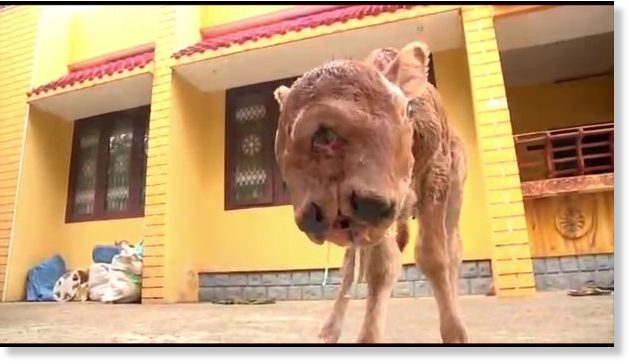
Signs and Portents: Two-headed calf born in Tamil Nadu, India

The calf has four eyes and two mouths, but only one pair of ears
© indiaphotoagency/ Jam PressThe calf has four eyes and two mouths, but only one pair of ears
A farmer got the shock of a lifetime when one of his cows gave birth to a calf with two heads.

Farmer Bhaskar was not anticipating any hitches when his cow gave birth at his farm in Paarasalai village in southern India last week.

He was therefore surprised when a calf popped out with conjoined heads.

The unusual cloven-hoved youngster had four eyes and two mouths, but only one pair of ears.

Bhaskar's farm has quickly became a tourist attraction, receiving visitors from neighbouring villages wanting to see the rare calf.