Strange Skies
S


Cassiopaea

Rare supernova remnant discovered in the core of the Milky Way

Supernova remnant called Sagittarius A East
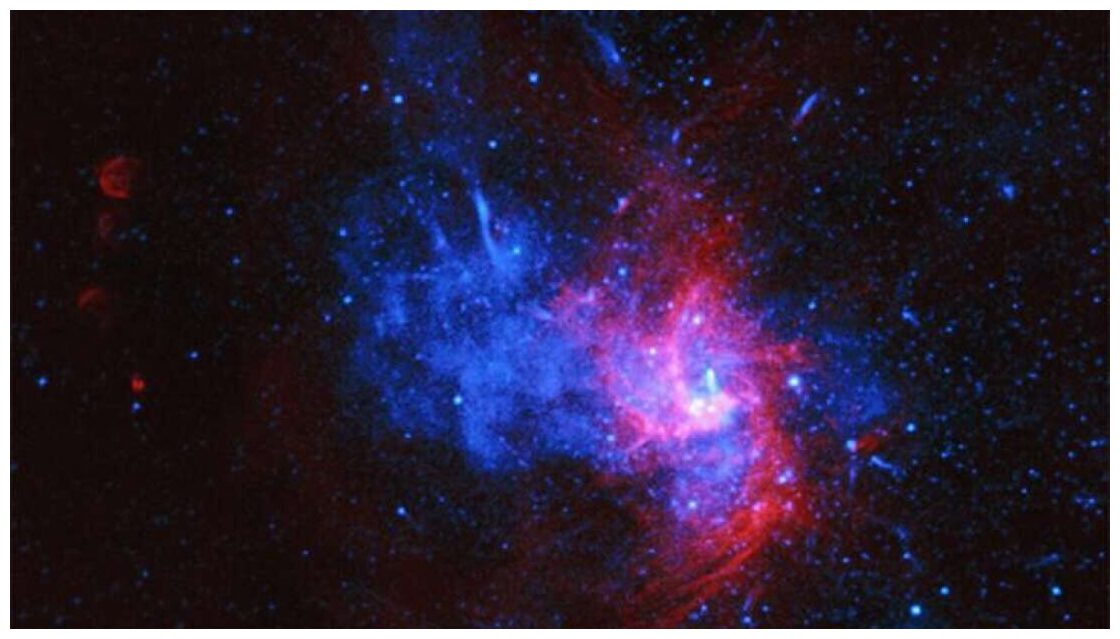
© X-ray: NASA/CXC/Nanjing Univ./P. Zhou et al. Radio: NSF/NRAO/VLANASA's Chandra X-ray Observatory captured a supernova remnant called Sagittarius A East (Sgr A East) near the center of our Milky Way galaxy.
NASA's Chandra X-ray Observatory has discovered the remains of a rare kind of stellar explosion near the center of the Milky Way.

Supernovas are stellar explosions that seed the galaxy with elements vital for life. Sagittarius A East (or Sgr A East) is a supernova remnant that lies near Sagittarius A* — the supermassive black hole in the center of the Milky Way. This supernova remnant is the first known example in our own Milky Way galaxy of an unusual type of white dwarf stellar explosion called a Type Iax supernova, according to a statement from the Chandra X-ray Observatory.

"While we've found Type Iax supernovae in other galaxies, we haven't identified evidence for one in the Milky Way until now," Ping Zhou, lead author of the study from Nanjing University in China, said in the statement. "This discovery is important for getting a handle of the myriad ways white dwarfs explode."

Nebula

Fata morgana: Rare 'hovering ship' superior mirage photographed off coast of Cornwall, UK

fata morgana
© David Morris/APEXAn optical illusion caused the ship to appear as though it was hovering above the horizon
Images of what appears to be a hovering ship have been captured as the result of a rare optical illusion off the coast of England.

David Morris took a photo of the ship near Falmouth, Cornwall.

BBC meteorologist David Braine said the "superior mirage" occurred because of "special atmospheric conditions that bend light".

He said the illusion is common in the Arctic, but can appear "very rarely" in the UK during winter.

Comment: It's possible that this is yet another sign of the increasingly cooler conditions on our planet:


Cassiopaea

Best of the Web: Cosmic climate change: 'Space plasma hurricane' observed in ionosphere above North Pole!

space hurricane
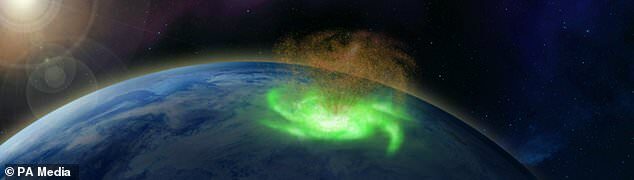
Scientists have confirmed the existence of space hurricanes following observations of electrons raining down in Earth's upper atmosphere
Scientists have confirmed the existence of space hurricanes following observations of electrons raining down in Earth's upper atmosphere.

A team led by Shandong University in China made the announcement after analyzing a 621-mile wide swirling mass of plasma spotted hundreds of miles above the North Pole.

Observations show a large cyclone-shaped auroral spot with a nearly zero-flow center and strong circular horizontal plasma flow and shears, all of which are found in hurricanes in the lower atmosphere - but instead of raining water, it rained electrons.

The space hurricane moved in an anti-clockwise rotation and lasted about eight hours before breaking down.

Comment: This actually happened in 2014. It sure took a while for it to 'leak out'. They obviously don't want people to be spooked by dramatic signs of solar-system-wide 'climate' shift.

See also: And check out SOTT radio's:


Comet 2

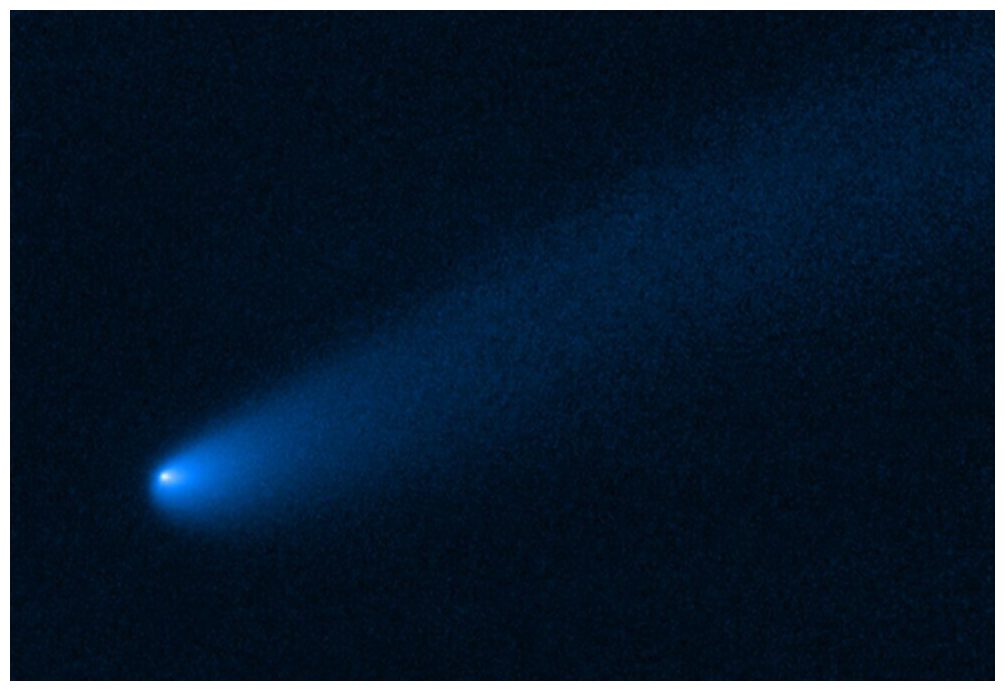
Hubble spots comet near Jupiter

Roaming Comet
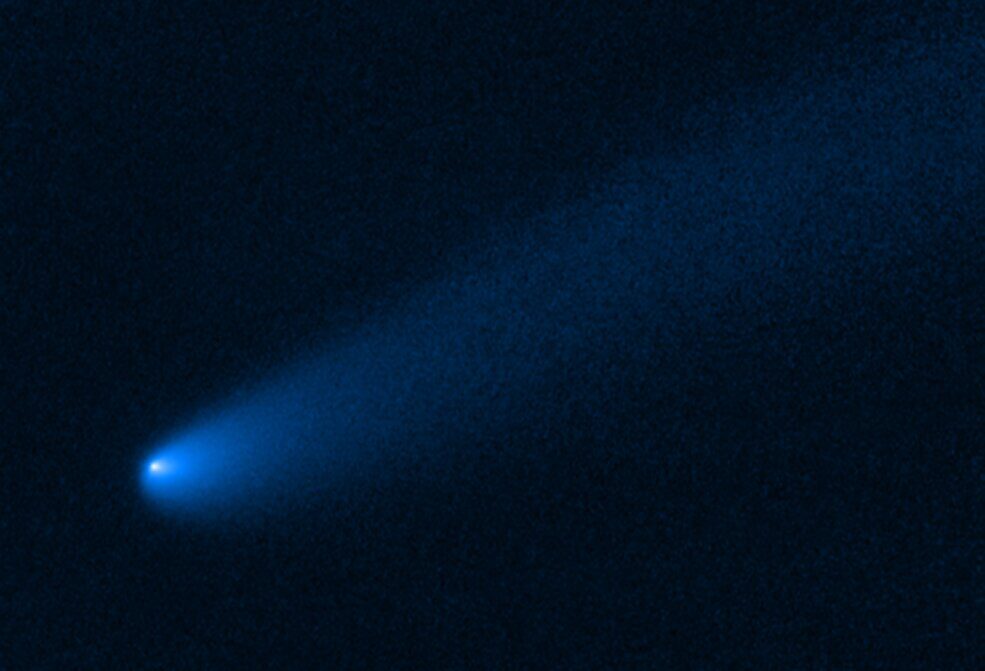
© NASA, ESA, and B. Bolin (Caltech)Astronomers found a roaming comet taking a rest stop before possibly continuing its journey. The wayward object made a temporary stop near giant Jupiter. The icy visitor has plenty of company. It has settled near the family of captured asteroids known as Trojans that are co-orbiting the Sun alongside Jupiter. This is the first time a comet-like object has been spotted near the Trojan asteroid population. Hubble Space Telescope observations reveal the vagabond is showing signs of transitioning from a frigid asteroid-like body to an active comet, sprouting a long tail, outgassing jets of material, and enshrouding itself in a coma of dust and gas.
After traveling several billion miles toward the Sun, a wayward young comet-like object orbiting among the giant planets has found a temporary parking place along the way. The object has settled near a family of captured ancient asteroids, called Trojans, that are orbiting the Sun alongside Jupiter. This is the first time a comet-like object has been spotted near the Trojan population.

The unexpected visitor belongs to a class of icy bodies found in space between Jupiter and Neptune. Called "Centaurs," they become active for the first time when heated as they approach the Sun, and dynamically transition into becoming more comet-like.

Visible-light snapshots by NASA's Hubble Space Telescope reveal that the vagabond object shows signs of comet activity, such as a tail, outgassing in the form of jets, and an enshrouding coma of dust and gas. Earlier observations by NASA's Spitzer Space Telescope gave clues to the composition of the comet-like object and the gasses driving its activity.

"Only Hubble could detect active comet-like features this far away at such high detail, and the images clearly show these features, such as a roughly 400,000-mile-long broad tail and high-resolution features near the nucleus due to a coma and jets," said lead Hubble researcher Bryce Bolin of Caltech in Pasadena, California.

Describing the Centaur's capture as a rare event, Bolin added, "The visitor had to have come into the orbit of Jupiter at just the right trajectory to have this kind of configuration that gives it the appearance of sharing its orbit with the planet. We're investigating how it was captured by Jupiter and landed among the Trojans. But we think it could be related to the fact that it had a somewhat close encounter with Jupiter."

The team's paper appears in the February 11, 2021 issue of The Astronomical Journal.

The research team's computer simulations show that the icy object, called P/2019 LD2 (LD2), probably swung close to Jupiter about two years ago. The planet then gravitationally punted the wayward visitor to the Trojan asteroid group's co-orbital location, leading Jupiter by about 437 million miles.

Attention

Best of the Web: Astonishing discovery: First-ever 'space hurricane' was observed in upper atmosphere above North Pole in 2014

Space hurricane
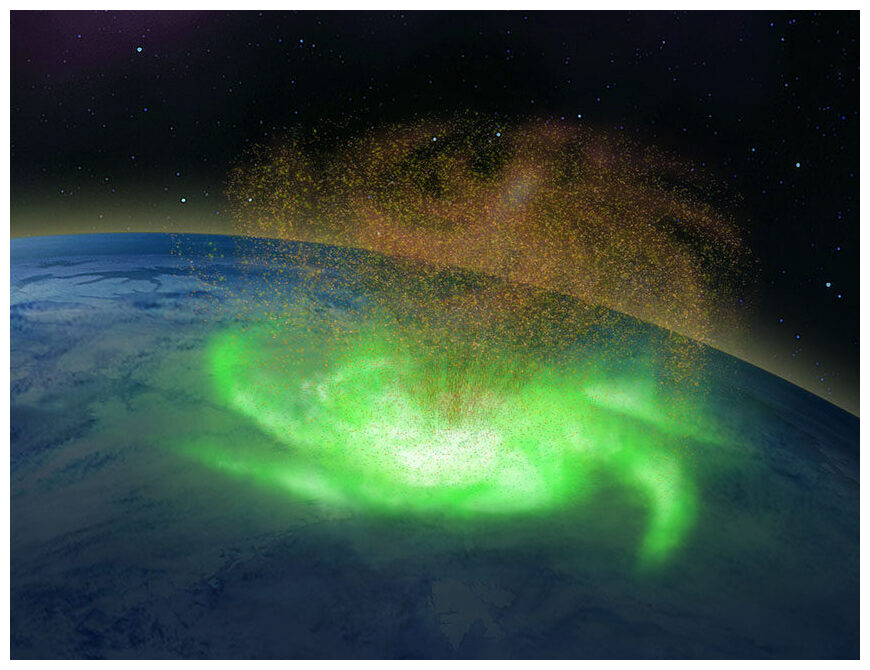
© Birkeland Centre for Space ScienceIllustration of a space hurricane by Shandong University at Weihai in China.
In a new study in Nature Communications by Zhang et al. [2021], the first observations of a space hurricane over the Earth's polar ionosphere is shown.

Co-author and professor at the Birkeland Centre for Space Science, Kjellmar Oksavik, finds the new results remarkable: "Hurricanes are well-known in the Earth's lower atmosphere, causing destruction and harm to people and infrastructure. We had no idea that a similar phenomenon could be found in the upper polar atmosphere, several hundred kilometers above the ground".

The space hurricane was observed on August 20, 2014, when four DMSP (Defense Meteorological Satellite Program) satellites detected a cyclone-like auroral spot around the north magnetic pole, having a diameter over 1000 km with multiple arms and anti-clockwise rotation. After showing its presence for nearly 8 hours, the space hurricane gradually decayed and merged into the duskside auroral oval.


Comment: WOW!


Comment: This happened 7 years ago, but was carefully kept under wraps.

We wonder if it has happened since.


Info

Potential habitable-zone planet discovered in Alpha Centauri

An image of Alpha Centauri
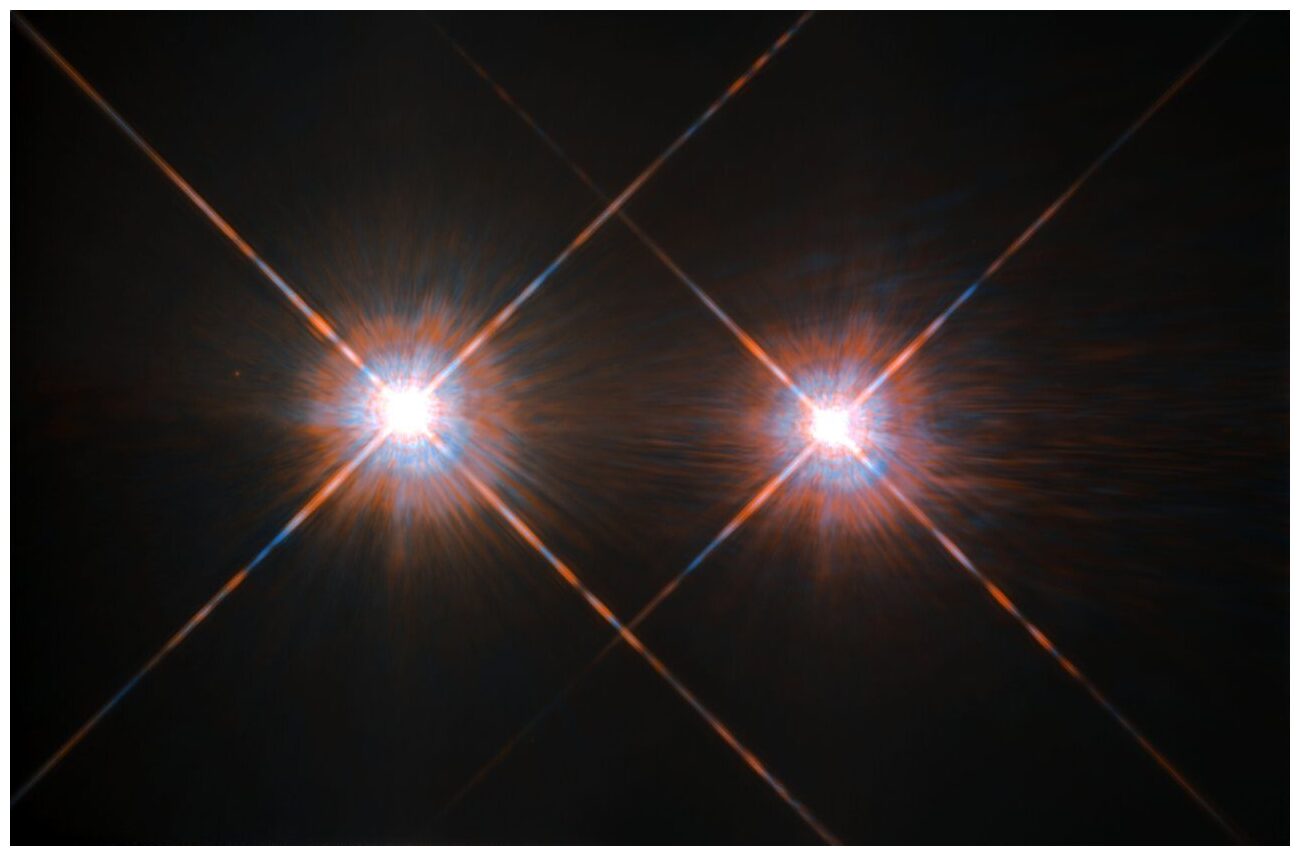
© NASA/ESAAn image of Alpha Centauri by the Hubble Space Telescope.
An international team of astronomers has found signs that a habitable planet may be lurking in Alpha Centauri, a binary star system a mere 4.37 light-years away. It could be one of the closest habitable planet prospects to date, although it's probably not much like Earth if it exists.

What's Alpha Centauri? It's the closest star system to our own, comprising three different stars. There are Alpha Centauri A and B, which are sun-like stars that form a tight binary orbit around one another about 4.37 light years away. And then there's Proxima Centauri, a small red dwarf that's actually closer to us (4.24 light-years away) and has a much looser gravitational relationship with the other two stars.

Proxima Centauri is orbited by two planets, one of which (Proxima b) seems be an Earth-size exoplanet in the habitable zone (the region of a star's orbit where liquid water can form on the surface). But Proxima b is thought to be tidally locked and inundated by stellar winds, which means it's unlikely to be habitable.

Cassiopaea

Rare type of supernova discovered in our galaxy

Sagittarius A East
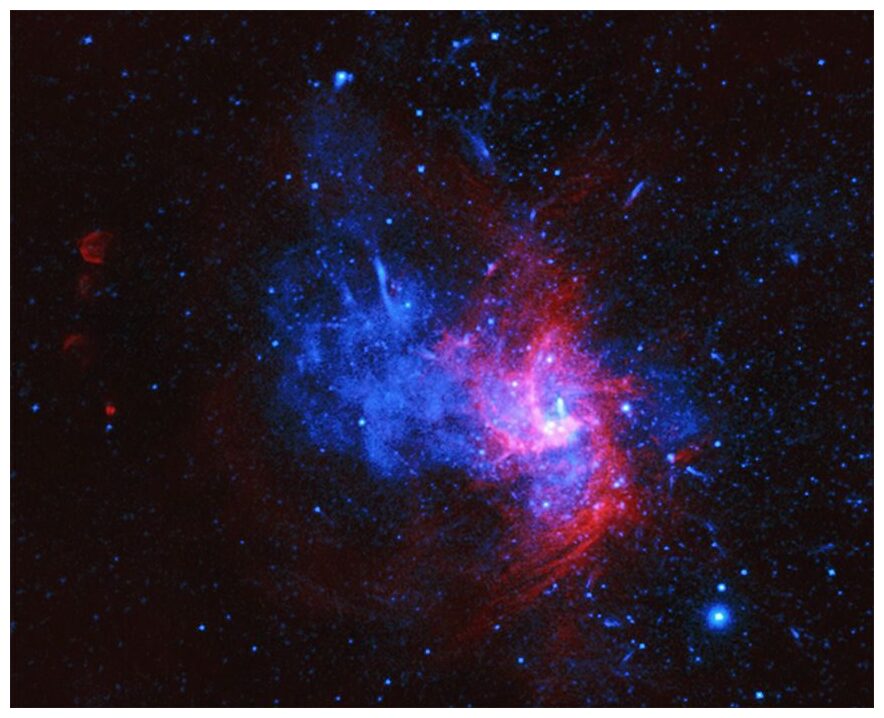
© X-ray: NASA/CXC/Nanjing Univ./P. Zhou et al. Radio: NSF/NRAO/VLAComposite image of X-ray data from Chandra (blue) and radio emission from the very large array (red) of Sagittarius A East. Elements detected suggest this is the first remnant of a rare type Iax supernovas found in our galaxy.
Supernova explosions seed the galaxy with elements vital for life and serve as tracers revealing the fate of the universe to us. Yet for all their importance, they include some sub-types we barely understand. Perhaps the most confusing are those known as Type Iax (pronounced one-ax), but the possible remnants of one of these events could provide some major clues to understanding them, and it could be the first one ever found in the Milky Way.

Before we had any idea what caused them, supernovas - powerful, luminous stellar explosions - were categorized based on their dominant spectral lines. The most useful of these for research purposes turned out to be those known as Type Ia, which have the very convenient trait of always being roughly the same in their intrinsic brightness. By measuring how much light we see from a Type Ia supernova astronomers can get a good estimate of how far away the explosion, and therefore the galaxy in which it is housed, is from us.

This has served us well enough to reveal the fact the universe's expansion is accelerating, but between one-sixth and one-third of what at first looks like Ia supernovae aren't. Among these are a group sometimes called Type Iax supernovas, which have a spectrum marked by ionized silicon like ordinary Type Ias, but are considerably fainter.

While at the University of Amsterdam, study lead Ping Zhou observed a supernova remnant known as Sagittarius A East using the Chandra X-Ray telescope. Zhou thinks this is the first residue of an Iax supernova we have found in our galaxy.

Info

Second Earth orbiting Trojan asteroid discovered

A recently discovered asteroid appears to be an Earth Trojan, orbiting a gravitationally stable area with only one other known occupant.

Earth has a second Trojan asteroid sharing its orbit, reports amateur Tony Dunn on the Minor Planet Mailing List. The asteroid, dubbed 2020 XL5, is a few hundred meters across and its orbit is tied to a gravitationally stable ahead of the Earth in its orbit.
Earth-Sun Lagrange points
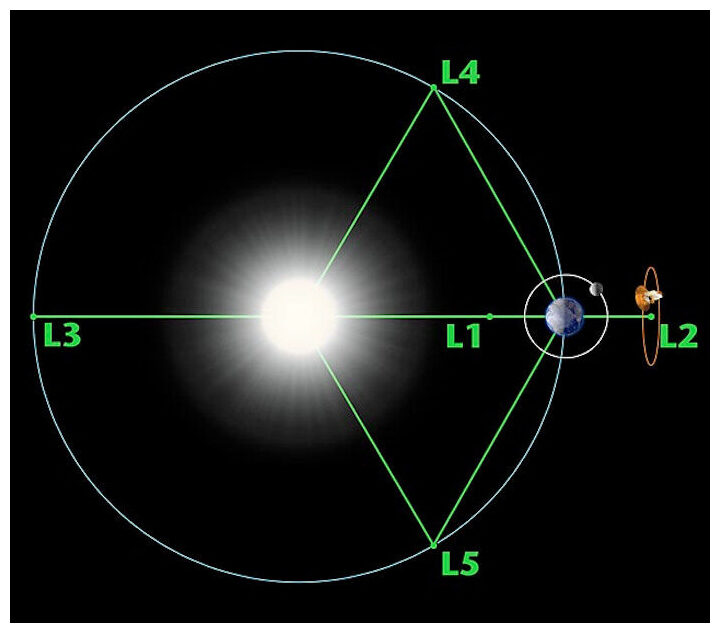
© NASA / WMAP Science TeamThis diagram shows the Earth-Sun Lagrange points (not to scale). Trojans orbit near the L4 and L5 regions, though their orbits may stray from those exact points.
Trojans are asteroids gravitationally locked to stable Lagrange points either 60° ahead (L4) or behind (L5) the planets in their orbits around the Sun. 2020 XL5 was found around the L4 point. Massive Jupiter has more than 9,000 Trojans. In theory, Trojan orbits would be stable around every planet except Saturn, where Jupiter's gravity pulls them away. So far, Trojans have been found sharing orbits — at least temporarily — with Neptune, Uranus, Mars, Venus, and Earth.

Earth Trojans are hard to find because during most of their orbits, they appear close to the Sun in the sky. Not only that, but the gravitational resonance does not hold them in lockstep at 60° ahead and behind of the Earth, explains Dunn. Instead, the objects trace paths around the L4 and L5 points, which are themselves moving as Earth orbits the Sun.

Cloud Grey

Rare 'hole punch clouds' spotted over Georgia, US

Several fallstreak holes over Georgia
© NATIONAL WEATHER SERVICE ATLANTASeveral fallstreak holes, or “hole punch clouds,” were spotted across parts of northern Georgia on Friday.
Several saucer-shaped formations dotted the skies over north Georgia, giving residents a reason to look up.

Fallstreak holes, also known as "hole punch clouds," were spotted across the Atlanta metro area and northern parts of the state on Friday, according to 11Alive.

The rare clouds form when "supercooled water droplets" suddenly freeze within mid- to high-level cumulus clouds, according to the National Weather Service. When these ice crystals fall, a giant hole is left behind.

Residents took to social media to share photos of the rare phenomena.

Comment: In recent times this rare cloud phenomena has appeared over UAE, Canada, Southern California, UK, Texas, Louisiana, Mississippi and Alabama.

Other strange cloud anomalies seem to be appearing globally with higher frequency and intensity. Factors which may contribute to these 'strange skies' are atmospheric dust loading from increased comet and volcanic activity and changes in the layers of the atmosphere. See also: An indicator of this dust loading is the intensification of noctilucent clouds we are observing. As explained in Pierre Lescaudron's book, Earth Changes and the Human-Cosmic Connection:
The increase in noctilucent clouds is one of the effects - among others - of increased dust concentration in the atmosphere in general, and in the upper atmosphere in particular. We suspect that most of this atmospheric dust is of cometary origin, while some of it may be due to the recent increase in volcanic activity.
See also: Chemtrails? Contrails? Strange skies


Comet 2

New Comet C/2021 A1 (Leonard)

CBET 4907 & MPEC 2021-A99, issued on 2021, January 10, announce the discovery of a comet (magnitude ~19.5) by Gregory J. Leonard on CCD images taken on Jan. 3.54-3.56 UT with the Mount Lemmon Survey's 1.5-m reflector. The new comet has been designated C/2021 A1 (Leonard).

We performed follow-up measurements of this object while it was still on the PCCP webpage.

Stacking of 14 unfiltered exposure, 120 seconds each, obtained remotely on 2021, January 6.4 from H06 (iTelescope network, New Mexico) through a 0.43 m f/4.5 Reflector + CCD, shows that this object is a comet with a diffuse coma about 7" in diameter.

Our confirmation image (click on it for a bigger version; made with TYCHO software by D. Parrott):
Comet C/2021 A1 (Leonard)
© Remanzacco Blogspot
M.P.E.C. 2021-A99, assigns the following nearly parabolic orbital elements to comet C/2021 A1: T 2022 Jan. 3.3; e= 0.99; Peri. = 225.09; q = 0.6; Incl.= 132.68