Strange Skies
S


Cassiopaea

Rare green flash above Jupiter captured by astrophotographer

green flash jupiter
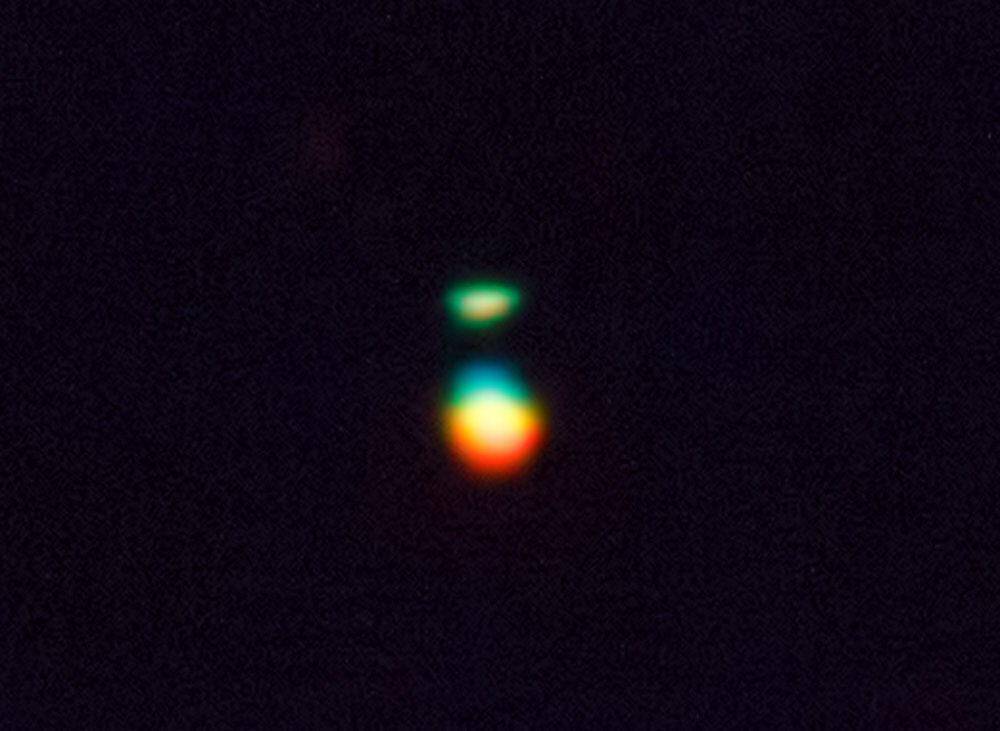
You've heard of a green flash on the sun. But a green flash on Jupiter? "I've never come across one before," says atmospheric optics expert Les Cowley. Until now, that is. Spanish astrophotographer Juan Manuel Perez Rayego captured the rare phenomenon on Dec. 26th:

"I was taking one last photo of the Great Conjunction between Jupiter and Venus, just saying goodbye," says Rayego. "Suddenly, a green fragment of Jupiter split off and floated away from the planet. It was spectacular."

"I've analyzed Juan's image and conclude that it is very likely a mock mirage--the same type of mirage that can create green flashes on the sun," says Cowley.

Comment: There are significant signs that a shift is occurring in our atmosphere - and in those of other planets in our solar system:


Question

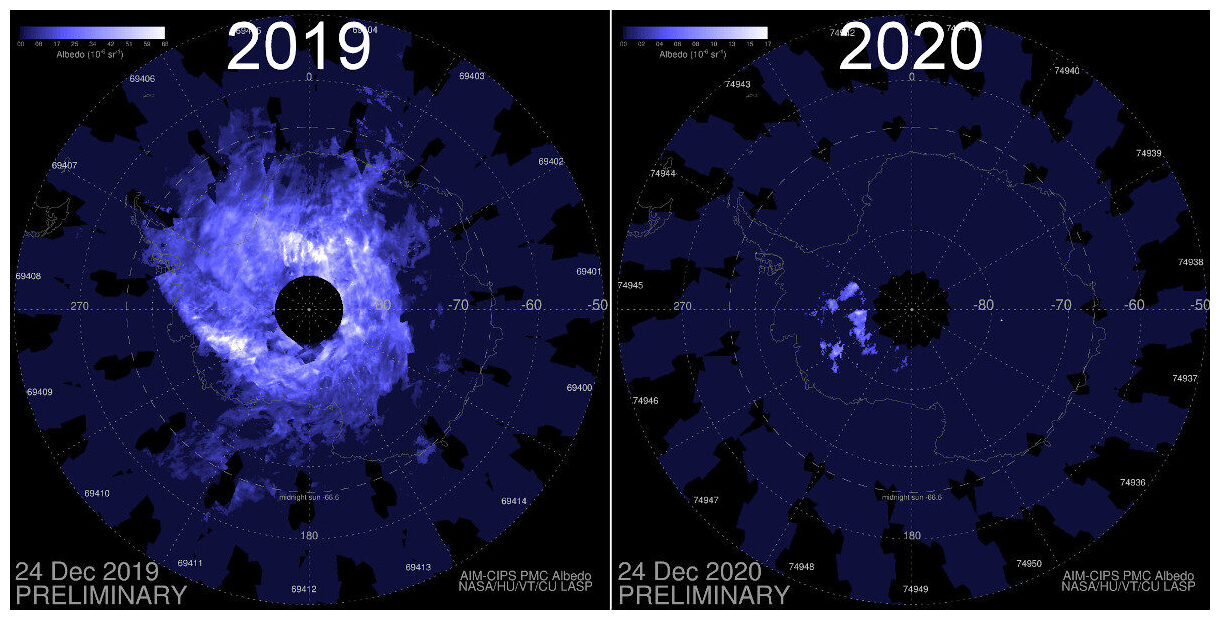
Noctilucent clouds almost completely missing over Antarctica

Something strange is happening 50 miles above Antarctica. Or rather, not happening. Noctilucent clouds (NLCs), which normally blanket the frozen continent in December, are almost completely missing. These images from NASA's AIM spacecraft compare Christmas Eve 2019 with Christmas Eve 2020:

Noctilucent Clouds
© NASA
"The comparison really is astounding," says Cora Randall of the University of Colorado's Laboratory for Atmospheric and Space Physics. "Noctilucent cloud frequencies are close to zero this year."

NLCs are Earth's highest clouds. They form when summertime wisps of water vapor rise up from the poles to the edge of space. Water crystallizing around specks of meteor dust 83 km (~50 miles) above Earth's surface creates beautiful electric-blue structures, typically visible from November to February in the south, and May to August in the north.

Info

Pair of brown dwarfs found in the constellation Ophiuchus

Brown Dwarfs
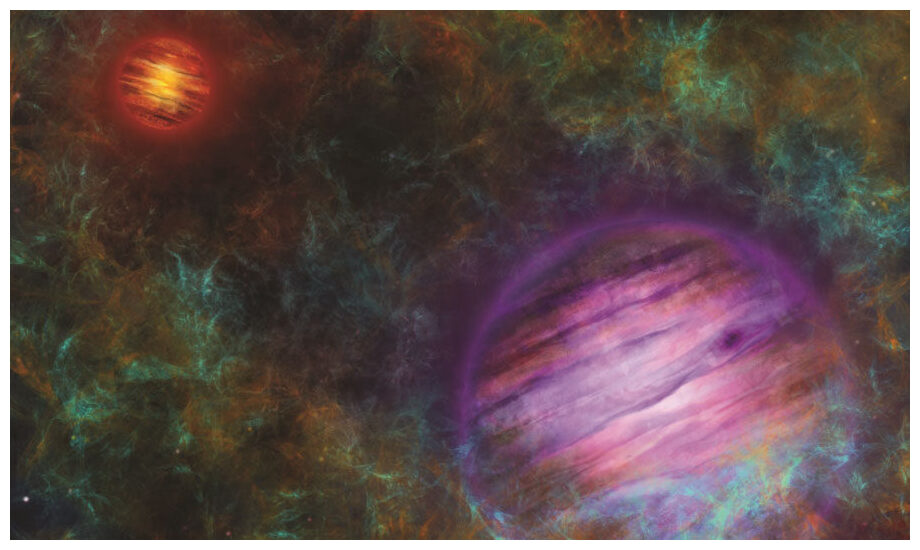
© Universität Bern / University of Bern, Illustration: Thibaut RogerArtist's composition of the two newly discovered brown dwarfs.
Pluto is not a planet, according to the vast majority of astronomers. While it orbits the Sun and is mostly round, it does not orbit alone, instead traversing the solar system accompanied by several moons, including a companion almost half its size. This is the main reason for its demotion in 2006.

A few holdouts continue to debate this definition, but they may have a new epistemic challenge to contend with: What makes a star? When a distant object is too small and too faint to be a star, but also too big to be an exoplanet, and is not solitary, how can you be sure what it is?

Astronomers recently found a most mystifying example of such in-between objects: a pair of planetlike orbs, some 450 light-years away, that aren't bound to any host star and travel the void together. They are brown dwarfs, which are dim not-quite-stars that never grew large enough to fuse hydrogen. But they are tiny, even by brown dwarf standards, and they look more like planets than anything stellar, according to Clémence Fontanive of the University of Bern in Switzerland, the astronomer who discovered them. The larger brown dwarf of the pair sits along the boundary astronomers use to differentiate stars from planets, around 13 times the mass of Jupiter. The smaller one weighs in at only eight times the size of Jupiter.

"According to that definition, it should be a planet. But if you define that a planet should form around a star, then it's not really a planet, either," Fontanive said. She calls them "planetary mass brown dwarfs."

Info

Stories about the Pleiades may date back 100,000 years

Pleiades
© NASA / ESA / AURA / Caltech
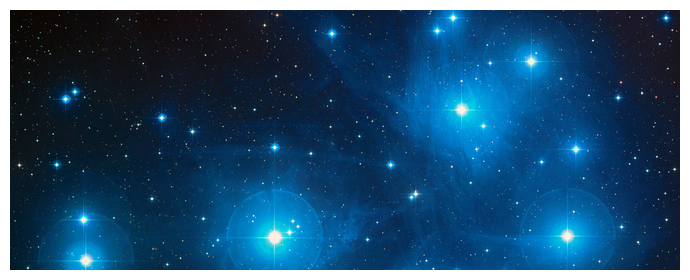
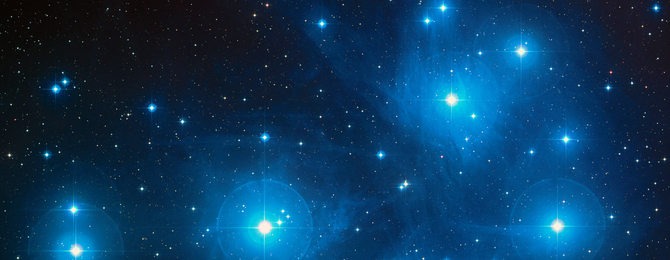
In the northern sky in December is a beautiful cluster of stars known as the Pleiades, or the "seven sisters". Look carefully and you will probably count six stars. So why do we say there are seven of them?

Many cultures around the world refer to the Pleiades as "seven sisters", and also tell quite similar stories about them. After studying the motion of the stars very closely, we believe these stories may date back 100,000 years to a time when the constellation looked quite different.

The sisters and the hunter

In Greek mythology, the Pleiades were the seven daughters of the Titan Atlas. He was forced to hold up the sky for eternity, and was therefore unable to protect his daughters. To save the sisters from being raped by the hunter Orion, Zeus transformed them into stars. But the story says one sister fell in love with a mortal and went into hiding, which is why we only see six stars.

A similar story is found among Aboriginal groups across Australia. In many Australian Aboriginal cultures, the Pleiades are a group of young girls, and are often associated with sacred women's ceremonies and stories. The Pleiades are also important as an element of Aboriginal calendars and astronomy, and for several groups their first rising at dawn marks the start of winter.

Close to the Seven Sisters in the sky is the constellation of Orion, which is often called "the saucepan" in Australia. In Greek mythology Orion is a hunter. This constellation is also often a hunter in Aboriginal cultures, or a group of lusty young men. The writer and anthropologist Daisy Bates reported people in central Australia regarded Orion as a "hunter of women", and specifically of the women in the Pleiades. Many Aboriginal stories say the boys, or man, in Orion are chasing the seven sisters - and one of the sisters has died, or is hiding, or is too young, or has been abducted, so again only six are visible.

Arrow Up

Randall Carlson - Winter Solstice 2020

Winter Solstice 2020
© Randall Carlson.com

Winter Solstice
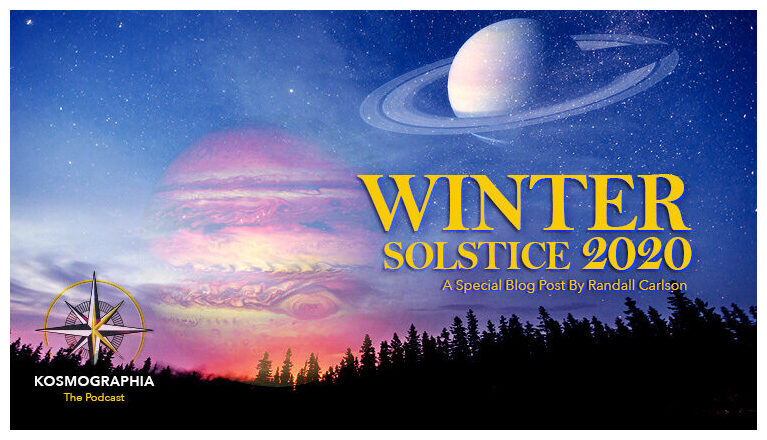
, the longest and darkest night of the year (in the northern hemisphere) will present to astronomical enthusiasts a once in a lifetime celestial event. It has been 794 years (1226 A.D.) since Jupiter and Saturn have aligned so closely that to the naked eye observer they appear as one object ‒ only the Moon will be brighter.

The overtaking of the slower planet Saturn by the more rapidly orbiting Jupiter takes place every twenty years. Due to its much greater distance from the Sun than Jupiter, Saturn's orbital period is right at 29.457 Earth years while Jupiter's is 11.86 Earth years. This overtaking is called a planetary conjunction. The apparent close association between two planets in conjunction, in this case Jupiter and Saturn, is due to the fact that the Earth, Jupiter and Saturn all lie in a straight line, more or less, and in this particular conjunction the alignment is very close, lying only 6 arc minutes, or one tenth of one degree apart at their closest passage.

Here is a way to think about the phenomenon: Assume Jupiter is conjunct Saturn. After 11.86 Earth years Jupiter has revolved around the Sun and returns more or less to the same position in the sky. However, Saturn, even though considerably slower in its orbit, has moved on ahead, enough, in fact, that it takes Jupiter about another 8 years to catch up. This means that there is a regular progression of Jupiter/Saturn conjunctions around the Zodiac. The last Jupiter/Saturn conjunction occurred over May 28-29 in the year 2000 against the backdrop of the star constellation Taurus. Prior to that event there was a triple conjunction in 1980 in the constellation of Libra that lasted from late December to early August in the constellation Virgo.

This year the conjunction is taking place between the constellations of Capricorn and Sagittarius, as seen in the following graphic captured from Stellarium. The fact that this conjunction is taking place on the Winter Solstice is a remarkable coincidence.

Christmas Lights

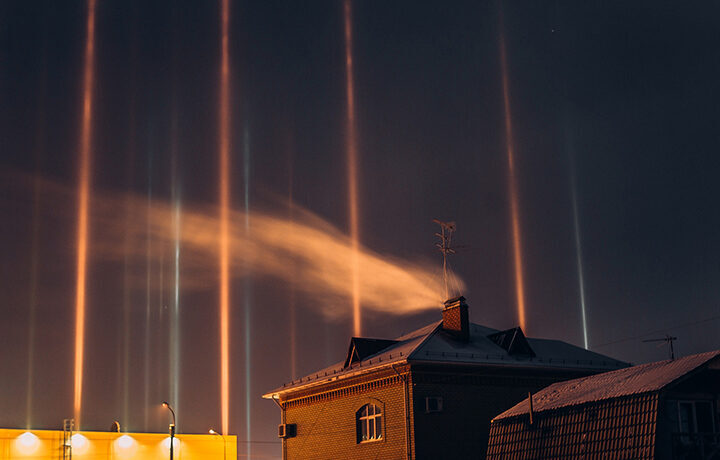
Impressive light pillars recorded over Tyumen in Western Siberia

Light pillars over Siberia
© Yevgenia
Local resident and photographer Yevgenia shared pictures and video of the spectacular natural phenomenon, recorded at the beginning of December in Tyumen.

Dozens of vertical lights appeared in the sky just before midnight, and were visible for several minutes, prompting many residents to rush outside to enjoy the sight.

She posted on her Instagram: 'It was exactly midnight and quite cold outside, -15C degrees. I quickly grabbed the camera, pulled on my pants, put a pair of the most compact lenses in my jacket pockets, 50mm and 35mm, and run outside.

'My hands were stiff from the cold, but I managed to capture the lights!


Info

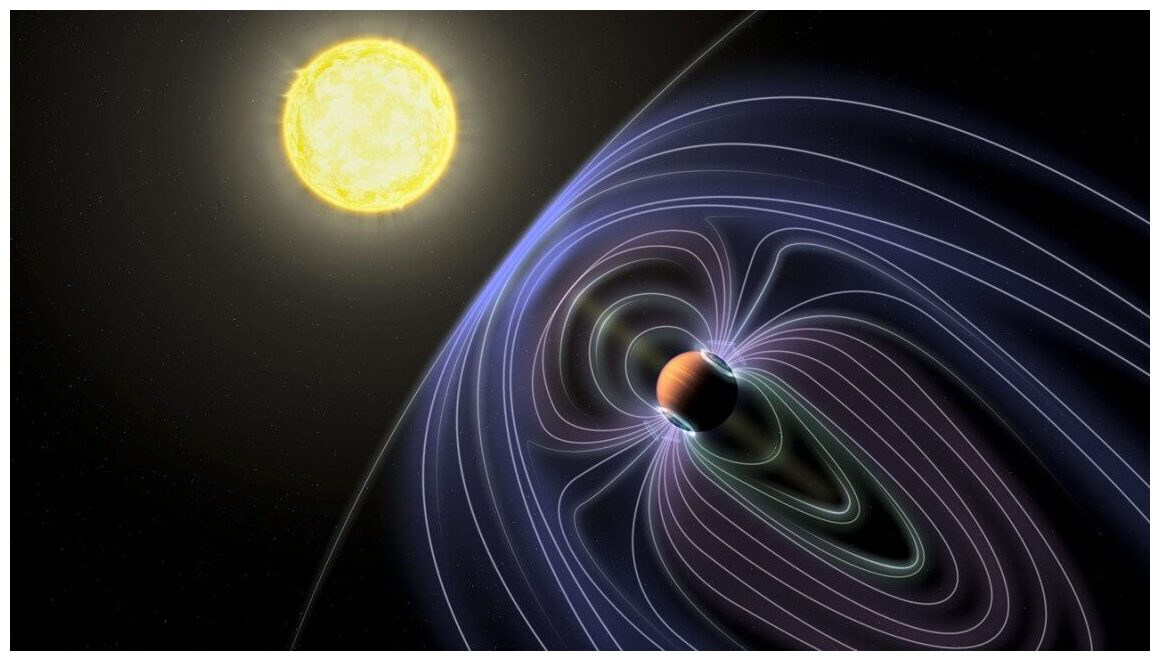
Radio emissions may have been detected from exoplanet

Tau Boötes b system
© Jack Madden/Cornell UniversityIn this artistic rendering of the Tau Boötes b system, the lines representing the invisible magnetic field are shown protecting the hot Jupiter planet from solar wind.
By monitoring the cosmos with a radio telescope array, an international team of scientists has detected radio bursts emanating from the constellation Boötes - that could be the first radio emission collected from a planet beyond our solar system.

The team, led by Cornell postdoctoral researcher Jake D. Turner, Philippe Zarka of the Observatoire de Paris - Paris Sciences et Lettres University and Jean-Mathias Griessmeier of the Université d'Orléans will publish their findings in the forthcoming research section of Astronomy & Astrophysics, on Dec. 16.

"We present one of the first hints of detecting an exoplanet in the radio realm," Turner said. "The signal is from the Tau Boötes system, which contains a binary star and an exoplanet. We make the case for an emission by the planet itself. From the strength and polarization of the radio signal and the planet's magnetic field, it is compatible with theoretical predictions."

Among the co-authors is Turner's postdoctoral advisor Ray Jayawardhana, the Harold Tanner Dean of the College of Arts and Sciences, and a professor of astronomy.

"If confirmed through follow-up observations," Jayawardhana said, "this radio detection opens up a new window on exoplanets, giving us a novel way to examine alien worlds that are tens of light-years away."

Snowflake

Adapt 2030 Ice Age Report: Three possible reasons changes are happening in front of you

Tasmania snow
© YouTube/Adapt 2030 (screen capture)
Looking at Summer snow in Tasmania, 11 foot snowfalls in Europe, sunspot anomalies, the changes or an age or geoengineering, so many changes are happening, I wonder which is the most responsible for the shifts in the world we are seeing.


Comment: See also:


Info

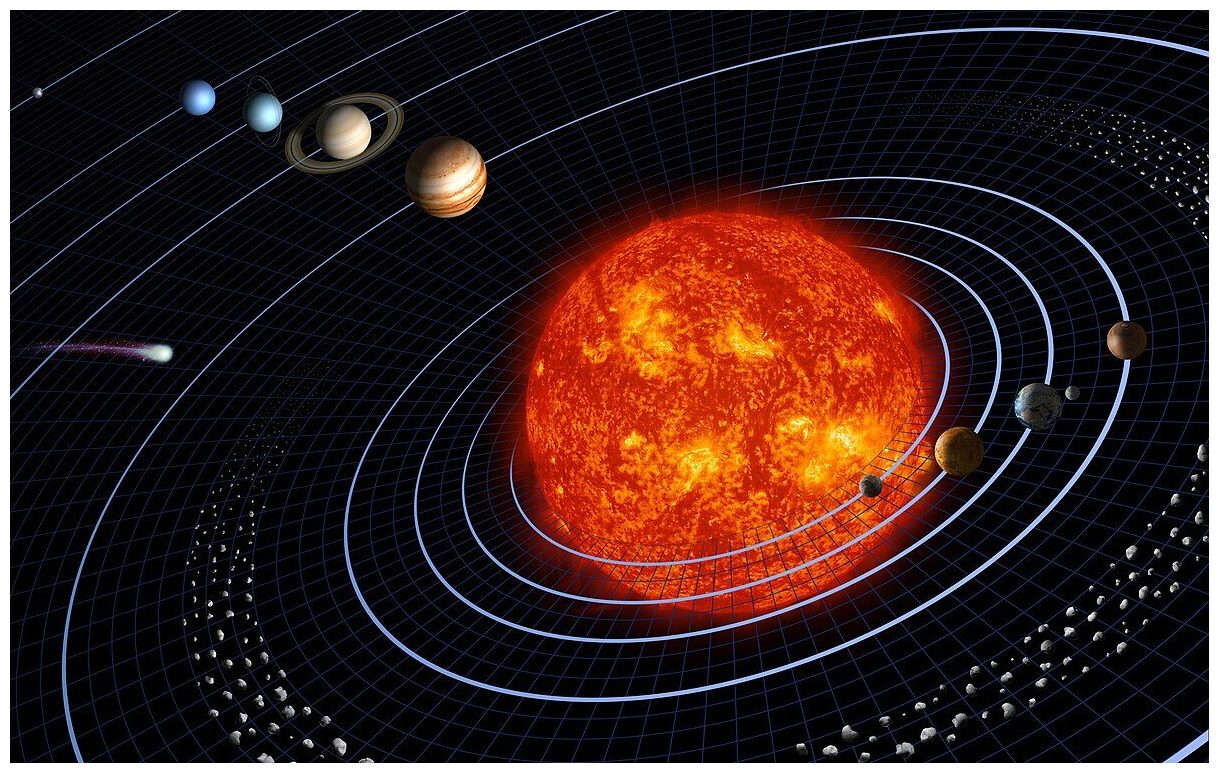
New super highway network discovered in the Solar System

Solar System
© NASA
Researchers have discovered a new superhighway network to travel through the Solar System much faster than was previously possible. Such routes can drive comets and asteroids near Jupiter to Neptune's distance in under a decade and to 100 astronomical units in less than a century. They could be used to send spacecraft to the far reaches of our planetary system relatively fast, and to monitor and understand near-Earth objects that might collide with our planet.

In their paper, published in the Nov. 25 issue of Science Advances, the researchers observed the dynamical structure of these routes, forming a connected series of arches inside what's known as space manifolds that extend from the asteroid belt to Uranus and beyond. This newly discovered "celestial autobahn," or celestial highway, acts over several decades, as opposed to the hundreds of thousands or millions of years that usually characterize Solar System dynamics.

The most conspicuous arch structures are linked to Jupiter and the strong gravitational forces it exerts. The population of Jupiter-family comets (comets having orbital periods of 20 years) as well as small-size solar system bodies known as Centaurs, are controlled by such manifolds on unprecedented time scales. Some of these bodies will end up colliding with Jupiter or being ejected from the Solar System.

Sun

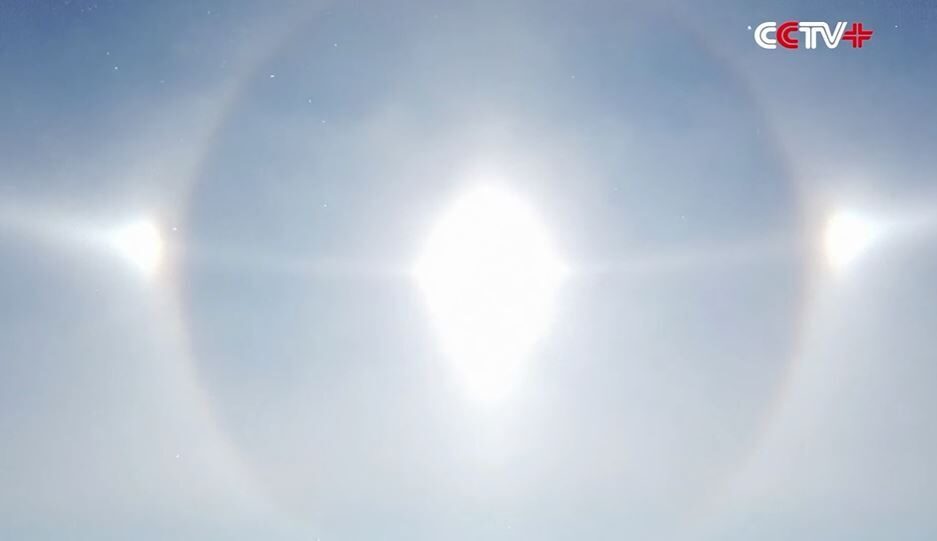
Three suns phenomena appears in Inner Mongolia skies

Three suns mongolia
Stunning sun dogs appeared in the sky above Xilingol Prairie on Friday, creating an illusion of three suns interlinked by a huge halo.

A sun dog, sometimes called a parhelion or mock sun, are caused by the refraction of sunlight through ice crystals in the atmosphere. It typically appears as a pair of subtly colored patches of light above the horizon at the same altitude as the sun.


Comment: Three suns also appeared one month prior in China's Inner Mongolia: