
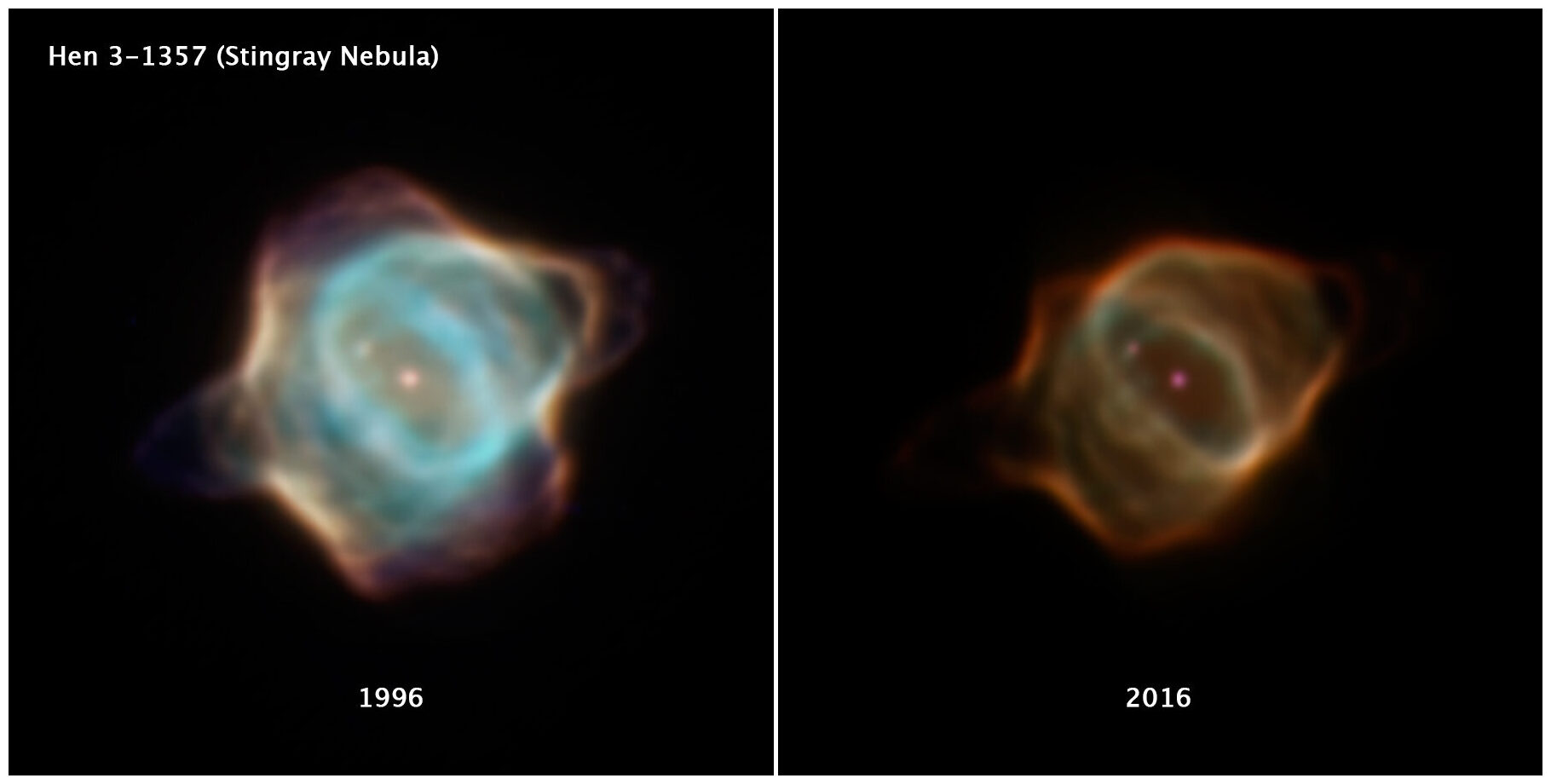
© NASA/ESA/Bruce Balick/Martín Guerrero/Gerardo Ramos-LariosTwo images of the Stingray Nebula, located in the direction of the southern constellation Ara — or the Altar — captured 20 years apart by NASA’s Hubble Space Telescope. The image on the left was taken in March 1996, while the image on the right was captured in January 2016.
So when a previously typical star's behavior rapidly changes in a few decades, astronomers take note and get to work.
Such is the case with a star known as SAO 244567, which lies at the center of Hen 3-1357, commonly known as the Stingray Nebula. The Stingray Nebula is a planetary nebula — an expanse of material sloughed off from a star as it enters a new phase of old age and then heated by that same star into colorful displays that can last for up to a million years.
The tiny Stingray Nebula unexpectedly appeared in the 1980s and was first imaged by scientists in the 1990s using NASA's Hubble Space Telescope. It is by far the youngest planetary nebula in our sky. A team of astronomers recently analyzed a more recent image of the nebula, taken in 2016 by Hubble, and found something unexpected: As they report in a paper accepted to the Astrophysical Journal, the Stingray Nebula has faded significantly and changed shape over the course of just 20 years.
If dimming continues at current rates, in 20 or 30 years the Stingray Nebula will be barely perceptible, and was likely already fading when Hubble obtained the first clear images of it in 1996, according to lead author Bruce Balick, an emeritus professor of astronomy at UW.










Comment: 'Superbolts' detected above atmosphere are over 1,000 times brighter than normal lightning